A quick stocktake
Multipolar acceleration, the tariffs imbroglio and autoimmune self-harm

China’s April trade data shows that the drop off in trade with the US, on the back of the Trump tariffs announced on April 2, 2025, have been offset by expanded trade with the rest of the world. This adjustment dynamic is something I have written about in the past and this short stocktake note seeks to pull together the threads of the argument for convenience. Put simply, the offset should have come as no surprise and it also speaks of the potential speed at which countries and enterprises can adjust to a post-US tariffs world in which multilateral trade continues to expand but under new conditions.

So, here’s the stocktake in chronological order (earliest to latest). The original articles are linked for convenience.
On February 3, 2025 I published a piece called To Be Like Water. It explored the ramifications on BRICS countries in light of Trump’s then threats to impose tariffs of 100% or 150% on BRICS nations that dared contemplate shifting away from a USD-centric trading world. The analysis was that BRICS nations would effectively adjust within 2-4 years, and perhaps quicker with fiscal policy intervention and coordination, to loss of access to the US market. I also argued that the US would also adjust with parts of the economy managing an adjustment in about 4 years but other parts could take up to, or more than, a decade. But, the US adjustment would be to a higher cost systemic plateau.
On February 14, 2025, I published The Transition Away from the US Dollar. This was a follow-up to To be Like Water, and examined claims that a rapid transition away the USD-dominated system wouldn’t be possible because no other country’s capital markets were sufficiently deep or wide to finance the trade settlements. This claim is premised on a mainstream economic idea that the US trade deficit is financed by America’s capital markets. This is wrong, and confuses cause and effect. The scale of America’s capital markets are the effect of US deficits, financed through the issuance of new money through Congressional appropriations and commercial bank credit.
On April 2, 2025, I published China’s Economic Model Revisited. There’s a cartoonish caricature of China’s economic model that abounds in a lot of the mainstream western commentary. The claim is that China is ‘export dependent’ and that it suppresses domestic consumption demand in favour of investment. This results in global imbalances. I show that these claims misunderstanding the dynamics of China’s economic development model and experience. China is not an export-dependent economy, though its exports do deliver massive low-cost opportunities to the Global South. China’s model can better be understood as one underpinned by autonomous investment-driven demand, that spurs private capital formation and real income growth.
This was followed up on April 4 by Never Look a Gift Horse in the Mouth. Written in response to Trump’s tariffs announcement, I argued that rather than being something that should cause trembles across the capitals of especially the Global South, the tariffs announcement should be grasped as what is in effect an accelerant opportunity. No supposed crisis should be wasted, and Trump’s tariffs announcement created an opportunity to hasten the ongoing processes of American decentering.
Revisiting the Bancor was published on April 14, which explored the key issues and design parameters of a national currency-based settlements system in which a Universal Settlements Denominator (an eUSD), curated through BRICS Clear, could play the role of numeraire. This piece was less about what is necessarily being designed, though I suspect the issues discussed are at the forefront of those folk in BRICS working on BRICS Clear, but about demonstrating the possibilities of alternative systems. Again, there is nothing to fear about the need to create new ways of doing things.
Then, I drilled into questions of supply chain disruptions and reconfigurations in Supply Chain Disintermediation: Another Unintended Consequence of Trump’s Tariffs (April 21, 2025). This essay demonstrates that the contours of global value flow will be affected in ways that were, one suspects, not anticipated. In short, Trump’s tariffs shone the light on the value composition of products across an entire supply chain, illustrating that ‘producer power’ ultimately dictates terms in competitive environments.
Behind the Potemkin facade: an emperor denuded followed (May 2, 2025). This piece provided a detailed analysis of how China has in effect been developing a non-USD denominated system of value flows from within the USD-dominated system. This shows that many of the necessary elements for a post USD-centric world are already in place.
And then, I tried to pull some threads together through both a ‘tactical’ game theoretic lens and a strategic contextual lens based on this existing body of analysis, to evaluate the unfolding US tariff gambit. The piece is titled Oops! Strategic Miscalculation and the Evolving Global Trade Game (May 8, 2025), which speaks of the general tenor of the assessment. The basic claim is that ‘China holds the cards because China makes the cards’. Again, the centrality of productive capacity to the unfolding contours of geopolitical argy-bargy is emphasised. But I also show how tactical decisions - such as the 90 day suspension of tariffs on all countries other than China and China’s refusal to ‘kneel’ - shifted decisively the nature of the ‘game parameters’ from one of a hubs-and-spokes set-up to a multiple player coordination game.
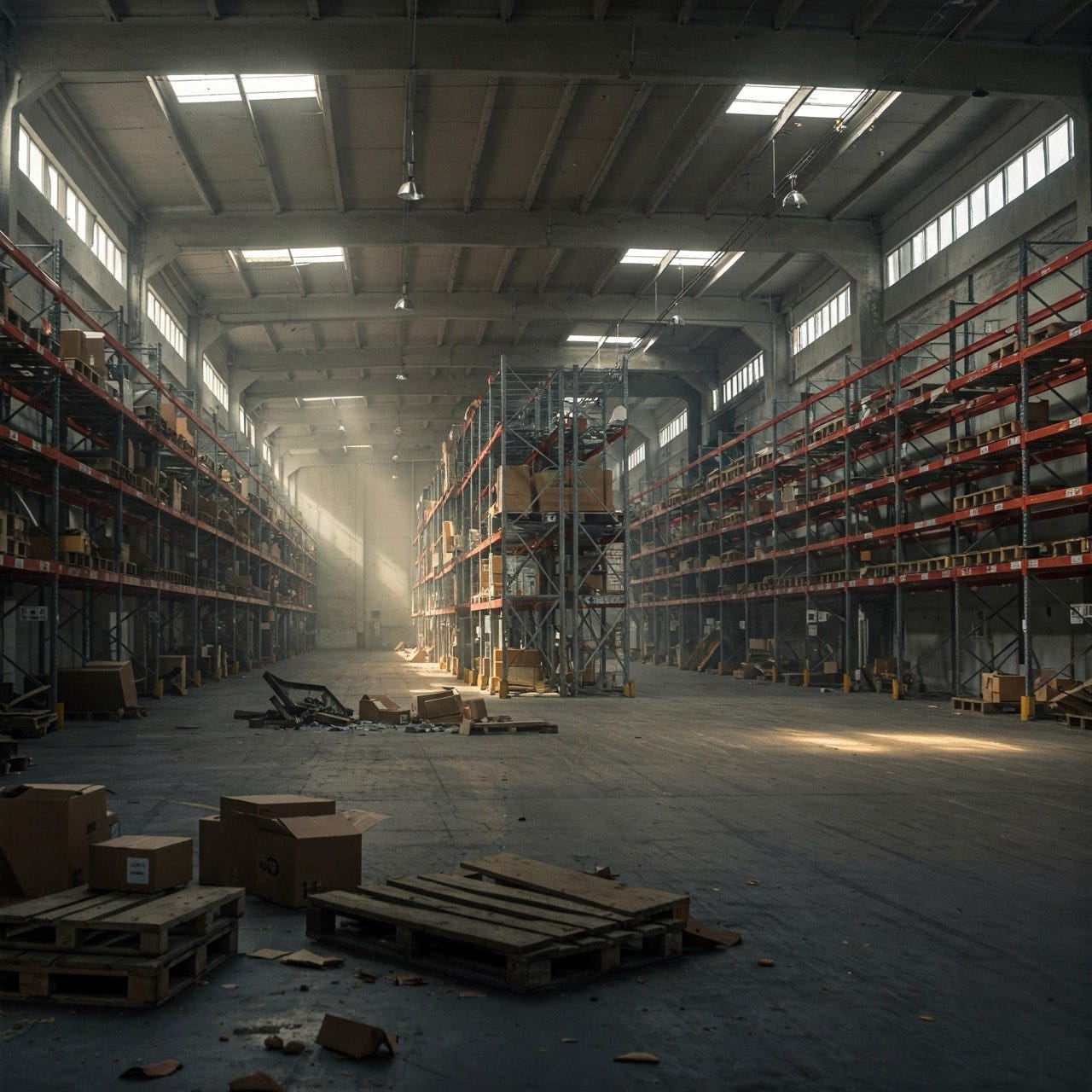
Meanwhile, risks of empty shelves in the US grow …