
Top 10 Emerging Technologies
Harnessing Emerging Technologies for Higher Energy Returns and a Sustainable Future

Preface: The “Summer Davos” was recently held in Dalian, China. Amongst other things, the event released a “Top 10 Emerging Technologies of 2026.” This short essay explores the list and seeks to make some sense of its core aspects, with a tilt towards those things that have occupied my time and attention of late — energy return on energy invested, amongst other things. Whatever we may otherwise think of these kinds of events and these kinds of lists, they are a useful catalogue of some of the key developments that are taking place across the globe and point to things that we would be well advised to keep an eye on.
The World Economic Forum recently convened in Dalian, China. There, it revealed its Top 10 Emerging Technologies of 2026. These innovations — covering various technologies and developments in energy systems, materials science, biotechnology, and artificial intelligence — emphasise three things: (1) personalisation, (2) decentralisation and (3) achieving more with less. From my perspective, these technologies align closely with imperatives to boost Energy Return on Energy Invested (EROEI) and minimise exergy waste, that is the useful work potential lost in inefficient processes. As China advances its dual carbon goals and promotes development of new quality productive forces, these technologies constitute strategic opportunities to strengthen energy security, drive high-quality growth and contribute to global sustainability. Put another way, they are cornerstones of China as a thermoeconomic state.
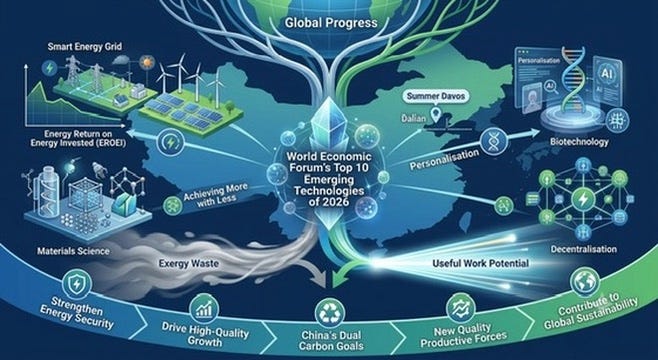
EROEI measures the ratio of usable energy output to the energy required for extraction, processing and deployment. As I have discussed in my book, Thermoeconomics in a Time of Monsters and in various essays, EROEI is the pivotal “measure” of systemic trajectory. Higher values deliver higher levels of societal surplus — what I dubbed Available Energy Surpluses or AES — which can then be mobilised for activities beyond “mere” reproduction, such has ongoing innovation, research and development, cultural development and broader dimensions of social well-being. Exergy, meanwhile, goes to questions of quality: not all energy is equal and waste arises from mismatches, heat losses or irreversible degradation. In my book, I referenced this in terms of EROEIu. Traditional economic systems often suffer low net returns due to resource intensity and various inefficiencies in production, transmission, storage and use. The WEF list proposes technological innovations that counter these inefficiencies and raise EROEI by enabling smarter resource use, distributed production and reduced upstream burdens. These are principles that resonate with China’s leadership in renewables, manufacturing scale and circular economy practices.
At the forefront of the WEF list is “everything-to-grid energy,” or virtual power plants that transform idle distributed assets such as electric vehicles, home and factory batteries and data centres, into flexible grid resources. There was a time when this was inconceivable; where energy systems were essentially designed as “one way streets.” We need to recall that renewables, like solar, peak during the day but wane during evening demand surges. This leads to intermittency, the standard critique of renewable energy harvesting / generating systems. Bidirectional flows, however, mobilise stored power precisely when needed. This dramatically reduces reliance on fossil peaker plants and curtailment. In California, for example, solar-equipped homes have already delivered significant megawatts back to the grid without emissions. In Australia, homeowners have long been incentivised to install solar systems and sell excess back into the grid. For China, with its vast and growing EV fleet and world-leading battery production, scaling this could elevate the effective EROEI of renewables by optimising existing infrastructure. Policies promoting vehicle-to-grid (V2G) integration and smart grids under the 14th and upcoming Five-Year Plans position China ideally to lead deployment.
Complementing this is direct lithium extraction (DLE). This technology extracts battery-grade lithium from brines in hours rather than years. This results in less water and land usage while at the same time, tapping geothermal or wastewater sources. Traditional evaporation ponds are geographically limited and resource-heavy; DLE diversifies supply and reduces the energy intensity of storage production. China, which already accounts for a major share of global lithium processing, can leverage its manufacturing capability and high levels of domestic knowhow to refine and scale DLE. This reduces the embodied energy in batteries, and boosts the net returns of the entire renewable-plus-storage ecosystem critical for energy transition.
Passive radiative cooling materials is another efficiency leap. We’re talking about things like coatings and paints that reflect sunlight while radiating heat to space, cooling surfaces without electricity. Over a decade ago, in Northern Australia, some farsighted local authorities were already promoting the idea of “white roofs” as one critical — if understated — strategy to improve regional energy efficiency and support more effective demand side management. Applied to buildings, coatings and paints promise up to 20% energy savings; extending to other surfaces, such as on power cables, they boost transmission capacity. Already mandated in parts of China for green buildings, more expansive adoption could further curb cooling demand — a growing load amid climate pressures — thus preserving primary energy and cutting exergy destruction in HVAC systems. Combined with China’s strengths in advanced materials, this scales low-cost, passive solutions for urban and industrial heat management.
Precision fermentation turns microbes into efficient “micro-factories” for proteins, enzymes, chemicals and materials. This approach bypasses traditional agriculture or fossil synthesis. It demands far less land, water and energy while at the same time enabling decentralised production. In food and chemicals, this cuts supply-chain losses and exergy waste from inefficient biological or industrial conversions. China’s biotechnology investments and large-scale fermentation infrastructure are a foundation upon which these innovations can be integrated with its agricultural modernisation and bioeconomy goals, all towards enhancing food security and reducing environmental footprints.
PFAS destruction technologies break down persistent “forever chemicals” via advanced oxidation or electrochemical methods, addressing long-term remediation burdens that drain societal energy resources. Cleaner water and soil mean fewer future exergy sinks in environmental restoration. This is particularly significant in a place like China, which continues work to remediate damaged soil and water bodies and return more land to productive purposes. I’ve touched on some related initiatives in soil remediation in another recent essay, Reviving Incurable Lands?.
Broader technologies hold the potential to amplify these gains. World models and quantum simulation accelerate R&D by predicting physical behaviours and molecular interactions more accurately. This then reduces failed experiments and trial-and-error energy costs in materials, drugs and climate modelling. Exosome delivery and personalised mRNA vaccines promise improved health outcomes with targeted efficiency, preserving human capital. Lattice-based cryptography secures data flows in an increasingly digital energy system against quantum threats.
Collectively, these innovations support an ongoing effort toward higher-EROEI, lower-waste systems. Decentralised production minimises transport losses; it delivers power where it’s used. A commitment to “more with less” reduces material and energy inputs, and personalisation matches solutions to local needs. This all dovetails with China’s strengths as the world’s only industrial superpower. China’s manufacturing prowess in solar systems, batteries, EVs and wind generation systems has been driving down costs for years via scale and innovation, making clean tech accessible globally. Estimates indicate that over the past two decades, Chinese manufacturing costs have fallen by 46% or thereabouts (see Richard Balwin’s essay here).
If the WEF list holds a lot promise, there’s no doubt that challenges persist. How could they not? We are, after all, dealing with areas of complex material and chemical sciences as well as sophisticated engineering and mathematics. We can expect to see challenges emerge in integration costs (things are unlikely to be smooth), the development of standards (or compliance with existing standards), the need for a talent pipeline not to mention aspirations for equitable access across not just a vast country, but across the globe. Yet China’s track record — evidenced by global leadership in patent filings in areas like clean energy and its demonstrated capacity in renewables manufacturing and operations — demonstrates a reservoir of capability to tackle and, in time, overcome them. In an ideal world, ongoing international collaborations will not only contribute to ongoing advances in addressing some of these challenges, but also contribute to accelerated proliferation of benefits globally. I say “ideal” though there are strong headwinds, with the US National Science Foundation, for example, recently announcing plans to prohibit funding for projects involving collaborations with Chinese research institutions.
That said, looking ahead, embracing these technologies advances the ongoing development of China as a thermoeconomic state, and perhaps — if handled well — contribute to the advancement of a human ecological civilisation. Higher EROEI makes available resources for education, cultural infrastructure and social well-being initiatives amongst other things. Reduced exergy waste aligns with circular economy principles, minimising environmental damage and getting more “bang for every buck.” For China, these pathways reinforce the drive towards technological self-reliance, first articulated explicitly in the Made in China 2025 initiative launched in 2015, and contributes to its ongoing footprint in global leadership in sustainable development. By investing in these frontiers China can not only contribute to the meeting of its own carbon peaking and neutrality targets but also export solutions that help developing nations leapfrog fossil-dependent paths, a point I have discussed on many previous ocassions.
Gatherings like the WEF tend to focus on how change and technology can reshape human economic and social development positively. The 2026 List certainly has the potential to make meaningful, constructive contributions towards a world of enhanced EROEI, resilient systems and a higher standard of ecological living for all. For these reasons, the List is one we should pay attention to.
I’m not sure a transnational organization like the WEF is concerned with the average person’s well being, quite the opposite in fact, and am rather surprised and disconcerted you would put forward such a claim Dr. Powell.
Yes, “in an ideal world.” Yet we have only one world, only one chance to keep it survivable, yet a multitude of ways to diminish all prospects for a livable future. The recent Putin/Xi conference on building a new security architecture for the world was a great start, working toward “an ideal world” in which all cooperate for the betterment of all, without any nation interfering in the affairs of others. Repairing this bigger picture helps enable all these other goals of the List.