
The Endogenous Crisis Machine
How Degrading EROEI, Fictitious Capital and Informational Noise Drive Systemic Rupture

Preface: My book, Thermoeconomics in a Time of Monsters, articulates a theoretical framing of system dynamics and economic crises before exploring the case of China, US etc. Part 1 of the book covers the theoretical elements in detail. This short essay summarises the basic argument, and draws especially on Chapter 8 of the book, which brings together the bulk of the conceptual scaffold. The book is now available on Amazon. It is available as a Kindle ebook, or as a paperback or hardback.
The first part of Thermoeconomics in a Time of Monsters seeks to flesh out the conceptual scaffold for how we can anchor an understanding of socio-economic system change through the frame of thermodynamics, and describes the elements of what I have called Systemic Exchange Value (SEV). Chapter 8 pulls together the threads of SEV into a coherent summary of the economic metabolism - the living circuit of energy, finance, information and fictitious capital that either sustains order or accelerates disorder. At its heart is a simple and straightforward proposition: crises are not external shocks or policy errors per se. They are endogenous - baked into the system’s own dynamics once EROEI begins to degrade.
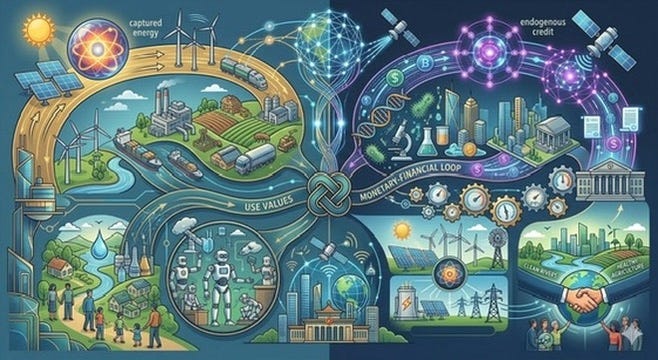
The economic metabolism is a triple circuit; visualise it as a triple helix, perhaps. First, there is the material-energetic loop: energy is captured, deployed, transformed through supply chains into use values (goods, services, machinery, infrastructure etc.), and dissipated in reproduction and consumption - that is, validation. Second is the monetary-financial loop: endogenous credit creates exchange-value claims that mobilise resources today in anticipation of future use-value realisation. These two circuits must remain roughly aligned for the system to reproduce itself without debilitating rupture. A third circuit - information - intersects these and to some extent binds them together. Information itself is an energetic artifact, while also playing a key role in enabling each of the other circuits to work and to interact.
When EROEI degrades - whether from geological depletion, geopolitical disruption, political retardation of enhancements or technological lock-in - the material circuit delivers less surplus energy per unit invested. The system’s capacity to generate new use values contracts. Yet the monetary circuit does not automatically slow. On the contrary, it accelerates.
Liquidity and fictitious capital expansion becomes the short-order “rational” response of validation constraints. Faced with slowing real growth and validation constraints, agents (firms, households and states) issue more claims on future value to keep the circuit turning today. Debt rises, asset prices inflate and derivatives multiply. This is not irrational exuberance or moral failure; it is a logical, system-preserving move in the short run. More liquidity is injected to bridge the growing gap between what the real economy can actually deliver and what the claims promise.
But every round of expanded liquidity injection and accelerated fictitious capital widens the very gap it is meant to close. Claims on use value outpace the energetic-material capacity to validate them. The divergence grows. Balance sheets swell (they are a measure of exchange value) while the underlying metabolic substrate frays. The system becomes increasingly fragile.
Informational noise makes the problem worse. In an SEV world, information is not costless or inherently negentropic. It is an energetic artefact. Viable information reduces turnover time, improves coordination and raises overall EROEI across production nodes and in supply chain networks. But when fictitious capital dominates, the informational environment floods with unviable noise: speculative narratives, hype cycles, mispriced risk signals and algorithmic echo chambers. This noise consumes energy (data centres, trading infrastructure and mass media) while actively degrading coordination. It distorts price signals, misallocates liquidity and accelerates the decoupling between claims and reality.
The result is an endogenous crisis mechanism. Degrading EROEI is the root cause. Accelerated fictitious capital is the short-term palliative that becomes the long-term poison. Informational noise is the accelerant. Together they produce a self-reinforcing loop:
Degrading EROEI → slower real surplus growth → liquidity gap → fictitious capital expansion → wider claims–delivery gap → more noise → further degradation of coordination and EROEI → deeper crisis.
This is why crises feel both inevitable and surprising. They are not random. They are the predictable outcome of a system that has substituted financial claims for energetic renewal. When the claims can no longer be validated through real transformation, the circuit ruptures in the form of financial crashes, inflation spikes, supply-chain breakdowns or social reproduction crises.
Chapter 8 of the book shows this is not a pathology of capitalism alone. It is a thermodynamic feature of any monetary production system once EROEI begins its secular decline and negentropic interventions are too weak or misdirected. The autumn phase of Arrighi’s hegemonic cycles is precisely this moment: material expansion gives way to financial expansion, fictitious capital becomes dominant, and the gap between exchange value and use value widens until the system can no longer paper it over.
The antidote is not moral restraint or better regulation alone. It is deliberate, systemic negentropic renewal: raising EROEI through new energy systems and production coefficients, pruning unviable informational noise, and managing liquidity so that fictitious capital serves renewal rather than postponing it. Societies that achieve this coherence - China’s deliberate EROEI-augmenting path is the clearest contemporary example - can climb to higher plateaus of surplus potential. Those that cannot descend into accelerating entropy.
This is the summary architecture of the economic metabolism presented in Chapter 8. It is not a counsel of despair. It is a diagnostic map. Once you see crises as endogenous outcomes of degrading EROEI and the short-term rationality of fictitious capital expansion, the path to renewal becomes visible: align the monetary circuit with the energetic one, prune noise, and invest in genuine negentropic augmentation.
The monsters of our time - financial fragility, energetic shocks and informational overload - are not mysterious. They are the visible symptoms of a metabolic system whose internal dynamics have tipped toward entropy. Understanding that mechanism is the first step toward mastering it.