
The Base-Effect Mirage
Why the Panic Over China’s Consumer "Splutter" Misses the Macroeconomic Plumbing

Preface: The May 2026 economic data for China was released a few days ago (16 June 2026). It caused a stir of excitement amongst the western commentariat who leapt on the drop in retail consumption on a year-on-year basis, implying that China’s economic conditions have taken a decidedly bad turn. This is grossly misleading, if somewhat self-serving. After all, this commentariat has long run the line that China’s economic structure needs to boost consumption as a share of GDP, and if it fails to do this, then the economic vitality of China is imperilled. I’ve dealt with this “consumption as percentage of GDP” shibboleth before, so won’t go into it again. But, it is worthwhile exploring what the latest data actually tells us. That’s what this short essay does.
The mainstream western financial commentary surrounding China’s economic trajectory has fallen into a predictable, mechanical rhythm. Every negative decimal point is framed as a symptom of systemic collapse, while every positive print is dismissed as policy manipulation. So, when the National Bureau of Statistics (NBS) announced a -0.6% year-on-year contraction in headline retail sales for May 2026 — the first negative print since the post-pandemic reopening — the narrative machine kicked into overdrive. “The Chinese consumer has capitulated,” the headlines blared.
It is a neat, dramatic story. It is also completely wrong.
To understand what actually happened in May 2026, one must look past the immediate financial ledger and examine the physical plumbing of the macroeconomic system. What looks like an organic demand collapse is, upon closer inspection, a textbook manifestation of a base-effect mirage, a policy-induced demand hangover, and a profound structural shift from physical goods to service consumption. Far from collapsing, China’s aggregate demand trajectory is normalising as the effects of the pandemic begin to wear off. The real story isn’t a crisis of consumption; it is the friction of a state-directed, physical political economy adjusting to its own success.

The Hill of May 2025
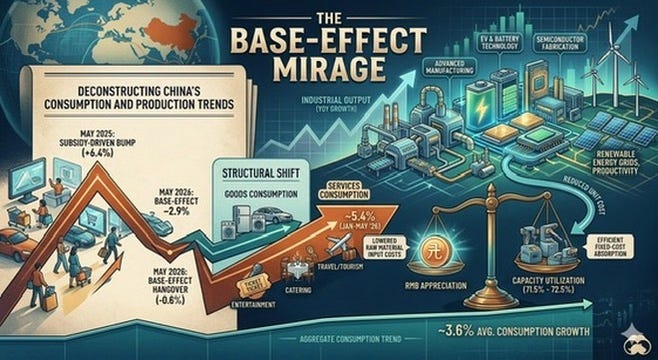
To diagnose the present, we must look at the baseline. In May 2025, retail sales didn’t just grow — they surged by an unexpected +6.4% year-on-year, scaling a massive 4.133 trillion yuan pinnacle. This spike was not a spontaneous outburst of consumer optimism or consumption animal spirits; it was policy-induced. It was the direct result of Beijing’s aggressive rollout of large-scale consumer goods trade-in initiatives and heavy subsidy structures for high-value items.
Faced with lucrative, time-sensitive incentives, Chinese households behaved entirely as one would expect: they front-loaded big-ticket purchases. Millions of consumers who had planned to buy an electric vehicle or upgrade their home appliances in 2026 pulled those transactions forward into the spring of 2025.
Consequently, May 2025 became an artificially high hill for the data of 2026 to climb. The -0.6% contraction in May 2026 is the statistical hangover of that front-loaded demand. This is particularly obvious when you look at the specific categories that dragged the headline index down: automobile sales, the primary target of last year’s subsidies, contracted by 16.1% year-on-year.
When you smooth out this policy-induced volatility over a 24-month horizon, a much cleaner, more sober trajectory emerges. Compounding the +6.4% leap of 2025 with the -0.6% statistical “correction” of 2026 yields a two-year average growth rate for physical goods retail of roughly 2.9%. It is not explosive, but it is entirely stable. We can set this against a slightly longer durational context, just to be sure. In May 2023, we saw retail consumption boom by +12.7% YoY to 3.780 trillion yuan, on the back of post-pandemic reopening surge and a lower base effect from 2022. The following year (May 2024) retail consumption grew +3.7% to 3.921 trillion yuan. Growth normalised, and was bolstered significantly by high-tech goods, sports equipment and early trade-in initiatives.
The Qualitative Pivot: Goods vs. Services
The broader mistake Western analysts make when evaluating Chinese consumption is relying on an outdated metric. Traditional “Total Retail Sales of Consumer Goods” is an excellent tool for measuring an industrialising society buying refrigerators and concrete, but it is a blunt instrument for measuring a maturing middle class.
The real action in the Chinese domestic market is qualitative, characterised by an industrial restructuring where consumption growth in services is far outpacing that for goods. Recognising this shift, the NBS recently began reporting a broader, bundled gauge of both goods and services consumption. The divergence within this data is striking. While physical goods retail crawled along at +1.2% year-to-date through May 2026, service consumption — catering, domestic tourism, hospitality and entertainment — surged by +5.4% over the same five-month period.
Service consumption makes up roughly 40% to 45% of total household consumption expenditures in China’s urban centres. Blending a resilient ~5.4% services track with a smoothed ~2.9% baseline for physical goods lifts China’s aggregate consumption growth rate precisely into a comfortable mid-3% range (with the 5-month aggregate index sitting at +2.8% and gaining momentum into the summer).
This is not a picture of a broken consumer. It is a picture of a consumer whose “marginal yuan” is migrating from the car dealership to the travel agency and the restaurant.
The Capacity Floor and the Western Misconception
However, highlighting this stable consumption path does expose a genuine structural tension. While aggregate consumption is growing at a smoothed rate of ~3.6%, China’s high-tech manufacturing sector is expanding at a far more aggressive clip — with industrial production up +4.5% overall in May, and high-tech manufacturing roaring at +15.1%.
If global export orders taper due to geopolitical friction or rising tariff walls later this year, this massive industrial output will be impacted. In that scenario, factory capacity utilisation — which sat at 73.6% in Q1 2026 — could conceivably slide into the 71.5% to 72.5% range, testing the historical floor of the long-run industrial average.
In a standard Western economics textbook, dropping into the low-70% capacity utilisation range is a flashing danger signal. Under financialised capitalism, such a drop triggers a cascade of corporate deleveraging: credit freezes, mass layoffs and the permanent destruction of capital assets as private creditors scramble to protect their balance sheets.
But China is a physical political economy, not a financialised one, and applying Western analytical models to it yields flawed conclusions. From a material or thermodynamic perspective, a 71% utilisation rate on a vastly expanded, state-of-the-art industrial base yields far more physical wealth and systemic capability today than a 74% rate did on a smaller, older base five years ago. The physical assets — the fully automated factories, the cleanrooms and the advanced foundries — do not evaporate during a slowdown. They remain anchored in the real world, ready to be activated with the flip of a switch. Capacity utilisation is a key modulator.
Because the state ultimately controls the banking apparatus and system liquidity, credit can be directed to absorb the carrying costs of underutilised fixed capital indefinitely. Financial restructuring under this model is a state-guided bookkeeping exercise, not a terminal existential crisis. The fixed capital survives, the jobs remain largely insulated, and the physical capacity remains intact. We can, on this front, note that the latest data shows unemployment falling moderately to 5.1% (from 5.2%), again suggesting that the basic structure of the economy remains robust.
The Irony of the Rising RMB
Furthermore, this system contains a powerful, built-in macroeconomic shock absorber that Western commentators consistently overlook: the structural irony of an appreciating Renminbi.
Standard economic theory dictates that a strengthening currency damages an export-reliant nation by making its goods more expensive abroad. But China’s position in the global economy has evolved. It is no longer a low-value, sweatshop assembly line; it is the world’s primary processing and refining clearinghouse for the raw materials and energy substrates that power the modern world.
China imports roughly 70% to 80% of its iron ore, over 70% of its crude oil, and vast percentages of raw bauxite, lithium, copper and nickel. Many of its most advanced manufactured outputs rely upon imported raw materials, as I have discussed in detail separately before (see this and this in which I discuss why an appreciating RMB carries with it the paradox of improving Chinese price competitiveness, rather than dampening it). When the RMB rises, China’s purchasing power at the source explodes. We see this clearly in the May 2026 data: while factory-gate PPI grew at +3.9%, the purchasing price index for industrial producers jumped by +5.8%. A strengthening RMB acts as a deliberate shield against global upstream inflation, slashing the real-resource cost entering the factory gates. (An appreciating RMB also makes Chinese foreign direct investment more cost-effective.)
This creates a beautiful counter-balancing mechanism. While running a factory at 72% capacity utilisation introduces a per-unit cost penalty because fixed amortisation costs are spread over fewer items, a rising RMB drastically reduces the variable input costs of raw materials and energy. The variable cost curve shifts downward, effectively neutralising the fixed-cost penalty. The factory can run at a lower utilisation rate and still maintain competitive per-unit marginal costs. Mainstream commentators who argue for further appreciation of the RMB in the hope that this will stall Chinese export competitiveness (in the name of “rebalancing trade”) are off the mark.
Moreover, because China holds a near-monopoly on advanced processing — refining over 80% of the world’s battery-grade graphite and 90% of rare earth elements — foreign buyers cannot easily substitute away. They are forced to absorb the currency conversion costs, meaning the foreign buyer bears the burden of the stronger RMB, while the Chinese factory pockets the discount on raw inputs.
As an aside, it’s worth adding that many mainstream western observers argued that China would be concerned that the war against Iran would dampen global demand for its exports, suggesting that China had a great need for the war to be brought to an end sooner rather than later. The evidence for the period March through to May shows that Chinese exports and imports have both risen strongly; this is despite China’s imports of crude oil falling dramatically. In other words, the “mental models” of mainstream western observers about the structural dynamics of China’s economic linkages to those of the world at large do not accord with what’s been actually happening.
Time to Calm Down
When the global financial community looks at China, it looks through a glass darkly, viewing a physical, state-directed industrial colossus — the world’s only industrial superpower, as Richard Baldwin put it — through the narrow lens of Western equity markets and consumer-credit models.
The negative headline from May 2026 is a statistical mirage, a predictable bump on an otherwise stable trajectory of domestic rebalancing. The Chinese consumer has not died; they have simply changed their behaviour, buying services instead of stockpiling white goods. Meanwhile, the industrial engine continues to build genuine, material wealth.
If external demand softens and capacity utilisation dips later this year, the system will not fracture. Backed by state-directed liquidity and insulated by a stronger currency that drives down raw material costs, China’s physical capital will remain waiting, intact and dominant. It is time for the commentators to calm down, throw away their Western textbooks, and start reading the real plumbing of the machine.
This sentence at the top really sums it up: "Every negative decimal point is framed as a symptom of systemic collapse, while every positive print is dismissed as policy manipulation."
This is the Western narrative employed against every country they hate. Same tactic against Russia. They are incapable of seeing a physical economy winner through their usual lens of financialization, or, as you call it, through a glass darkly. Besides 1 Cor. 13:12, this phrase is particularly relevant, from "Through a Glass Darkly: American Views of the Chinese Revolution", a 2006 book by William H. Hinton