
The 100 GW Mirage
America’s Soft Underbelly Exposed as AI crowds out manufacturing's dreams and hurts households

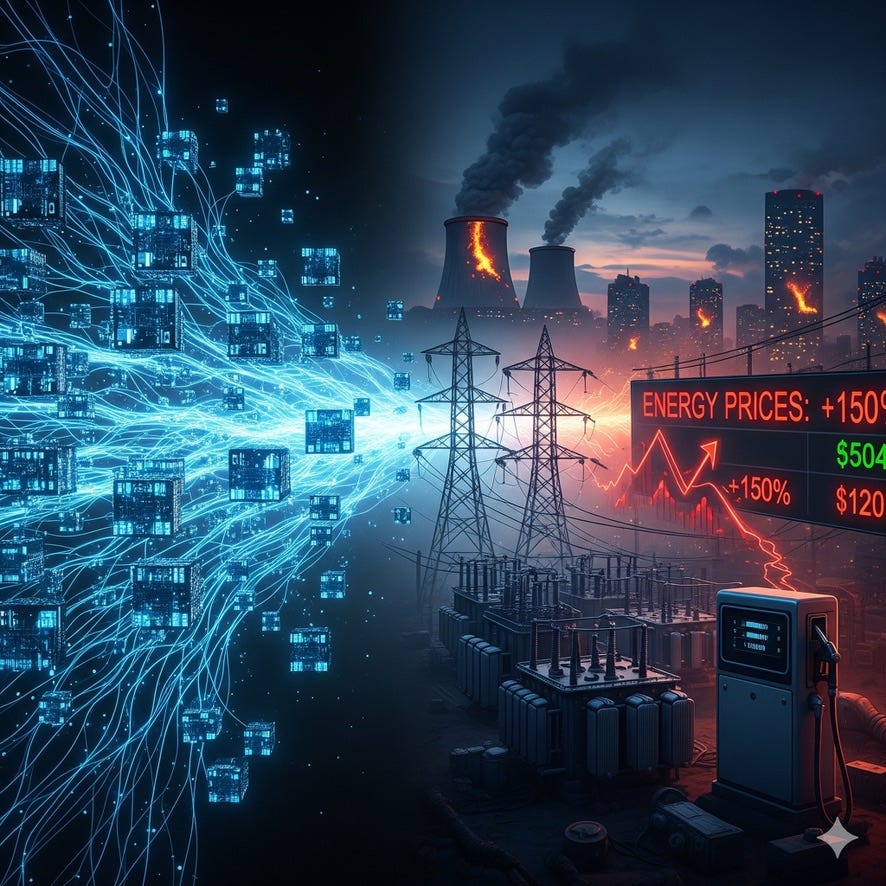
In late September 2025, the U.S. Secretary of Energy Chris Wright declared that America must add at least 100 gigawatts (GW) of firm power capacity within the next five years if it is to maintain global leadership in artificial intelligence (AI) and fuel a broader reindustrialisation of the economy. At face value, the claim is as ambitious as it is urgent. AI systems and data centres are voracious energy consumers, requiring constant, reliable supply, while any serious revival of domestic manufacturing likewise depends on stable and affordable electricity. Yet the scale of the proposed expansion - 100 GW of firm power, not intermittent renewables - demands close scrutiny.
This essay argues that the target is not only implausible, but close to impossible under present conditions. In making the observation, Wright inadvertently exposed one of America’s most vulnerable soft underbellies. The United States faces deep structural bottlenecks in energy infrastructure development, ranging from regulatory delays and transmission constraints to capital costs, skilled labour shortages and technological readiness. Even in the absence of international complications, these domestic hurdles make a five-year timeline for 100 GW of firm power capacity effectively unachievable. The implications are brutal and stark. Curtailed and costly electricity supply for AI and manufacturing will impair American economic competitiveness, with knock-on effects for household affordability. These impacts are already becoming evident, with wholesale pool prices in the U.S. rising by 267% over the past 5 years, on the back of skyrocketing electricity demand from the AI sector (Bloomberg).
Additionally, China’s dominance of global energy supply chains magnifies the challenge and American vulnerability. By controlling choke points in critical inputs - from transformers to batteries to nuclear forgings - China possesses the industrial leverage to raise costs or direct capacity to other parts of the world. The Belt and Road Initiative (BRI) provides an obvious and growing outlet for energy generation and storage capacity; and as these markets expand, the deeper issue is America’s own energy dilemma: it cannot meet its stated ambitions on its own terms, and global supply dynamics are moving against it.
The Scale of the Demand
To grasp the scale of the Energy Secretary’s call for 100 GW of firm power within five years, it is useful to place the figure in the context of America’s existing energy system. The U.S. has roughly 1,250 gigawatts of total installed capacity, of which perhaps 700–750 GW can be considered “firm” or dispatchable - meaning it can reliably deliver electricity when required, unlike variable renewable generation such as solar and wind. Adding 100 GW of firm capacity would therefore represent an increase of roughly 8–9% of total U.S. generation capacity, or closer to 14% of firm capacity, in a period shorter than a presidential term.
The historical record suggests this scale of expansion is highly unusual. For example, during the 2000s, a boom in natural gas combined-cycle plants added capacity, but even at its peak the country was only bringing on 20–25 GW of firm generation per year - and that under more favourable financial, regulatory, and supply-chain conditions than today. Nuclear construction has been all but stagnant for decades, with only two new reactors completed in the past 30 years, both plagued by delays and cost overruns. Duke Energy, which operates the country’s largest regulated nuclear fleet, just filed a new resource plan that pushes earliest nuclear reactor online date to 2036, maintains optionality on SMR vs. LLWR, adopts a 2nd-mover approach, and states that additional cost overrun protection is needed:
“support will be required in the form of cost overrun protection, which currently does not exist, or other cost mitigation measures... the first and second movers for the next advanced reactor projects will be assuming construction risks and therefore will need some form of insurance to protect customers.”
Coal is in structural decline and politically challenging as a source of new capacity. Hydroelectric potential is largely tapped out. In short, there is no precedent in recent U.S. energy history for building 100 GW of reliable, non-intermittent capacity on anything like a five-year horizon.
What makes the target even more daunting is the nature of the demand driving it. Artificial intelligence workloads, especially large-scale training and inference at hyperscale data centres, are not only energy intensive but also highly inflexible. Unlike some industrial processes that can adjust consumption in response to price signals, AI data centres require uninterrupted, round-the-clock electricity. Similarly, reindustrialisation - particularly in energy-heavy sectors such as semiconductors, aluminium, steel and advanced chemicals - cannot function on the basis of intermittent or unreliable supply. In this sense, the demand is qualitatively different from household or commercial loads: it is not merely a matter of average consumption, but of firm availability under all conditions.
The 100 GW target thus reflects an underlying recognition that America’s existing energy system cannot support the dual ambitions of powering AI and reviving manufacturing. But recognition of the problem should not be confused with feasibility. Even under optimistic assumptions, the scale of new firm generation required would be difficult to marshal in a decade. To attempt it in half that time demands not just an unprecedented construction boom, but also the resolution of entrenched structural bottlenecks that have long constrained U.S. energy development.
Domestic Bottlenecks in Power Expansion
The United States has long struggled to add large-scale firm power capacity in a timely and cost-effective way. The Secretary of Energy’s 100 GW ambition collides directly with these entrenched obstacles. Even before accounting for international supply chain risks, the domestic picture reveals a set of bottlenecks so severe that the target borders on fantasy.
The most notorious obstacle is permitting and regulatory delays. Utility-scale energy projects - whether natural gas plants, nuclear reactors, hydro expansions or major transmission lines - face prolonged regulatory review. On average, it takes seven to ten years to permit and construct a new high-voltage transmission line, and even longer for nuclear. Some high voltage transmission projects take 13 to 19 years from application to completion, while nuclear power plants can take a decade or more to construct, with some large projects in the US taking over 12 years. Environmental reviews, litigation, and local opposition (“Not In My Backyard” dynamics) delay or derail projects across the country.
The Inflation Reduction Act (IRA) offered vast subsidies for clean energy, but it did not resolve permitting paralysis. Proposals to streamline approvals remain stuck in political stalemate. Without reform, even shovel-ready projects can take years to break ground, making a five-year timeline for 100 GW of firm capacity structurally unachievable.
The energy sector is capital intensive, and in the current macroeconomic environment, financing is becoming harder, not easier. Interest rates remain elevated, and the levelized cost of energy (LCOE) for new firm generation is highly sensitive to financing costs. Nuclear, in particular, becomes nearly unbankable without government guarantees. Natural gas projects face not only capital costs but also investor hesitancy tied to decarbonisation mandates and climate litigation.
In effect, there is a capital allocation dilemma. Wall Street prefers the short-cycle returns of data centres and digital infrastructure to the long-cycle, risk-heavy returns of generation projects. Even if financing is available, it is at terms that inflate project costs and therefore consumer prices.
The U.S. lacks the skilled workforce required for a massive build-out of firm generation, or for manufacturing in general. Nuclear welders, pipefitters, specialised civil engineers, and high-voltage linemen are already in short supply. Large-scale construction projects across sectors - from semiconductors to transport infrastructure - are competing for the same scarce pool of skilled labour.
This creates what economists call a “Dutch Disease” effect within the domestic economy: a boom in one sector (energy infrastructure for AI and reindustrialisation) drives up wages and costs, siphoning resources away from other productive activities. Regions that do not see significant energy upgrades will face the worst of both worlds - higher prices for electricity and labour, but no direct investment benefits. This distortionary effect makes national reindustrialisation even harder, as it fragments the economy into “energy haves” and “have-nots.”
There are also technology specific constraints.
Gas-fired generation is the most scalable form of firm power that can be built quickly. However, new plants require new pipelines and compressor stations, many of which are politically contentious and subject to the same permitting gridlock described above. Methane emissions concerns make gas politically divisive, undermining long-term bankability.
As for nuclear energy development, small modular reactors (SMRs) are touted as a solution, but none have been proven at commercial scale in the U.S. The NuScale project in Idaho was recently cancelled due to spiralling costs. Large-scale nuclear power is even more problematic. The Vogtle units in Georgia took over a decade and cost more than $30 billion for just 2.2 GW of capacity.
Hydro and Pumped Storage also face constraints. The U.S. has already tapped most viable hydro sites. Pumped hydro storage remains technically attractive but requires long construction times and unique geographic features, both of which limit scalability within a five-year horizon.
Battery Storage: While battery storage is expanding rapidly, it does not yet provide true firm power. Lithium-ion batteries typically offer four to eight hours of storage, useful for balancing renewables but inadequate for multi-day or seasonal reliability. Moreover, scaling batteries to firm power levels would worsen dependence on Chinese supply chains.
Transmission bottlenecks are a reality that will impact the viability of the Energy Secretary’s ambitious timelines. Even if new generation capacity could be built, it must be connected. The U.S. transmission system is already congested, with interconnection queues exceeding 2,000 GW of projects. Transformers - essential for new lines and substations - are in critically short supply. Lead times for large transformers now exceed three years, and many are imported from China or South Korea. Without massive transmission upgrades, new generation capacity would be stranded or under-utilised.
None of these constraints is isolated, as each has systemic interaction implications for other issues within the overall system. Each bottleneck compounds the others. Scarcity of labour raises project costs; high capital costs deter financing; regulatory delays make investors wary; and transmission shortages choke off integration. Together, these barriers form a systemic block against rapid firm capacity expansion.
The Energy Secretary’s 100 GW demand thus collides not with a single obstacle but with a web of interrelated structural constraints. In practice, the U.S. might realistically add 30–40 GW of firm power over five years, if it pushed aggressively across multiple fronts. But this is far short of the stated goal, and the mismatch between aspiration and deliverability will have profound implications.
Price and Systemic Implications
The gap between the Energy Secretary’s 100 GW ambition and the realistic 30–40 GW that might be achieved within five years is not a mere technical shortfall. It has profound economic and systemic consequences. Electricity prices, industrial competitiveness, and the feasibility of AI growth are all tightly bound to the availability of firm, cost-effective capacity.
Firstly , it will create upward wholesale price pressures. Electricity markets balance supply and demand at the margin on a time interval basis. When firm capacity is scarce, prices are set not by the average cost of generation but by the most expensive unit needed to meet peak demand. If new firm power falls short, peaker plants - often inefficient, high-emissions gas turbines - will increasingly set prices.
The result is predictable. We see a structural upward shift in wholesale pool prices. It is not unreasonable to estimate that if only 40 GW of new firm power is added instead of 100 GW, wholesale prices could rise by 30% or more. This increase would ripple across all sectors, raising production costs and feeding into general inflation. The AI boom would thus not simply consume electricity, it would inflate its price for everyone else.
AI workloads are electricity-hungry. Training large models requires hundreds of megawatts at a single site, often running continuously for weeks or months. Inference - the day-to-day operation of serving AI outputs - also demands round-the-clock power. Unlike some industries, data centres cannot easily shift demand in response to high prices; uptime and reliability are paramount.
This means AI firms will pay - for now - whatever is necessary to secure power. In the short term, hyperscale providers may absorb higher costs, but as prices rise, those costs will be passed through to customers. Cloud and AI services will become more expensive, reducing accessibility and eroding the competitive advantage the U.S. currently holds. Meanwhile, rival economies with more abundant or cheaper electricity - most obviously China - will gain an edge.
Energy-intensive manufacturing faces a harsher dilemma. Unlike data centres, which theoretically at least, can monetise their services globally and justify higher costs, manufacturers compete in international markets where margins are tight. A 30% rise in electricity costs devastates sectors such as aluminium, steel, glass and semiconductors. Some may relocate abroad; others may shut down.
This is the paradox at the heart of the Secretary’s ambition. The very reindustrialisation the policy aims to fuel may be undermined by the attempt to power AI. A limited capacity build-out means that AI, as a “price-insensitive” sector, outbids traditional industries, crowding them out of affordable electricity supply. Instead of a balanced industrial renaissance, the U.S. risks a bifurcated economy with thriving AI enclaves surrounded by a hollowed-out industrial base.

Consumers will not be spared. Rising wholesale prices translate directly into higher retail tariffs for households and small businesses. For lower-income households, already squeezed by inflation, a sustained rise in electricity bills could be politically explosive. Unlike AI firms, households cannot hedge costs or relocate. They are captive to local utilities.
The “Dutch Disease” dynamic reappears here in another form. An energy boom oriented toward AI siphons resources away from the broader economy, leaving many regions worse off. Communities without major data centre or industrial investment see higher costs without corresponding benefits, deepening geographic inequality, which is already a problem. AI’s potential to crowd-out hopes of manufacturing’s revitalisation are also real, as its demand for resources and personnel adversely impact the latter. Modern manufacturing is electricity intensive, particularly when it is realised that much of it is now being automated through the application of robotics. Without firm, low-cost electricity, robotised automation is a pipe-dream.
Perhaps the most important systemic implication is that electricity ceases to be an enabler of growth and becomes a bottleneck. For most of the 20th century, the U.S. enjoyed abundant, cheap power, underpinning its status as a manufacturing superpower. The 21st-century vision of AI-driven prosperity assumes the same foundation. Yet without sufficient firm capacity, the foundation crumbles.
Electricity scarcity will act as a governor on growth. AI firms will pay through the nose for capacity, passing costs to customers; manufacturers will struggle to compete; households will face political backlash; and the broader promise of “energy-led reindustrialisation” will ring hollow.
China’s Supply-Chain Leverage
Even if the United States were to overcome its domestic bottlenecks and build 30–40 GW of new firm capacity in the next five years, the challenge would not end there. Critical components for modern energy infrastructure are increasingly controlled by foreign suppliers, particularly China. This dependency introduces a layer of strategic vulnerability that amplifies the domestic constraints and drives up costs for both AI and manufacturing.
China dominates key segments of the global energy supply chain. In battery production, China manufactures more than 80% of lithium-ion cells and a similarly high proportion of precursor materials such as lithium, cobalt, nickel, and graphite. In solar panels and polysilicon, over 70% of the world’s polysilicon and wafer production occurs in China. As for transformers and HVDC equipment, large transformers, critical for connecting new generation to the grid, have lead times of up to three years and are heavily imported from China and South Korea. Lastly, in nuclear forgings and reactor components, China controls much of the heavy industrial capacity for forging reactor-grade steel, large pressure vessels, and other nuclear-grade components.
All of this has strategic implications.
China’s potential to control these chokepoints gives it a subtle but potent form of leverage. The U.S. cannot quickly scale domestic production. Setting up new cell plants, polysilicon refineries or forging facilities requires years of capital, skilled labour, environmental approvals and industrial know-how. As noted, much of this is not available in sufficient quantity in the U.S. to matter in the short term. Meanwhile, China can prioritise the allocation of its capacity to other markets - including Belt and Road Initiative (BRI) countries, the European Union and Southeast Asia - effectively constraining availability for U.S. projects.
Unlike an overt export ban, this leverage is largely invisible until prices spike or projects are delayed. By channeling capacity abroad, China increases both cost and risk for U.S. energy projects. The result is that even the 30–40 GW of “realistic” domestic build-out becomes more expensive and slower than anticipated.
China’s dominance is not just about project timelines; it directly affects costs. Limited supply of transformers, batteries and other critical inputs allows global suppliers to raise prices. For example, transformer lead times exceeding three years, coupled with surging demand for grid upgrades, have already pushed prices up by 25–40% in recent years. Battery shortages similarly amplify storage costs, undermining attempts to firm intermittent renewables.
This has serious implications for American AI and ambitions for reindustrialisation. The combined effect of domestic and international constraints is that electricity for AI and manufacturing becomes expensive and unreliable. AI data centres, which cannot flexibly reduce consumption, will bid up costs, further straining industrial users. Energy-intensive manufacturing - already squeezed by global competition - will face higher input prices, making reindustrialisation far more difficult.
The Belt and Road as Incidental Beneficiary
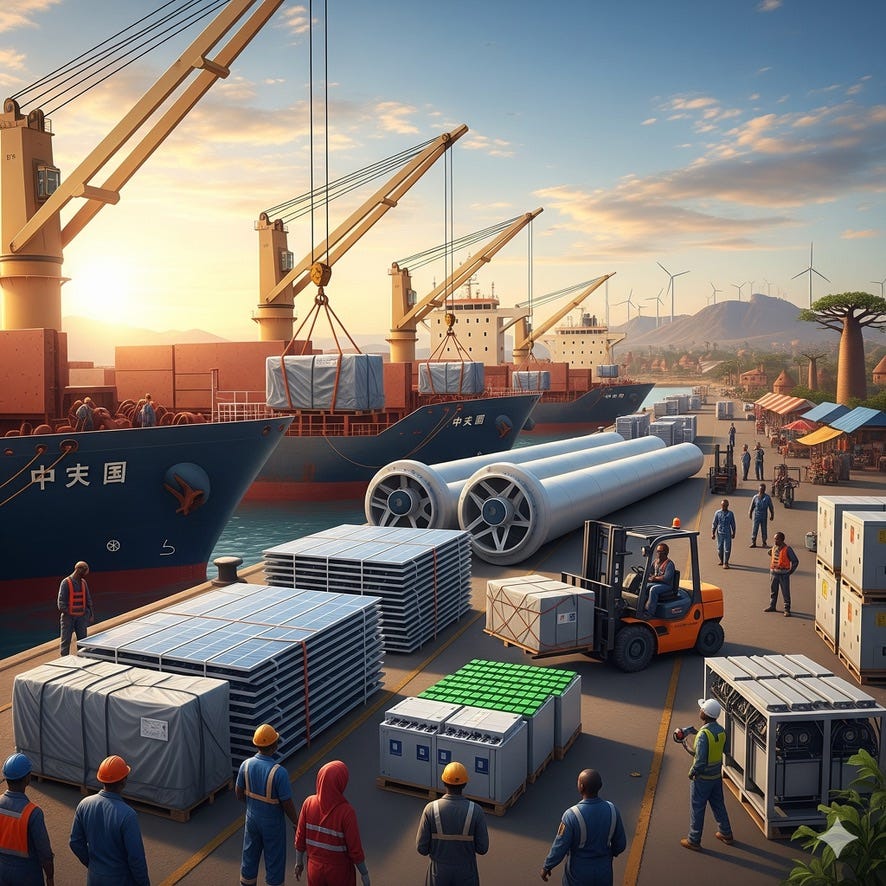
While the primary focus of U.S. energy policy is domestic capacity expansion, the global allocation of China’s industrial and energy infrastructure capacity creates significant implications for the U.S.. China’s Belt and Road Initiative (BRI) is a clear outlet for China’s industrial capacity. We are already seeing rapid growth in Africa’s imports of renewable energy systems, particularly solar solutions, and ongoing Chinese investments in BRI projects is likely to see expanded demand for Chinese industrial outputs in the energy generation space.
Through the BRI, China finances and builds energy generation and transmission projects in participating countries, often at preferential rates and with bundled technology packages. These projects accelerate energy transitions in BRI nations, giving them access to cheap, firm and reliable power. At the same time, the capacity, materials and labour devoted to these overseas projects are, in effect, capacity that is not available for the U.S. market. Transformers, batteries, solar panels, HVDC modules and nuclear components are finite resources. If China allocates them to BRI projects, U.S. developers face scarcity and higher costs.
The inadvertent effect is twofold. First, U.S. energy expansion is slowed or made more expensive. Even projects that are otherwise “ready to build” may be delayed for years due to global supply chain pressures. Second, other nations benefit from accelerated energy transitions, gaining firm power capacity at lower cost and positioning themselves competitively in manufacturing and industrial development. The U.S., in contrast, experiences constrained energy supply, higher prices and reduced flexibility to power AI and industrial ambitions.
In short, the Belt and Road functions as a growth channel for China’s expansive capacity. It is not the root cause of U.S. energy difficulties, but it magnifies the consequences. The underlying problem remains the domestic challenge of adding 100 GW of firm power in a compressed timeframe. The BRI simply illustrates the broader opportunity cost: while America struggles to deliver on its ambitious target, other nations are able to leapfrog forward using the very resources that might have helped U.S. energy expansion.
The next section will conclude the essay by synthesising these insights, highlighting the implausibility of the 100 GW target, and examining the systemic and strategic consequences for AI, reindustrialisation, and the broader U.S. economy.
Conclusion
The U.S. Energy Secretary’s call for 100 GW of firm power within five years is, in light of the evidence, a near-impossible ambition. Structural domestic constraints - from permitting and regulatory delays, to financing hurdles, labour shortages and technological bottlenecks - make even a 30–40 GW expansion highly challenging. These bottlenecks are amplified by global supply-chain realities. China dominates critical inputs such as transformers, batteries, solar panels and nuclear components, meaning that U.S. projects face both scarcity and elevated costs. Meanwhile, China can allocate its industrial capacity to Belt and Road Initiative projects, accelerating energy access abroad while leaving the U.S. to struggle with unmet demand. The result is a perfect storm of curtailed firm capacity, rising electricity prices, and regional economic distortions reminiscent of Dutch Disease effects.
For AI, the implications are profound. High electricity costs and constrained capacity will act as a governor on U.S. ambitions. Data centres and training operations are price-insensitive to a degree, but rising operational costs will eventually pass through to customers and may slow deployment. Meanwhile, China, though behind the U.S. in advanced semiconductor fabrication, can offset this hardware gap with cheaper electricity and more efficient deployment of software - “smarter software” compensates for less brute-force hardware. Open-source AI further reduces barriers, allowing competitors to innovate without the capital intensity required by hyperscale U.S. deployments.
Critically, the U.S. AI ecosystem’s ability to absorb high electricity costs is currently underwritten by investor support. Many AI firms are burning cash to scale operations, relying on continued inflows of venture and public capital. A prolonged electricity crunch, combined with escalating costs, threatens to expose these business models. Should the “AI bubble” falter, the financial fallout would be systemic: Nvidia alone constitutes roughly 8% of total S&P 500 market capitalization, and the collapse of other AI darlings would ripple through equity markets, potentially destabilizing broader investor confidence. Add to the mix the diminishing prospects of growing Nvidia sales in China, and there are storm clouds on the horizon.
The combined effect is a sobering wake-up call for the Americans. U.S. dominance in AI - let alone a broader reindustrialisation powered by cheap, abundant electricity - appears increasingly aspirational rather than achievable. Ambitious targets collide with structural domestic bottlenecks, international supply dependencies and global redistribution of capacity. Without radical acceleration of domestic energy infrastructure, diversification of supply chains and careful management of financial risk, America’s proclaimed ambitions risk remaining a fantasy, constrained not by ingenuity or policy will, but by the physics, economics and geopolitics of power - and the fragility of the financial structures that currently prop up AI expansion.
America’s energy system has revealed its soft underbelly. The U.S. Secretary of Energy’s call for 100 GW of new firm capacity in five years underscores the scale of the challenge: AI and reindustrialization are not limited by talent or capital, but by electrons. Delivering this capacity domestically is almost impossible on current timelines, especially if Chinese supply chains are excluded. China dominates the production of grid transformers, batteries, solar wafers, turbines and transmission gear. By quietly prioritising Belt & Road Initiative projects and supplying the EU, ASEAN, and developing nations, Beijing can deny America the resources it needs without a single overt sanction. The result is a devastating cost spiral: U.S. projects face 30–50% higher capex, delayed deployment and wholesale electricity price rises of 30% or more. AI and industry become costlier while households and businesses absorb the burden. Meanwhile, China can continue to enable access to cheap power and AI globally. In this way, the strategic field tilts further away from the U.S. without confrontation - not by Chinese firms outcompeting American AI labs (though this is increasingly happening), but by controlling the industrial sinews of energy supply.