
Salty, salty ...
Sodium-ion: The Quiet Revolution That Makes Renewable Energy Economically Inevitable

Preface: Energy features centrally in my ongoing reflections on economic systems and geopolitical dynamics. That’s why I remain keenly interested in developments in energy-related technologies, whether it’s in harvesting / generation, or storage.
Different energy systems, understood through the lens of Energy Return on Energy Invested (EROEI), underpins the performative differentials between various AI configurations. Physical and electricity constraints are manifestly going to cause significant structural and social disruptions in the US, as hyperscaler data centres make larger and larger claims on electricity potential. When green hydrogen gets cheap, a host of downstream implications and possibilities will become apparent, even as they remain elusive today. Differences in EROEI ultimately define the varying civilisational possibilities of nation states, with geopolitical implications. Indeed, nations can be reconceptualised as Systemic Exchange Value Regimes underpinned by EROEI vectors.
This essay explore another emerging breakthrough in energy: the possibilities of sodium-ion batteries delivering another step-wise change in EROEI possibilities.
Salt has occupied a remarkable place in human economic history, functioning not only as a vital preservative and flavouring agent but also, at various times, as a medium of exchange and a store of value. Its economic significance stemmed from its essential role in sustaining life and enabling long-distance trade before the widespread availability of refrigeration and modern preservation techniques. Because of its scarcity in some regions and its necessity everywhere, salt became a natural candidate to function as money.

Archaeological and historical evidence shows that salt was traded as early as the Neolithic period (around 6000 BCE), when salt springs and coastal evaporation sites became important sources of wealth. In ancient China, records from the Zhou dynasty (c. 1046–256 BCE) describe a state monopoly on salt production and trade, one of the earliest examples of government revenue derived from a single commodity. In the Mediterranean world, the word salary derives from the Latin salarium, referring to the salt allowance given to Roman soldiers, implying that salt could serve both as a payment medium and as a unit of account.
Throughout Africa, particularly between the 8th and 16th centuries CE, salt was a cornerstone of trans-Saharan commerce. Caravans transported salt blocks from Taghaza and Bilma to exchange for gold, grain, and slaves in the Sahelian kingdoms of Ghana, Mali and Songhai. In some regions, such as Ethiopia and parts of Central Africa, salt bars or cakes - known as amolé - circulated as standard currency well into the 19th century CE. Similarly, in parts of Europe, such as Venice and Salzburg (literally “Salt Fortress”), the control of salt routes generated immense economic and political power.
Salt’s role as a store of value lay in its durability, divisibility and universal desirability. However, with the rise of coined money around the 7th century BCE in Lydia and the expansion of global trade networks, salt’s monetary function gradually diminished. It retained symbolic and strategic importance, but its use as a currency faded as metallic and later paper money offered greater portability and uniformity.
Yet salt’s history as “white gold” endures as a reminder of how human economies evolved from the trade of necessities to abstract representations of value. And now, we are on the cusp of another chapter in salt’s storied history - this time as the medium for the storage of energy, in a world in which energy itself can be understood as the embodiment of value.
The Energy Arithmetic Behind the Transition
When China’s Contemporary Amperex Technology Co. Limited (CATL), the world’s largest battery manufacturer, announced it had launched a commercial sodium-ion battery, I suspect that few outside the industry grasped the scale of what had just happened. The company claimed its new chemistry delivers comparable energy density to lithium-ion cells, but at roughly one-tenth the cost and with a lifespan of up to twenty-five years.
If lithium-ion batteries made renewable energy systems viable, sodium-ion makes them inevitable. This is the straightforward arithmetic of energy return on energy invested (EROEI).
EROEI is a simple but profound measure. It asks: how much energy must we spend to get a given amount of usable energy back? For any energy technology - oil wells, coal-fired power, wind farms or batteries - the higher the EROEI, the more surplus energy remains available to society for everything else: manufacturing, healthcare, culture, public spaces, libraries, innovation and what-have-you.
Historically, fossil fuels offered EROEIs in the range of 30:1 to 100:1. As the energy transition unfolds, renewables must not only replace these fuels in gross output (or at the very least, contribute proportionately more to the marginal expansion of energy production) but also sustain comparable net energy returns once storage is included. For intermittent sources like solar and wind, the key determinant of system EROEI is the storage component. That’s where sodium-ion’s significance comes sharply into focus.
To see how transformative CATL’s claim might be, I constructed a simple comparative model of EROEI for lithium-ion and sodium-ion batteries, using consistent assumptions. The model examines a single kilowatt-hour (kWh) of installed storage capacity operating over a 25-year system lifetime.
The basic method is straightforward:
Delivered energy: Each battery delivers 1 kWh of capacity per full equivalent cycle (FEC). Assuming one full cycle per day, that’s 365 cycles per year. Multiply by round-trip efficiency (RTE) - the fraction of energy recovered after accounting for losses - to find the usable energy delivered each year.
Total lifetime energy delivered: Multiply annual delivered energy by system lifetime, adjusting for battery replacements when lifespan is shorter than 25 years.
Energy invested: Embodied manufacturing energy - the primary energy required to produce each kWh of battery capacity - is summed across all packs produced during the 25-year horizon.
EROEI: Divide total lifetime energy delivered by total embodied energy invested.
This model does not account for recycling credits, balance-of-system costs, or degradation curves. It is intentionally conservative and transparent. Core assumptions:
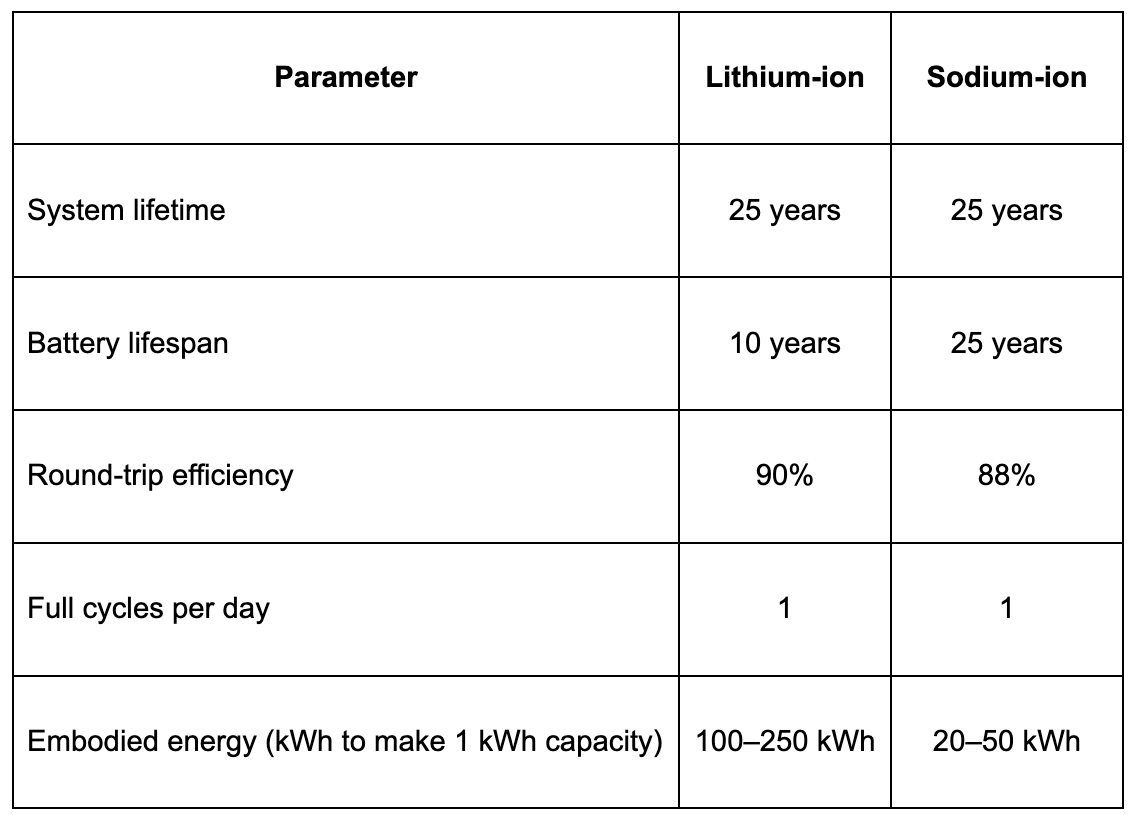
For lithium-ion, the model assumes full replacements at years 10 and 20 - three manufacturing cycles in total across the 25-year horizon. Sodium-ion, with its full 25-year calendar life, requires only one manufacturing cycle.
Across low, medium, and high embodied-energy scenarios, the results are striking.
Lithium-ion:
Low (100 kWh embodied): EROEI = 27
Medium (150 kWh embodied): EROEI = 18
High (250 kWh embodied): EROEI = 11
Sodium-ion:
Low (20 kWh embodied): EROEI = 402
Medium (30 kWh embodied): EROEI = 268
High (50 kWh embodied): EROEI = 161
Even under pessimistic assumptions, sodium-ion’s EROEI is an order of magnitude higher than lithium-ion’s. In the medium scenario, sodium’s ratio is roughly 15 times better.
The reasons are intuitive: sodium-ion batteries require less energy to manufacture and last much longer before needing replacement. Over 25 years, a sodium system delivers around 8,000 kWh of usable energy for every 30 kWh of energy invested in making it. Lithium delivers a similar 8,200 kWh but demands roughly 450 kWh of manufacturing energy, spread across multiple replacements.
Lifespan multiplies through the EROEI equation. Most lithium-ion systems today have calendar lives of 8–12 years before capacity loss renders them commercially unviable. In a 25-year energy project - say, a solar farm - lithium storage must be replaced two or three times. Each replacement repeats the high embodied energy and material extraction process, compounding the energy cost of maintaining capacity.
By contrast, a sodium battery rated for 25 years aligns perfectly with the expected lifetime of the generation asset it supports. One build, one installation, one decommissioning cycle. The embodied energy is paid once; the delivered energy accrues continuously for a quarter century. The compounding effect of avoided replacements drives the EROEI leap.
Material Abundance and Manufacturing Simplicity
Lithium-ion chemistries depend on relatively scarce and geopolitically concentrated minerals - lithium, nickel and cobalt. Their extraction and refinement are energy-intensive and environmentally taxing. Sodium, in contrast, is among the most abundant elements on Earth, derived easily from common salt or soda ash. Sodium-ion batteries use aluminum current collectors rather than copper, and iron- or manganese-based cathodes instead of cobalt or nickel. These materials are not only cheaper but also require far less processing energy per unit of stored capacity.
Manufacturing sodium-ion cells, therefore, involves lower-temperature, less complex steps. The reduction in embodied energy is not speculative; it simply follows from basic thermodynamic and metallurgical realities. Lower temperatures, fewer purification stages, and abundant feedstocks translate directly into higher EROEI.
The Economics of Relative Abundance
A battery that is ten times cheaper and lasts twice as long effectively eliminates the economic bottleneck in renewable energy systems. Energy storage moves from being a cost centre to an infrastructural given, like the pylons and wires that carry electricity today.
At grid scale, this means intermittent renewables such as solar and wind can finally be firmed without cost distortion. At distributed scale - households, farms or villages -storage becomes affordable and durable enough to provide full autonomy. The developing world, in particular, stands to benefit. Regions where the cost of lithium-based systems has been prohibitive could now leapfrog directly to 24-hour renewable power without fossil baseload backup.
The macroeconomic consequences are significant. Energy costs cascade through every sector. When the marginal cost of firmed renewable electricity collapses, manufacturing, transport and digital infrastructure all become cheaper to operate. Energy transitions from being a constraint to a multiplier of economic productivity.
Reaching the Limits of Lithium
Lithium-ion technology, first commercialised in the early 1990s, has been the indispensable enabler of portable electronics, electric vehicles, and grid storage. But its material foundation is now under strain. The International Energy Agency and several independent studies warn that global demand for lithium could exceed known economically recoverable reserves by 2030, even after accounting for planned extraction and recycling.
Lithium’s geology poses a host of problems: it is concentrated in a small number of regions - including Australia, Chile, Argentina and China - and its extraction is water-intensive, environmentally disruptive and energy costly. As demand accelerates for electric vehicles and stationary storage, prices have already shown extreme volatility, reflecting the system’s physical and geopolitical limits.
Sodium-ion changes this equation entirely. Sodium is abundant in seawater and common rock salts, with virtually unlimited global availability. A shift from lithium to sodium relieves not only cost pressures but also resource exhaustion risk. It decouples the clean energy transition from the scarcity dynamics that have historically haunted resource-dependent systems.
If CATL’s sodium-ion batteries perform as claimed, they don’t merely offer better economics; they render the entire renewable system resource-resilient. In other words, the world can scale electrification without colliding with the hard geological ceiling that lithium dependence implies. That makes sodium-ion not just a technological breakthrough, but a planetary safeguard for the sustainability of the energy transition.
If the CATL cells perform as claimed, the global energy system’s net energy return improves by at least an order of magnitude for every kilowatt-hour of installed storage. That moves the renewable transition from a marginal proposition, sustained by subsidies and policy mandates, to an autonomous economic logic that simply outcompetes fossil systems on cost and energy productivity.
In short: lithium batteries made renewables viable; sodium-ion makes them inevitable.
From Energy Systems to Intelligent Systems
The impact of sodium-ion extends beyond the energy sector. It reshapes the economics of digital infrastructure itself.
The emergence of containerised AI stacks - self-contained computing units combining processors, memory, networking and cooling - depends critically on cheap, durable and long-life energy storage. With integrated solar and wind generation supported by sodium-ion batteries, these systems can operate autonomously, far from traditional grid infrastructure.
In effect, sodium-ion makes off-grid, high-performance computing viable. A 25-year battery life, aligned with the lifespan of photovoltaic and wind assets, allows modular “plug-and-play” AI units to function continuously with minimal maintenance. Energy storage ceases to be a limiting factor; it becomes a design enabler.
The implications cannot be underestimated. Localised AI infrastructure can now be deployed at the edge - close to data sources, communities and industries - without dependence on centralised energy grids or hyperscale data centres. Each containerised AI node can train and serve models tailored to its local environment, supported by clean, self-generated power. Distributed localised AI infrastructure enables users to bypass the geopolitical risks associated with America’s historic dominance of global computation capacity and communications networks, as documented in Underground Empire (Farrell and Newman, 2023).
This convergence of renewable abundance and computational autonomy marks the next phase of digital evolution: intelligent systems embedded within sustainable energy ecosystems. Just as sodium-ion decouples energy systems from resource scarcity, it promises to decouple AI from the constraints of centralised power and cooling. In the long run, that could transform not only the economics of computation but also its geography, distributing intelligence alongside energy itself.
Caveats and Next Steps
Caution remains warranted. Laboratory claims must survive the brutal physics of commercial deployment; temperature swings, cycling variability and maintenance realities will all have a say. Real-world EROEI will depend on actual embodied-energy data once manufacturing scales, as well as on verified cycle-life performance.
Even so, the directional truth seems clear. Lower embodied energy, longer lifespan and material abundance combine to deliver vastly better net-energy returns. The model’s order-of-magnitude advantage is robust to conservative stress-testing. The transition to a low-carbon or a post-carbon economy hinges not just on generating clean energy but on the net energy surplus those systems deliver after accounting for their own material and energetic costs. For two decades, lithium-ion has carried that burden, helping renewables reach grid parity but at the cost of supply bottlenecks and modest net-energy yields.
Sodium-ion breaks that constraint. It closes the economic gap between aspiration and inevitability. Once storage is effectively free in both financial and energetic terms, the last structural argument for fossil energy disappears.
Salt was displaced from its central role as a medium of exchange some centuries earlier. But, history has a quiet way of working itself around. Salt’s restoration as a central feature of modern life is well under way. The quiet revolution has begun. This has emerged not in a boardroom or on a trading floor, but in the chemistry labs of a Chinese battery giant. And if the numbers hold true, or near enough to true, the next twenty-five years of global energy development - and distributed AI infrastructure - will be defined not by scarcity and competition, but by abundance powered by salt.