
Provincialising Ricardo
Policy Counsel, Fixed Capital and the Instrumental Politics of Trade

Preface: There’s been a bit of a flurry of interest of late in the work of British classical economist David Ricardo. Most of you will know of Ricardo via the theory of comparative advantage, the central feature of mainstream trade theory. Who can forget the parable about Britain and Portugal being able to benefit if they each specialised? This parable, advanced as part of a wider intervention into the Corn Law debates of the early 1800s, has since been elevated into an axiomatic claim: “free trade good, protection bad.” I suspect that Ricardo would find much of this appropriation a stranger, and this essay seeks to show just what it is that we could actually learn from Ricardo, once we discard the neoclassical misappropriation. My suggestion is that he was neither a hardline free-trader nor a dogmatic protectionist; circumstances mattered. Rather, we find someone who was a pragmatic thinker with an approach driven by a focus on the facts of the day. In other words, context mattered a lot.
David Ricardo occupies a curious place in the history of economic thought. Textbooks and policy rhetoric have long presented him as the architect of comparative advantage and a foundational advocate of free trade; an axiomatic figure whose England–Portugal cloth-and-wine parable supposedly demonstrates the universal gains from specialisation. Yet this image is a profound decontextualisation, and consequently, a grossly misleading framing. Ricardo’s intellectual project was never centred on trade as an end in itself, still less on unconditional openness. It was a sustained analysis of production, distribution and accumulation in an industrialising Britain, framed explicitly as counsel to legislators amid the distributional conflicts of the post-Napoleonic era.
Keith Tribe’s historiographical project (which incidentally I first took interest in back in the early 1990s via his book Marxism and the Agrarian Question, co-authored with Athar Hussain), together with complementary work by Gauthier Lanot and Ryan Walter, restores this situated character. By “provincialising” Ricardo - that is, returning him to the genres of pamphlet, parliamentary testimony and advisory intervention; in other words, situating him in the milieu in which he was active - we see that his remarks on trade were marginal, highly conditional and subordinate to the overriding concerns of curbing unearned rents and sustaining industrial profits. Far from being a dogmatic free trader (or, conversely, a protectionist), Ricardo was a pragmatic instrumentalist whose stance was tethered to the material conditions of early-nineteenth-century Britain. A thinker so attuned to the specificity of fixed capital and sectoral interests would almost certainly adopt a similarly context-sensitive approach today. I end this essay with some reflections on what Ricardo may say today in relation to the U.S.’ trade deficit situation.
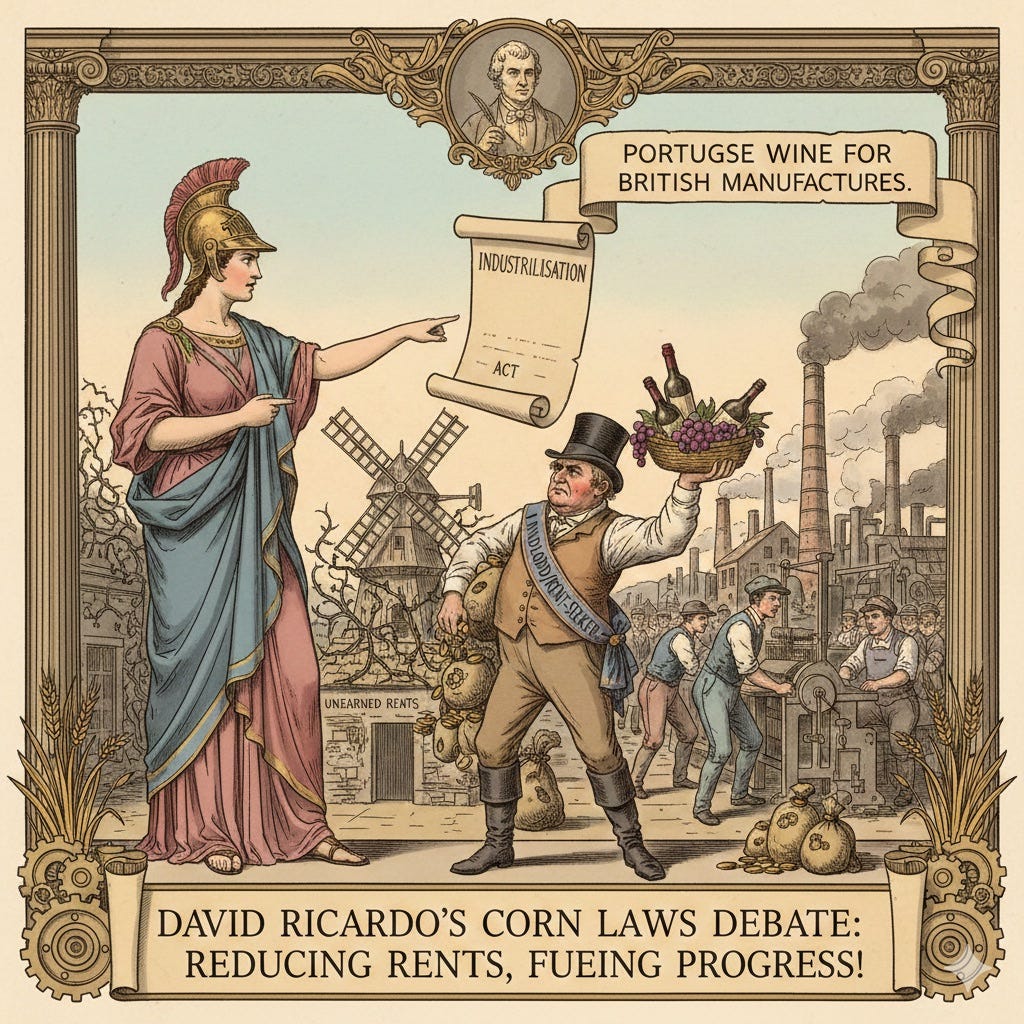
Ricardo’s Core Project: Production, Surplus and Distribution
Ricardo’s Principles of Political Economy and Taxation (1817, third edition 1821) is not a treatise on international trade. Trade occupies only one chapter (VII) amid a far broader inquiry into value, rent, wages, profits and the conditions for capital accumulation. The central drama is distributional: how the surplus generated by production is divided among labourers, capitalists and landlords (his three principal social-economic classes), and how that division affects the rate of profit and the pace of accumulation. As Ricardo stated plainly in the Preface:
“The principal problem of Political Economy [is] to determine the laws which regulate [the] distribution [of] the produce of the earth - all that is derived from its surface by the united application of labour, machinery, and capital - among the three classes of the community.”
Rent, in particular, is no neutral return but a differential surplus arising from the cultivation of successively worse lands. High corn prices inflate this unearned increment to landlords, raising money wages (to maintain real subsistence) and squeezing profits - the fund for accumulation. This analysis was not abstract; it diagnosed a concrete threat to Britain’s industrial supremacy in the aftermath of the Napoleonic Wars.
Hostility to “unearned” rents runs throughout. Landlords “love to reap where they never sowed,” Ricardo echoed Smith. The entire model is engineered to show how protecting domestic corn via the 1815 Corn Laws would entrench this rentier extraction at the expense of the “productive classes.” Trade policy enters only as a lever to cheapen wage-goods, hold down nominal wages, and thereby raise the general rate of profit. Production and circulation of surpluses remain the heart of the project - precisely the terrain Tribe has long emphasised as the situated discourse of classical political economy, not a proto-neoclassical discourse of allocation.
Ricardo’s realism about fixed capital further underscores this production-centred focus. Far from assuming frictionless reallocation, he repeatedly stresses the durability, specificity and potential loss of sunk investments occasioned by sudden changes in the contours of commerce. In Chapter XIX, “On Sudden Changes in the Channels of Trade”:
“It is not so difficult to withdraw a circulating as a fixed capital, from any employment in which it may be engaged. It is often impossible to divert the machinery which may have been erected for one manufacture, to the purposes of another… In rich and powerful countries, where large capitals are invested in machinery, more distress will be experienced from a revulsion in trade…”
He draws the parallel to agriculture: capital “for ever sunk in land” (draining, fencing) cannot be withdrawn without loss. Chapter XXXI, “On Machinery” (added 1821), goes further, acknowledging that converting circulating capital (wages) into fixed forms can reduce gross output and harm labourers even as net profits rise for capitalists. These passages reveal a thinker deeply attentive to path dependence, sectoral specificity, and the destructive side of progress - realities bracketed only in the stylised trade parable.
The stylised trade parable is from Chapter VII: “On Foreign Trade” where we find the famous England-Portugal example and the explicit caveat on capital mobility. This is the core illustration of comparative advantage, where Ricardo deliberately contrasts easy domestic/sectoral mobility with international immobility. Note how he qualifies intra-national movement without claiming frictionless sectoral repurposing of fixed capital. He writes:
“The difference in this respect, between a single country and many, is easily accounted for, by considering the difficulty with which capital moves from one country to another, to seek a more profitable employment, and the activity with which it invariably passes from one province to another in the same country.
If it were not for the difficulty with which capital moves from one country to another, to seek a more advantageous employment, and the disinclination which every man feels to quit the country of his birth and connexions, and entrust his capital to a government with which he is unacquainted, capital would be much more readily transferred from one country to another, and the profits of capital would be equalised in all countries.
[...]
Under such circumstances, it cannot be doubted that both nations would gain by the exchange: England would give cloth for wine, and Portugal wine for cloth, with the same advantage as if the commodities had been produced in the respective countries without any cost of production.” (Chapter VII, pp. 136–137 in Sraffa ed. Vol. 1; emphasis added on the “province to another” contrast. Ricardo lists frictions like “insecurity,” “habits,” “laws,” and “government” to explain why capital does not simply migrate internationally.)
This sets up the model but does not address fixed capital’s sectoral specificity; Ricardo saves that realism for later chapters. We therefore find in Chapter XIX: “On Sudden Changes in the Channels of Trade” (direct on fixed vs. circulating capital) explicit consideration of the costs of sudden trade shifts (e.g., from liberalisation or war/peace transitions), emphasising that fixed capital is often “wholly lost” or impossible to repurpose. To repeat:
“It is not so difficult to withdraw a circulating as a fixed capital, from any employment in which it may be engaged. It is often impossible to divert the machinery which may have been erected for one manufacture, to the purposes of another; but the clothing, the food, and the lodging of the labourer in one employment may be devoted to the support of the labourer in another.
In rich and powerful countries, where large capitals are invested in machinery, more distress will be experienced from a revulsion in trade, than in poorer countries where there is proportionally a much smaller amount of fixed, and a much larger amount of circulating capital, and where consequently more work is done by the labour of men.
[...]
It would be entirely a matter of calculation with him whether he should abandon the old machinery, and erect the more perfect, losing all the value of the old; or whether he should continue to use it, paying the higher wages which the increased price of corn would render necessary. Yet this is the argument of those who would wish us to prohibit the importation of corn, because it will deteriorate or annihilate that part of the capital of the farmer which is for ever sunk in land.” (Chapter XIX, pp. 265–266, 268 in Sraffa ed.. Ricardo uses the farmer’s sunk costs in land improvements as parallel to the manufacturer’s machinery - both “for ever sunk,” hard to withdraw without loss.)
In Chapter XXXI: “On Machinery” (added in the third edition, 1821), Ricardo refined his earlier views to acknowledge machinery’s labour-displacing and potentially injurious effects, stressing how fixed capital locks resources into specific forms and reduces the demand for labour if not offset by accumulation. Thus:
“I am persuaded, that whenever the net income of a society increases, its gross income will also increase, although a part of the increase in net income may be at the expense of gross income. [...]
The substitution of machinery for human labour, is often very injurious to the interests of the class of labourers. [...] the demand for labour will continue to increase with an increase of capital, but not in proportion to its increase; the difference will depend on the increased durability of fixed capital, and on the increased skill of the workmen.” (Chapter XXXI, pp. 388, 395–396 in Sraffa ed.)
The key point is that machinery converts circulating capital (wages/food) into fixed forms that are durable and specific, reducing immediate labour demand even as net profits may rise for the capitalist. Ricardo stresses this as a real distributional issue. These excerpts together demonstrate Ricardo’s detailed grasp of fixed capital’s rigidity: it is not merely hard to move geographically but often impossible to repurpose sectorally without total loss (“wholly lost,” “losing all the value of the old,” “for ever sunk”). This realism underpins his broader focus on production, accumulation, and class distribution - far from any assumption of costless reallocation.
The Corn Laws Crucible: Trade as Tactical Instrument
Ricardo’s most famous intervention - the 1815 Essay on the Influence of a Low Price of Corn on the Profits of Stock - was timed for the parliamentary renewal of the Corn Laws after Waterloo. Britain faced postwar adjustment: wartime protection had inflated rents; repeal (or liberalisation) promised cheaper imports. Ricardo’s argument was ruthlessly distributional: high corn prices → higher rents → higher wages → lower industrial profits → retarded accumulation. Freer trade in corn was the remedy to protect the profit rate and favour manufacturing over the landed interest.
The 1815 Essay on the Influence of a Low Price of Corn on the Profits of Stock and the relevant sections of the 1817 Principles were direct shots in the debate over the 1815 Corn Laws (which protected domestic grain prices after the Napoleonic Wars). High corn prices inflated landlords’ differential rents (his famous theory of rent as the surplus on better soils) and pushed up money wages to maintain workers’ real subsistence level. This squeezed industrial profits, slowed capital accumulation, and favoured the landed aristocracy over the manufacturing class. Free (or freer) imports of corn would cheapen wage goods, hold down nominal wages, raise the profit rate, and channel resources into industry - the exact outcome the rising industrial bourgeoisie needed for Britain’s early industrial takeoff.
It was never a generic “free trade good, protection bad” axiom. It was explicitly about sectoral distribution: curbing rentier extraction to fuel productive investment. Ricardo was quite open about this political economy dimension (he was himself a successful stockbroker and landowner, yet still pushed repeal). The repeal campaign that eventually succeeded in 1846 was framed in these class terms, with the Anti-Corn Law League mobilising manufacturers against “bread-taxing” landlords.
The England–Portugal example in Principles Chapter VII is introduced almost casually as an analogy. Ricardo explicitly flags the premise of international capital immobility:
“The difference… between a single country and many, is easily accounted for, by considering the difficulty with which capital moves from one country to another… and the activity with which it invariably passes from one province to another in the same country.”
This was no oversight or deception; it was pragmatic realism for his audience. Domestic mobility was a reasonable stylisation for an integrated island economy with turnpikes, canals and London finance; international movement faced insecurity, legal barriers, and national attachments. The parable served the immediate political task: to make freer corn imports the “irresistible conclusion” for industrial progress.
Provincialising Ricardo: Counsel, Casuistry, and the Pre-Doctrinal Milieu
Keith Tribe’s scholarship, especially the 2024 paper with Gauthier Lanot, “Before Political Economy,” provides the decisive historiographical corrective. Examining the 1794–96 dearth crises through Annals of Agriculture, London Gazette prices, and parliamentary materials, Lanot and Tribe demonstrate that discourse was overwhelmingly casuistic - reasoning from circumstance, local knowledge, and past experience - rather than doctrinal. Tropes now retroactively read into the period (systemic pauperism, landlord–manufacturer clash, population pressure on wages) are absent. Policy responses were practical: charity, soup kitchens, waste-land cultivation and temporary bounties. Arthur Young and the Board of Agriculture exemplify the advisory genre: “the collecting of information… was necessary before measures could be recommended to parliament.” As the abstract states: “A doctrinaire ‘political economy’ would develop in the early 1800s, but did not yet exist.”
Ryan Walter’s 2025 article “The Corn Laws of 1815: policy counsel, casuistry, and theory” extends this directly to Ricardo’s moment. Parliament expected “policy counsel” addressed to statesmen - prudent, context-specific weighing of wealth against justice, subsistence and social order. Abstract “theory” was suspect, associated with French Revolutionary enthusiasm. Malthus and Ricardo therefore framed their interventions as counsel. Ricardo’s Essay on Profits, Walter shows, “respecif[ied] the circumstances of the case so as to make free trade the irresistible conclusion,” yet remained awkward and marginal to the actual parliamentary resolution, which favoured protection via casuistry. Theory gained traction only by domesticating itself within the existing idiom of legislative advice.
Tribe’s companion 2024 piece, “The ‘English Model’ of Agrarian Development,” reinforces the point. Contemporaries viewed English agriculture through policy lenses - leases, Corn Laws for price stability and removal of feudal remnants - not as a mechanical “revolution.” Political economists acted as counsellors on “police” (administration), not detached theorists. Ricardo’s visit from Jean-Baptiste Say in 1815, where he showed off local manufactories, captures the practical, production-oriented milieu.
This provincialising work defies abstraction. Ricardo and his contemporaries were moral philosophers and advisers first, intervening in concrete crises of dearth, pauperism, and postwar adjustment. Their hostility to rents stemmed from a diagnosis of barriers to productive reinvestment, not a universal efficiency theorem.
Neither Free Trader Nor Protectionist: Pragmatic Instrumentalism
The neoclassical appropriation of Ricardo turns a highly contingent, class-aligned piece of policy counsel into a universal, frictionless axiom of “gains from trade” that can be deployed in any context, at any scale, regardless of capital mobility, sectoral rigidities, or national productive capacity. That move erases the entire political economy of the argument: the targeted assault on differential rents, the imperative to protect the profit rate for industrial accumulation, and the tacit acceptance that Britain was (temporarily) the workshop of the world with advantages that freer corn imports would reinforce rather than undermine.
By treating the England–Portugal illustration as if it were intended to be a self-standing, logically watertight theoretical construct - one that must collapse under scrutiny of its own internal premises about capital mobility - Ricardo is deceptively placed by the neoclassicals on an abstract plane.
Yet, in context, we can see that what appears to be inconsistencies in argumentation is in fact Ricardo being rhetorically economical for a specific polemical purpose. Ricardo’s critique of the Corn Laws was robust on its own terms, precisely because it never pretended to rest on a frictionless model of adjustment. Passages referencing capital mobility “province to province” served rhetorically to illustrate and rhetorically amplify the relative frictions of international mobility. Rather than belying inherent contradictions, they were deliberate qualifications meant to make the argument credible to a contemporary audience that would immediately raise the objection: “Why doesn’t English capital just go to Portugal and produce both goods more cheaply there?” Ricardo answers that question head-on, then proceeds with the parable as a second-best illustration under realistic constraints. He does not need perfect intra-national sectoral mobility for the distributional logic to hold; he needs only that domestic reallocation frictions be smaller than international ones, which was a reasonable stylisation for 1810s–20s Britain.
And when Ricardo turns to the actual dynamics of production and adjustment - in Chapters XIX and XXXI especially - he is unflinchingly realistic about fixed capital’s rigidity. Machinery erected for one manufacture is “often impossible” to divert to another; sunk investments in land improvements or plant are “for ever sunk”; sudden revulsions in trade cause “more distress” in rich manufacturing countries precisely because “large capitals are invested in machinery” that cannot be withdrawn without loss. These observations are not concessions squeezed out of him; they are central to his broader project of understanding how surpluses are generated, circulated, and reinvested in an industrial economy.
In other words, the Corn Laws critique stands robustly because it is grounded in the specific distributional mechanism (high corn → high rents → high wages → low profits → slow accumulation) that operates even with - indeed, because of - the fixed-capital rigidities Ricardo elsewhere analyses so carefully. Within the context of the debates at the time, the trade parable is a tactical simplification, not the foundation of the case. Its internal logic holds under the stated premises (international immobility plus relative domestic ease), and those premises are never abandoned elsewhere in the text. What Ricardo sought to show was why, in this conjuncture, freer corn imports would shift the balance toward the industrial interest without collapsing the system.
Ricardo therefore deserves justice on two fronts. Firstly, his nuanced position goes directly against the neoclassical sanitisation that turns him into the patron saint of unconditional openness. And secondly, against readings (including some heterodox ones) that fault him for failing to deliver a dynamic, adjustment-cost-aware model he never set out to provide.
His strength lies exactly in the refusal to abstract away from the material conditions of his time: the specificity of fixed capital, the sectoral and class incidence of policy changes, the path-dependent nature of accumulation. The Corn Laws argument is robust because it is embedded in those conditions, not despite them. A modern Ricardo, facing global hyper-mobility of capital, persistent trade imbalances, strategic industrial policies elsewhere, and new forms of rentier extraction (urban land, finance and IP), would almost certainly reason in the same casuistic, context-bound way: weigh the impact on the profit rate, on productive capacity, on distributional outcomes and recommend accordingly.
That grounded, instrumental sensibility - rather than any timeless doctrine - is what makes Ricardo worth recovering today. The neoclassicals abstracted him into irrelevance for contemporary debates. It would be doing him a injustice to read him as a flawed proto-theorist rather than the astute counsellor he actually was. Tribe’s provincialising lens restores the proper measure: Ricardo as diagnostician of power, distribution, and production in a specific historical moment, whose methods of reasoning remain far more useful than the axioms that later bore his name.
Once restored to context, Ricardo emerges as neither unconditional advocate of free trade nor of protection. His stance was strictly instrumental: freer imports of corn served Britain’s industrial interest by curbing rents and sustaining profits in the specific conjuncture of 1815–46. Where conditions differed, the counsel would differ. He supported the Navigation Acts (strategic protection for shipping) and acknowledged temporary safeguards. Fixed-capital specificity and adjustment costs, which he analysed so carefully elsewhere, further qualified any blanket prescription. Liberalisation that stranded machinery or destroyed sectoral capacity would undermine the very accumulation he sought to promote.
The same pragmatism governs his treatment of capital mobility. International immobility was not a theoretical sleight-of-hand but observed reality; domestic mobility was a relative stylisation. In a world of hyper-mobile capital, global value chains and strategic industrial policy abroad, the original caveats demand attention. His “free trade advocacy” was always aligned to sectoral distributional interests and national productive capacity, never an axiomatic end.
Concluding Reflections
The decontextualisation of Ricardo into a neoliberal slogan has served ideological purposes, but it has obscured a far richer thinker. Tribe, Lanot, Walter and the broader Cambridge-style history of economic thought restore him as a counsellor embedded in Britain’s transition to industrial supremacy - hostile to rentier extraction, focused on production and surplus circulation, realistic about fixed capital’s rigidities, and pragmatic about trade policy. His intervention on the Corn Laws was tactical counsel in a class-distributional struggle, not, I would suggest, the birth of timeless doctrine.
In an era when capital moves globally, rents reappear in new guises (urban land, intellectual property, finance), and nations pursue strategic autonomy, Ricardo’s situated approach offers more guidance than the abstracted axioms that bear his name. A thinker who tailored arguments so precisely to the material conditions and distributional stakes of his time would hardly endorse dogmatic openness today. Provincialising Ricardo does not diminish him; it reveals the enduring relevance of classical political economy as diagnostic counsel, not portable ideology. By recovering that situated intelligence, we gain a sharper lens on our own conjuncture - one in which trade policy, like Ricardo’s, must remain subordinate to the broader imperatives of production, accumulation and equitable distribution.
A provincialised Ricardo would, I suggest, approach the United States’ persistent trade imbalances in 2026 with the same diagnostic rigour he applied to Britain’s Corn Laws in 1815: start from the facts of distribution, trace their impact on the general rate of profit and accumulation, and calibrate policy instruments to restore conditions for productive reinvestment. He would not begin with ideological commitments to “free trade” or “protectionism.” He would observe the material conditions and ask: what is blocking the circulation of surpluses into domestic fixed capital?
The facts are unambiguous. The US goods-and-services trade deficit stood at $901.5 billion for 2025 (down marginally from $903.5 billion in 2024), but the goods deficit alone reached a record $1.24 trillion - driven by surging imports despite tariffs and rerouting. Manufacturing’s value-added share of GDP hovered around 9.4–9.5% in recent quarters, a long-term hollowing-out from peaks above 20% in the mid-20th century. Meanwhile, finance and insurance contribute roughly 8% of GDP (up from historical averages around 7.3%), with real value-added stabilised at elevated levels. Fossil-fuel production remains a massive export earner, with ongoing subsidies and LNG booms generating substantial resource rents.
Deindustrialisation reflects a clear shift in class power: finance has displaced industrial capital as the dominant claimant on the surplus. Capital inflows into US assets (equities, real estate and Treasuries in particular) and energy rents (shale oil/gas exports) appreciate the dollar, inflate asset prices and divert resources away from tradable manufacturing. I have detailed these dynamics elsewhere. This is the modern analogue of Ricardo’s differential rents: unearned increments accruing to owners of scarce financial claims and hydrocarbon reserves rather than to productive fixed capital. The profit rate in manufacturing is suppressed not by high food prices but by high asset valuations, a strong dollar and energy-sector pull that crowds out labour and investment from tradables.
Ricardo would note the new reality of capital mobility. Unlike 1815, when international frictions were high, US industrial capital can move offshore, and did. This is precisely what happened consistently since the 1960s, and arguably to varying extents before then too. Fixed capital (factories, machinery and equipment) was replicated or relocated abroad because barriers collapsed: low transport/communication costs, financial integration and investor protections made absolute advantage (or arbitrage) dominate. The result echoes his Chapter XIX warning: sudden changes in trade channels left large domestic capitals “wholly lost” or idle. Capital offshoring, consolidated and amplified since the 1990s–2000s, destroyed or stranded entire sectors (textiles, consumer electronics, parts of steel and autos). Adjustment was not smooth reallocation; it was destruction of productive capacity at home.
Faced with this, Ricardo would not reject free trade outright. He would - I submit - recognise that the US, like his Britain, needs low-cost capital goods via import channels to raise the profit rate. Machinery, machine tools, intermediate components, semiconductors and industrial inputs are today’s “cheap corn” - they lower the price of constant capital, free up surplus, and encourage new domestic investment in complementary fixed capital (assembly lines, automation and advanced manufacturing). He would actually counsel aggressive openness here: lower or eliminate tariffs on these categories, streamlined procurement and targeted agreements focused on capital-goods flows. This would act directly to boost profitability in tradable sectors, just as cheaper imported grain held down nominal wages and protected industrial profits in 1815.
But he would pair this selective openness with an equally ruthless assault on the new rentiers. The liberated surplus must not leak into finance or fossil-fuel windfalls; it must circulate back into domestic accumulation. Ricardo would, I suggest, prescribe the following measures:
Financial rents: Higher taxation on capital gains, carried interest, and financial transactions to shrink asset appreciation and fee extraction. Limits on share buybacks and dividends that divert profits from reinvestment;
Fossil-fuel rents: Windfall royalties, excess-profits taxes, or export levies on oil/gas to capture resource rents and weaken the dollar-appreciation channel. Redirect revenues toward public investment in infrastructure that complements manufacturing (ports, grids, skills training); and
Channeling mechanisms: Accelerated depreciation, investment tax credits, or public-private funds to direct higher profits into new domestic machinery and R&D - ensuring that gains from cheaper capital-goods imports translate into fixed-capital formation rather than further financialisation.
Where strategic sectors face dumping or require time to build fixed-capital capacity (e.g., advanced semiconductors, EVs and machine tools to name just a few), he may endorse temporary, targeted tariffs or subsidies - analogous to his tacit acceptance of the Navigation Acts for shipping. Protection would be instrumental, never permanent or ideological. This is pure Ricardian pragmatism: open the ports to the cheap machinery and components that will raise our profits, just as they were opened to cheap grain. But do not allow the landlords of finance and fossil fuels to reap where they never sowed. Restore the conditions under which industrial capital can once again accumulate at home, would be the response frame.
In this light, I speculate, Ricardo’s counsel for 2026 America is neither blanket free trade nor blanket protectionism. It is selective openness for capital goods to lower production costs, combined with aggressive measures against financialised and resource rents to prevent surplus leakage. His method - diagnostic, distributional and production-centred - remains live and powerful. The provincialised Ricardo does not deliver timeless axioms; he delivers a framework for reasoning about power, surplus circulation and accumulation in any conjuncture. Applied today, it points squarely at freer imports of productive inputs and a frontal attack on the new rentiers as the path to industrial rejuvenation.
Neither of these core directions are present in contemporary American policy-making, however.