

Preface: A community-initiated commission of inquiry into the AUKUS agreement was kicked off a couple of months ago, in Australia. The commission has been holding public hearings throughout Australia since then, and will be holdings hearings in Brisbane, Australia on 25 August 2026. I will present an oral submission at the time. Meanwhile, the commission welcomes written submissions. Below is the submission I have recently made. The focus is on reframing Australia’s sovereign agency envelope, to push beyond military procurement to taking a new stance to integrated regional security, economic autonomy and middle-power diplomacy. Interested members of the community can contribute to the commission of inquiry via its website (donations; submissions; attendances).
Preamble: I thank those individuals and organisations who have made this inquiry possible. That it has been left to the community to initiate this broader investigation and discussion is an indictment on the limitations of the institutions of parliament and the apparatuses of the security state that purport to govern in the national interest.
Executive Summary
Much of the public debate surrounding AUKUS has focused narrowly on defence procurement, tactical utility and the operational feasibility of acquiring nuclear-powered submarines. While these technical critiques remain relevant, they do not address the broader structural question facing the nation: What kind of nation does Australia intend to be in the 21st century, and how will it exercise sovereign agency within its immediate geographic region?
This submission argues that the AUKUS framework — and the broader strategic trajectory it represents — narrowly constrains Australia’s “Overton window” of foreign policy options. By evaluating national security predominantly through the lens of integrated military power with a distant great power, Australia risks accepting the premise articulated by critics of middle-power diplomacy: that middle-power autonomy is a dead end and that non-great powers must ultimately subsume their strategic choices under a lead state’s hegemony.
To prove that middle-power agency remains viable and essential, Australia must confront a trifecta of sovereignty dilutions:
Strategic-Military Entanglement & Foreign Basing: The lock-in of national defence posture with external power structures and the strategic compromise of hosting foreign military bases, limiting or even forswearing independent operational choice and turning Australian soil into a target.
Financial Capital Diversion: The increasing exposure of national savings (including superannuation capital) to over-concentrated US equity markets and defence-industrial ecosystems at the expense of domestic development, ethical integrity and regional economic integration and resilience.
Technological Stack Dependence: Deep reliance on proprietary external software, hardware and artificial intelligence infrastructure, which restricts autonomous decision-making and ties national policy to foreign corporate-state actors engaged in unethical warfare.
The AUKUS decision is a symptom of a deeper failure of political and policy imagination. Sovereignty has been compromised on multiple vectors. Military entrapment by way of boondoggles is but one.
To reclaim a broader sovereign agency envelope, Australia should shift from a doctrine reliant solely on “negative peace” (deterrence, power balance and bloc politics) to a proactive strategy of “positive peace”. This requires re-engaging authentically with ASEAN centrality, regional economic integration, and inclusive security architectures built on mutual security, non-alignment and the principle of indivisible security.

Section 1: The Middle-Power Challenge and the Overton Window
1.1 Beyond Procurement
The discussion surrounding AUKUS must look past the narrow metrics of force posture, delivery timetables and capital expenditure as significant and legitimate as these are. Legitimate concerns around nuclear waste management have also been aired, and Australians have every reason to be concerned that these issues and associated risks have not been sufficiently disclosed or addressed by decision-makers. However, this submission is that the fundamental issue raised by AUKUS goes beyond these issues, and ultimately is philosophical, existential and constitutional in the broadest sense: it asks how an independent nation state conceives of its security, its identity and its obligations to its region.
When security policy is reduced to hardware acquisitions, the range of acceptable policy options — the Overton window — collapses. Security becomes synonymous with military force integration, while economic statecraft, regional diplomacy, industrial sovereignty, and technological independence are relegated to secondary considerations.
1.2 Responding to the “Dead End” of Middle Power Autonomy
In contemporary geopolitical debate, prominent realpolitik theorists — such as US Department of War Under Secretary for Policy Elbridge Colby — have argued that middle-power autonomy in an era of intense great-power competition is illusory. Under this view, middle powers lack the scale to maintain independent strategic weight and must inevitably choose a side, subordinating their policy preferences to a dominant patron.
Accepting this premise creates a self-fulfilling policy trap. If Australia acts on the assumption that independent strategic agency is impossible, it will make choices that render independent agency impossible.
The task for Australian statecraft is to demonstrate that middle-power autonomy is not a dead end, but a viable and important stabilising force in a multipolar world. To do so, Australia must expand its strategic imagination beyond reliance on traditional security umbrellas and build a policy posture grounded in regional legitimacy, diplomatic flexibility and multi-faceted sovereignty.
Section 2: Historical Anxieties and the Hypocrisy of Geography
2.1 The Dual Anxieties: “Anxious Nation” and Fear of Abandonment
To understand Australia’s current strategic choices, one must examine the historical impulses driving Australian foreign policy. As documented by historians such as David Walker (Anxious Nation), and Allan Gyngell (Fear of Abandonment) Australian political consciousness has long been shaped by two deep-seated psychological currents:
Fear of Regional Isolation (”Asia Anxiety”): A historical apprehension regarding Australia’s geographic proximity to populous Asian nations, particularly China, historically framed through racial or cultural anxiety, and contemporarily framed as threat perception regarding rising regional powers.
Fear of Abandonment: A persistent belief that Australia cannot survive in its own region without the explicit protection of a distant, culturally familiar Anglo-American imperial or hegemonic power (historically Great Britain, and since 1942, the United States).
These dual anxieties and fears have repeatedly led Australian policymakers to seek security from Asia through external great-power guarantees, rather than seeking security in Asia through regional architecture and peaceful integration.
2.2 The Contradiction of Geography vs. Realpolitik
This historical mindset creates a fundamental contradiction between Australia’s geography and its diplomatic posture. Australia claims to be an integral part of the Asia-Pacific and emphasises its commitment to regional partnerships. Yet, when major security commitments are made, Australia frequently defaults to closed, exclusive arrangements headed by non-regional partners — principally the United States.
This contradiction generates significant diplomatic friction with Australia’s immediate neighbours. Claiming a desire for peaceful regional co-existence while hosting increasingly integrated foreign military assets and adopting explicitly containment-oriented postures creates a perception of strategic incongruence and insincerity.
Section 3: The Trifecta of Sovereignty Dilution
National sovereignty is not diluted solely through military treaties. In the 21st century, strategic autonomy is compromised through three mutually reinforcing domains: financial capital flows, technological platform dependencies, and defence-industrial and basing integration.
3.1 Financial Entanglement: Capital Allocation and Superannuation
A critical, yet under-examined, aspect of national sovereignty is where a nation invests its collective wealth. Through compulsory superannuation, Australia commands one of the largest pools of pension capital in the world (exceeding AU$4.4 trillion).
In recent years, policy settings and market incentives have increasingly directed Australian institutional capital toward overseas capital markets, particularly heavily inflated US equity markets weighted toward giant technology firms and defence contractors. An estimated AU$870 billion is already committed to the US equities market (APRA), with no more than about 22% of this hedged against currency fluctuations. According to the Australian Embassy in the US website (accessed 13 August 2026; see screenshot below), “Our superannuation (pension) capital is helping the US economy grow. By 2035, for every four dollars Australians save for retirement, one dollar will be helping businesses and projects in the US.”
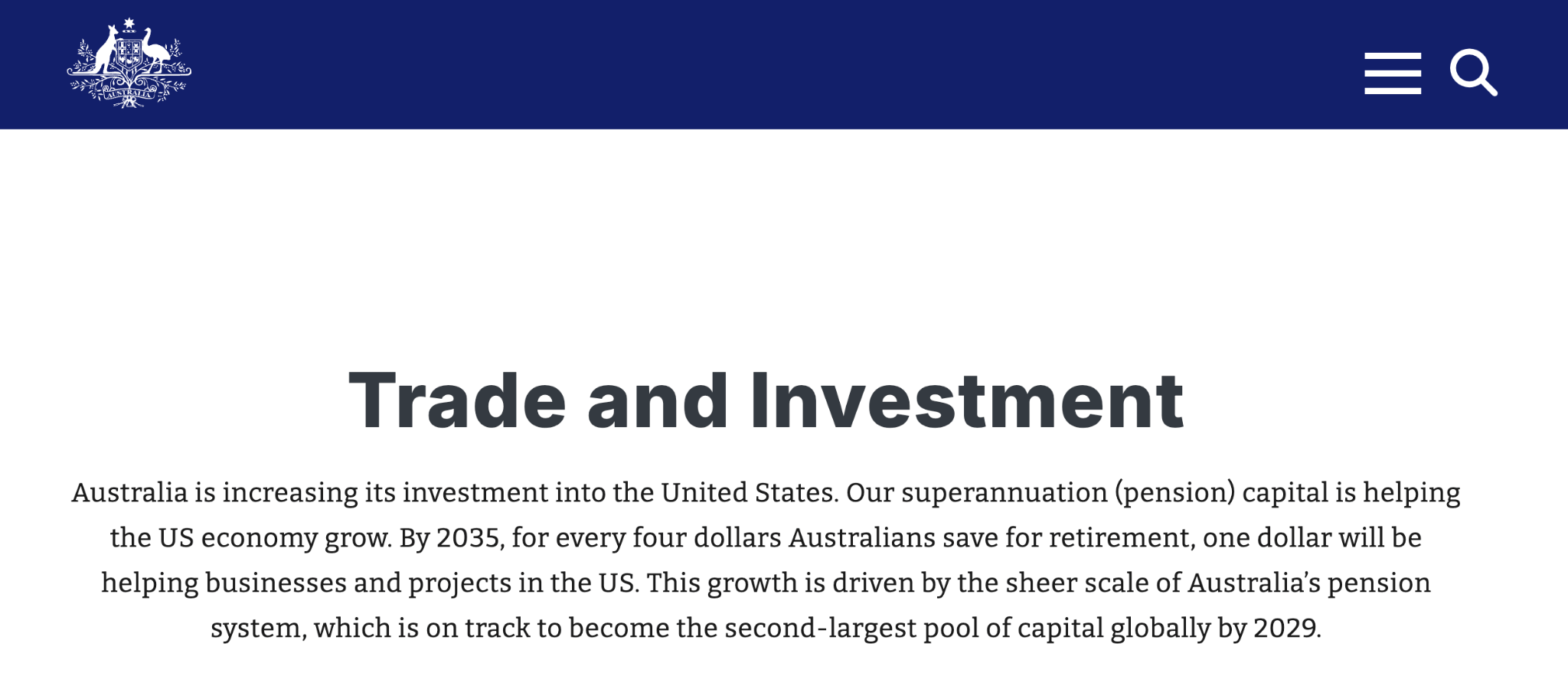
This capital allocation strategy presents three critical sovereign risks:
Economic Vulnerability & Market Exposure: Over-concentration in foreign technology and military-industrial sectors subjects Australian retirement savings to systemic shocks driven by foreign industrial policy, market volatility and overvalued valuation bubbles.
Domestic Opportunity-Cost: Capital exported to support foreign industrial complexes is capital starved from domestic infrastructure, sovereign industrial capacity, the renewable energy transition, and local housing development — initiatives that would build genuine national resilience.
Ethical Compromise: Australian workers’ retirement savings are routinely funnelled into foreign corporations involved in arms manufacturing and military supply chains tied to operations that violate international humanitarian law. Australian retirement savings is in this case tantamount to being global blood money.
3.2 Technological Stack Dependence and AI Vulnerability
Modern national sovereignty is inextricably tied to technological sovereignty. A nation that does not control its digital infrastructure, cloud architecture, data pipelines and core algorithmic platforms operates at the discretion of those who do. American willingness to weaponise its dominance in information technology systems has been ably demonstrated by Farrell and Newman’s 2023 book Underground Empire.
Australia’s reliance on foreign proprietary “technology stacks” — specifically US-dominated cloud systems, enterprise software, and emerging Artificial Intelligence (AI) models — creates deep operational dependencies:
Loss of Digital Autonomy: Key government services, critical infrastructure, and defence systems rely on proprietary architectures subject to foreign jurisdiction, regulatory shifts or export control regimes (such as ITAR and US cloud regulations).
Complicity in Immoral and Unethical Warfare: The rapid deployment of automated foreign AI platforms in military intelligence and target selection directly links Australia to the operational ethics and legal violations of foreign technology developers — including documented strikes causing mass civilian casualties and deaths that directly breach international law.
3.3 Strategic-Military Interoperability and Foreign Basing
The third leg of the trifecta is military operational integration and physical hosting. True defence capability provides a government with options: the choice to deploy, to refrain from deploying, or to pursue alternative diplomatic avenues.
A country that in effect permanently hosts foreign military forces, intelligence infrastructure and strategic bombers on its soil becomes fundamentally compromised. When a middle power’s defence platforms and territory are seamlessly integrated into a foreign superpower’s command structures, maintenance chains and global posture, the formal right to opt out of a conflict becomes a legal fiction. What begins as interoperability leads inexorably and directly to strategic entrapment.
Section 4: Unpacking “uncertainty” and Regional Multipolarity
4.1 Unpacking the “China Threat”: Historic Anxieties, Hegemonic Decline and the Security Dilemma
Official Australian defence and foreign policy documents routinely justify expansive military budgets and deep integration with foreign forces by pointing to a “dangerous and uncertain strategic environment” — a phrase that serves as polite shorthand for a rising China. However, when subjected to rigorous strategic and empirical analysis, the assertion that regional instability is driven by an inherent “China threat” reveals itself to be unsubstantiated conjecture. It is a narrative underpinned by deep-seated historical anxieties, ideological prejudices and a refusal to acknowledge the structural realities of great-power competition.
To construct a clear-headed national security posture, Australia must dismantle three pervasive myths surrounding Chinese military modernisation and American power in Asia.
When commentators highlight China’s military development as evidence of aggressive intent, they deliberately omit crucial context. First, China’s defence expenditure has grown largely in step with its broader economic expansion, consistently hovering around or below 2% of its GDP — a fraction of the GDP percentage spent by the United States. Indeed the U.S. spends more on so-called defence than the next 9 countries combined.
Second, Chinese military planners operate in an environment where their homeland has been surrounded for decades by a network of American military bases, forward-deployed troops, carrier strike groups and missile systems arrayed along China’s immediate maritime periphery.
Beijing’s military modernisation is fundamentally a rational, defensive response to this persistent encirclement. It is designed to establish a sufficient anti-access and area-denial capability to protect its sovereign territory and vital trade routes from foreign coercion.
Beijing’s assessment that the United States poses an immediate and structural danger to its national security is not driven by paranoid ideology, but by an objective reading of the historical record.
As documented in the comprehensive study Dying by the Sword (Duffy Toft and Kushi, 2023), the United States initiated an average of 2.4 military interventions per year between 1946 and 1989. Paradoxically, during the post-Cold War “unipolar moment” — when American national security was at its historical peak — this rate surged to an average of 3.7 military interventions per year between 1990 and 2019. The authors compellingly demonstrate that the United States operates as a nation “addicted to military interventions.” It is therefore a matter of basic strategic prudence that Chinese military planners would modernise their defensive capabilities to deter a superpower with such a well-documented habit of overseas military intervention.
Put plainly, there is no China threat to the Australian mainland other than in the imaginations of those who still harbour Cold War anxieties or seek to continue prosecuting millenarian ambitions premised on the perpetuation of American exceptionalism into a century where it no longer fits.
The primary driver of growing instability in the Asian region is due not to China’s rise per se, but to America’s military and industrial decline. The United States military is no longer capable of comfortably defending its forward bases in the Western Pacific against modern precision strike networks. Furthermore, the United States lacks the manufacturing capability, supply chain depth, and access to critical minerals necessary for modern munitions manufacturing to meaningfully recover its position in Asia. The acute limitations of the American arsenal have been clearly demonstrated in recent global conflicts and naval deployments.
Even prominent realpolitik strategists like Elbridge Colby openly concede that the balance of power in Asia is no longer in Washington’s favour. However, Colby’s proposed remedy — demanding that Asian allies dramatically boost defence spending to purchase American-made weapons and intensify militarisation on China’s doorstep — is a recipe for accelerated regional instability.
By pushing allies into aggressive arms accumulation, Washington triggers a classic regional security dilemma. Action provokes reaction; threat posture provokes counter-posture. Far from restoring balance, this approach locks the region into an escalating arms race, increasing the risk of miscalculation and directly compromising the security of middle powers like Australia. All this in a context in which China is the world’s only industrial superpower (Baldwin, 2024).
4.2 The Reality of Multipolarity
The Asia-Pacific, and the world writ large, is rapidly shifting toward a multipolar distribution of power. In this environment, no single state can permanently maintain absolute strategic hegemony without incurring unsustainable costs.
Acknowledging multipolarity is not an act of capitulation; it is an exercise in strategic prudence and mature statecraft. Middle powers that accept multipolarity can position themselves as flexible, mediating actors capable of building cross-cutting and inclusive coalitions to prevent any single power from dominating the region.
Section 5: Activating Middle-Power Agency and Positive Peace
To break out of the current strategic dilemma, Australia must broaden its foreign policy posture. This requires shifting from a reliance on negative peace to an active commitment to positive peace.
Negative Peace refers to the simple absence of direct military violence, maintained through strategic deterrence, military threat postures and rival alliance systems. It is fundamentally fragile, expensive and vulnerable to escalation.
Positive Peace involves building structural conditions, institutions, economic relationships and diplomatic frameworks that address the root causes of conflict and make war less attractive or necessary.
Australia’s current strategic focus is heavily weighted toward negative peace, at best. By reallocating diplomatic, economic and political resources toward positive peace, Australia can help build a new, resilient regional equilibrium.
5.1 Realising ASEAN Centrality in Practice
Australia frequently references “ASEAN Centrality” in its official diplomatic statements, noting its status as ASEAN’s first Dialogue Partner (established in 1974). However, diplomatic rhetoric must be matched by operational policy.
Many ASEAN member states view exclusive, bloc-based military arrangements like AUKUS with concern, fearing they escalate great-power competition, increase regional militarisation and undermine regional non-alignment mechanisms (such as the Treaty of Amity and Cooperation in Southeast Asia and the Southeast Asian Nuclear-Weapon-Free Zone Treaty).
To meaningfully support ASEAN centrality, Australia must:
Respect Non-Alignment Principles: Recognise that regional neighbours seek to avoid joining competing power blocs.
Prioritise Inclusive Institutions: Engage deeply with broader platforms like the ASEAN Regional Forum (ARF) and the East Asia Summit (EAS), rather than prioritising exclusive minilateral groupings.
Align with International Peace Principles: Re-examine foundational international framework concepts, such as the Bandung Principles (1955) of mutual respect for sovereignty and non-interference, alongside the Principle of Indivisible Security (Helsinki 1975) — the recognition that no state should strengthen its own security at the expense of another’s stability.
Section 6: Recommendations for Strategic Realignment
To expand Australia’s sovereign agency and correct the current imbalances in its strategic posture, this inquiry should consider recommending the following legislative, economic and diplomatic measures:
Recommendation 1: Full Foreign Basing Re-evaluation and Sovereign Capability Audits
Pass legislation requiring all defence platforms and foreign military force posture arrangements to undergo a mandatory Sovereign Freedom of Action and Basing Audit.
Parliament must explicitly re-evaluate the strategic risks of hosting foreign military bases, foreign-controlled intelligence facilities and rotational but in effect permanent forces on Australian soil, enforcing the foundational principle that a state permanently hosting foreign military bases compromises its sovereign independence. Furthermore, before any major military procurement is authorised, the government must verify that Australia can operate, maintain and sustain those assets independently in a crisis, completely free from foreign permission codes or operational vetoes.
Recommendation 2: Superannuation Reform, Opportunity-Cost Tests and the SMSF Pathway
Establish statutory Australian Economic Opportunity-Cost and Ethical Compliance Tests for institutional superannuation capital.
Legislative frameworks must incentivise a strategic pivot away from overweight, speculative US equities and foreign military-industrial complex and ethically questionable high tech assets, directing capital instead into domestic sovereign industry, green technology, regional economic partnerships and infrastructure among other things. Furthermore, superannuation funds must be legally barred from investing in defence contractors or technology firms complicit in human rights violations or illegal acts of war. If industry and retail superannuation funds and parliament fail to address these opportunity costs and ethical violations, Australian workers should be actively encouraged to utilise Self-Managed Super Funds (SMSFs) to reclaim direct democratic and ethical control over their national wealth.
Recommendation 3: Rejection of Immoral Tech Stacks and National Digital Sovereignty
Establish an absolute prohibition against adopting foreign technological platforms, cloud architectures and AI targeting systems tied to unethical military operations, human rights abuses or breaches of international law.
Propping up foreign tech behemoths that undermine national sovereignty and breach international standards represents a surrender of sovereign agency. Australia must enact a National Sovereign Technology Strategy focused on building open-source, sovereign and regionally collaborative digital infrastructure where critical data networks and AI systems remain under strict Australian legal jurisdiction and moral oversight.
Recommendation 4: Active Diplomatic Leadership for Inclusive Multipolar Peace
Go far beyond routine budget reallocations to actively deploy Australian diplomatic capability in constructing an inclusive, multipolar regional security architecture.
Diplomacy must not be treated as passive representation, but as the active construction of a positive peace. Australia must work directly alongside all countries of the Asia Pacific, and particularly ASEAN, to lead multilateral initiatives grounded in indivisible security, non-alignment, economic integration, climate resilience and collegiate dispute resolution — ensuring regional stability is built on shared regional interests rather than great-power hegemony. The focus should be on promoting an architecture that is designed from the foundations to enable positive multipolar peace.
Conclusion
The inquiry into AUKUS presents an opportunity for Australia to reflect on its strategic direction and define the fundamental character of a nation. The core issue facing the country is not merely the choice of a specific defence platform, but whether Australia will define its future through a narrow lens of external dependency or step forward as an autonomous, constructive middle power in the Asia-Pacific.
By confronting historical anxieties, addressing the structural risks of financial, technological and military dependency, and actively committing to a regional security model based on inclusive positive peace, Australia can expand its sovereign agency envelope. In doing so, it will prove that middle-power autonomy is not a “dead end,” but an essential contribution to a stable, peaceful and multipolar world.
Does the Australian political class have the wherewithal to prove Elbridge Colby wrong, or will we allow a foreign power — with a history of being addicted to military interventions — to lead Australia down the Primrose Path to war?
The question is whether we become a contributor to a multipolar positive peace or recede into permanent dependency.
References
Below are links to some of my writings that substantiate the arguments advanced in the submission.
How the United States built the world’s biggest military machine | Pearls and Irritations
America’s displacement anxiety and the decade of living dangerously | Pearls and Irritations
Third party references:
Richard Baldwin (2024) China is the world’s sole manufacturing superpower.
Henry Farrell and Abraham Newman (2023) Underground Empire: How American Weaponised the World Economy.
Allan Gyngell (2021) Fear of Abandonment: Australia in the World Since 1942.
Monica Duffy Toft and Siditha Kushi (2023) Dying the Sword: The Militisation of US Foreign Policy.
David Walker (1999) The Anxious Nation: Australia & the Rise of Asia 1850-1939.
Thank you, Prof. Powell! This is an excellent presentation, covering all important points. Except for the third alignment going on, that being Australia being captured also as a vassal of Israel. But that is a sub-set of UK alignment. But that’s a minor point. The big question is - does Australia really want to be yet another base surrounding China, for America’s final Great Bargain war? The thing holding back “middle powers” is that they don’t have the backbone to unite as a middle-power bloc to hold their place in the world. The principle of "indivisible security" has been corrected by replacing the term with "collective security." This entails mutual respect and commitment to dialogue over any irritants. As for pension funds, money that is not working in YOUR economy is not only abstracted from your economy, it is funding the over-consumption of another economy. Instead of chasing returns, fund managers must keep their funds working in their own economy. People complain that China has too much savings. If those savings are stuffed in the mattress, yes, they are removed from the economy. If the savings are bank deposits, they are then working in the economy. Likewise, if pension funds have left the country, they have been removed from the economy. What replaces that void? These funds are essentially the profit of the nation, so if removed, there is a void somewhere. If the funds don’t receive the desired return invested in Australia, they are at least part of the nation’s balance sheet as an asset, so the government as a monetary sovereign can always make up the pension payments. The U.S. continues to stand as the World’s Policeman by sapping the savings from all other nations. Stop funding them!
This is a substantial intellectual contribution to building peace in and for Australia in its community of nations. The recent visit of the Vietnamese head of state would have been an opportunity to consolidate diplomatic ground, and test a template for relations with ASEAN and the Pacific. I am wondering though what actually happened. Certainly better than providing troops to storm the beaches of Phillipines in a show of military strength (as depicted in Foreign Correspondent recently) .