

The Pacific Islands Forum Leaders Meeting will be held this week. There, Australian officials, are confident of securing a ‘region-wide’ policing agreement, possibly arranged via some form of regional body akin to EUROPOL and AMERIPOL. Efforts by Australia (with the support of its principal western sponsor, the United States) to ‘rope in the Pacific’ have taken place against a backdrop in which these powers have, over the past 24 months, reacted with increasing alarm at Chinese policing cooperation with a number of South Pacific Island nations.
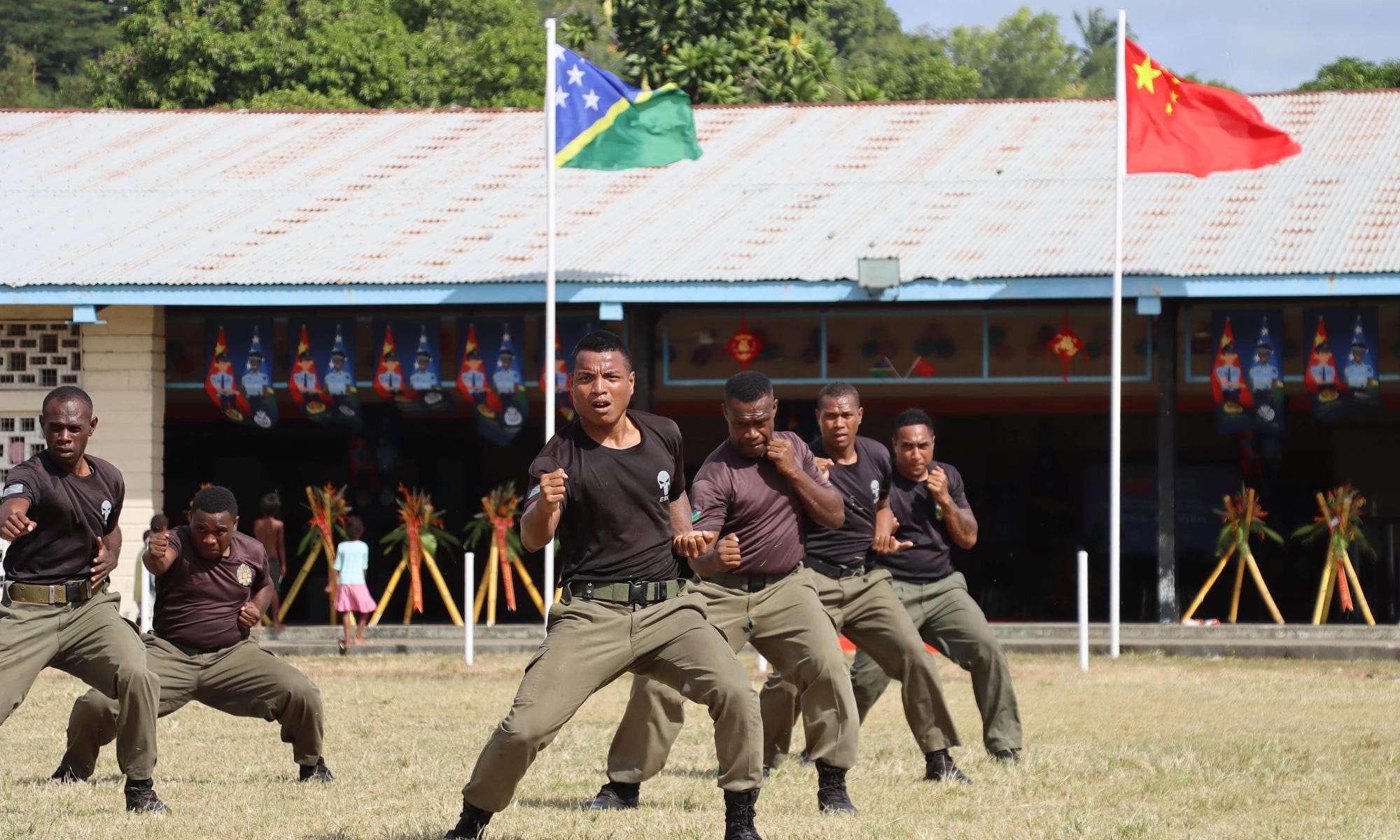
China’s involvement in policing matters in the South Pacific has been growing for the past decade, in part as a reaction to the extensive corruption and malpractices that have hampered regional policing previously. Fiji has a longstanding MOU with China, entered into in 2011, under which Fijian police are trained in China. While Fiji recently removed Chinese police from the Islands, the administration came short of rescinding the agreement after a 12 month review. Kiribati has a policing agreement with China, though there are few details available. China has recently deployed police to Kiribati, which has sparked opprobrium from the US and the ire of Australia. The Solomon Islands and China inked a security pact in April 2022. Papua New Guinea has begun talks with China about possible policing and security agreements, in the shadow of recent deadly riots. China has offered to provide “police assistance” to Tonga ahead of the Pacific Island leaders summit in Nuku'alofa in August 2024. China’s reassurances about its policing intentions in the Pacific have fallen on deaf-ears amongst the western allies.
All of these actions have drawn consternation and raised alarm in Australia, New Zealand and the United States, fearful that such agreements and initiatives would open the door to China’s quest for increased influence in the Pacific. The US has warned South Pacific Islanders not to accept offers of Chinese policing assistance. The White House has locked in the extension of the Compact of Free Association with its Northern Pacific Island states in December 2023. The US aims to increase its diplomatic presence in the South Pacific, and has opened embassies in Tonga, Solomon Islands and Samoa, with plans to open one in Vanuatu in 2024. New embassies on Cook Islands and Niue were also opened in 2023. Australia also moved to reassert a paternal posture in relation to what is euphemistically called the “Pacific Island Family”.
The Australian Minister for Pacific Island Affairs, Pat Conroy, has gone so far as to say that there should be “no role” for China in policing matters in the Pacific. The apoplectic reaction from the Western allies has been telling, evoking a sense of strategic alarm, perhaps even panic, against a history of languid insouciance towards the nations and peoples of the Pacific. Making sense of this panic requires an exploration of the historic configuration of the Pacific and the attitude and posture adopted towards it by the Western powers in the aftermath of the second world war in particular.
To the Victor, the Spoils
America’s Lake
The Pacific was described as America’s Lake in the years immediately following the Second World War (WW2). The United States had extended the Monroe Doctrine all across the Northern Pacific Ocean, as it sought to secure dominion over all corners of the globe. Having long ago secured a foothold by way of the Philippines, the postwar American Empire projected its force through militarised arrangements with client states, subordinated dominions and subimperial allies. Guam and the Commonwealth of the Northern Mariana Islands (CNMI) are US-affiliates. The Republic of the Marshall Islands, the Federated States of Micronesia and the Republic of Palau are technically independent though also fall under the broad remit of US political supervision via the Compact of Free Association. Under the Compact, the island nations’ citizens have the right to live and work in the US, and where the US provides financial assistance in exchange for the US operating military bases on the islands.
The nature of sovereign independence is, in the case of small developing nations, invariably mediated through a post-colonial lens in which questions of aid, trade, security and preferential employment and migration arrangements with former colonial or contemporary imperial powers, are common. Kerryn Baker suggests that this opens up a question for a ‘third’ configuration between sovereignty and territory. This isn’t necessarily a good thing, as Baker makes clear.
The US has, through its agreements with small Pacific Island nations, been able to build up and project its military power over the decades since the end of WW2. The bases on these islands provide the logistics foundations for projection of maritime power into the so-called ‘first ocean chain’, which stretches from Japan in the north, via Taiwan Island and through to the Philippines. The island chain is seen as a significant geographic feature that defines effective combat zones, for both the US and the US’ perceptions of Chinese military planning.
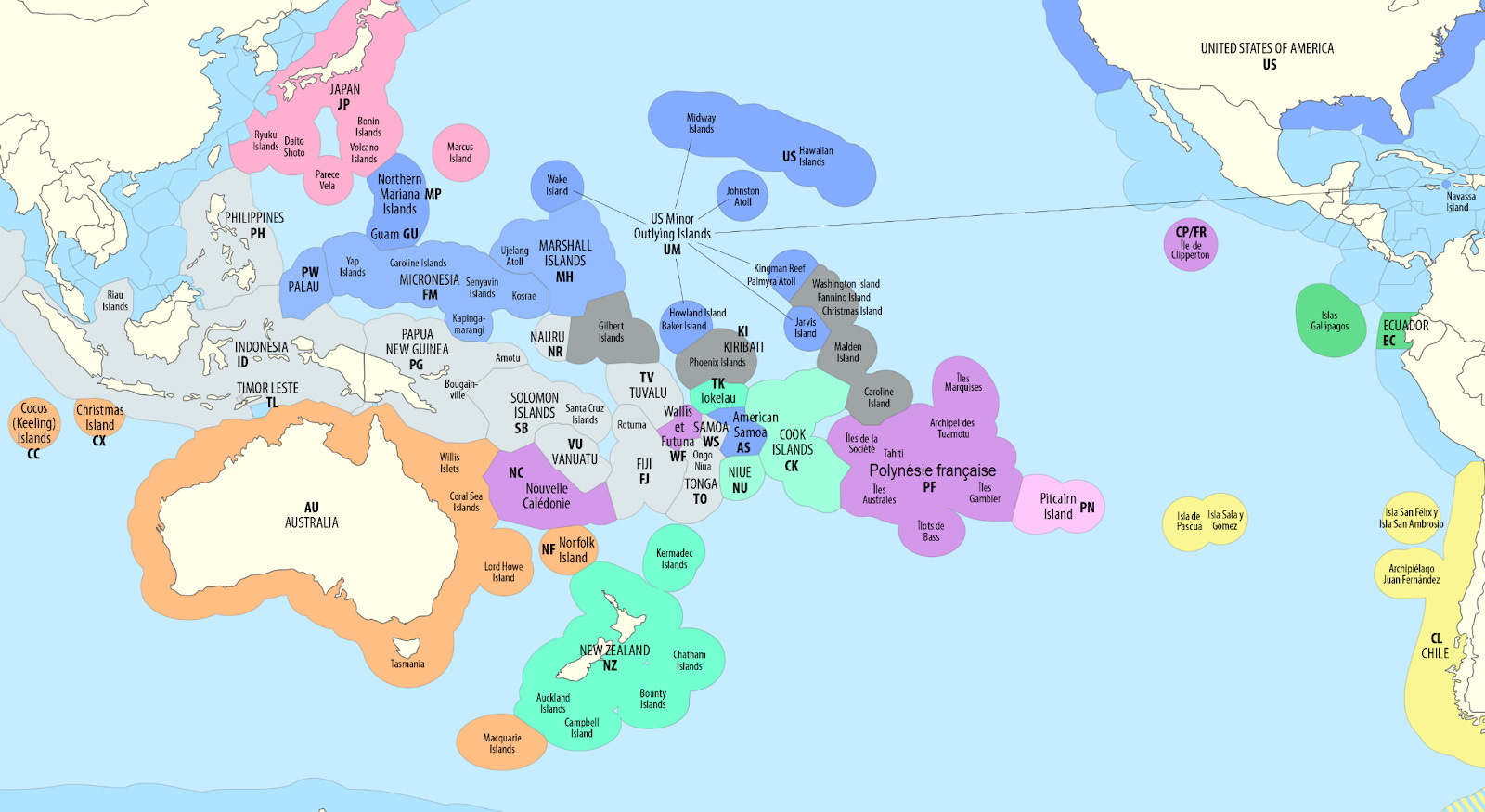
A lawful footprint over vast swaths of the Pacific Ocean, by way of each nation’s Exclusive Economic Zones (under UNCLOS), is also a major piece in the overall security configurations. As shown in the map below, the blue areas are the EEZs of America’s associated states, conferring upon the US a significant economic footprint if nothing else, in the North Pacific Ocean.
As a reminder of the colonial subjugation, the US and its allies have been running naval exercises across the Pacific since 1971, despite local population hostility to these RIMPAC exercises.
Map: Exclusive Economic Zones, Pacific Ocean
Languid Insouciance
While the US had direct and active supervisorial interests in the Northern Pacific, the independent island states of the South Pacific Ocean were in some respects left to Australia and New Zealand to manage and ‘keep and eye on’.
Aside from ‘keeping an eye on things’, there was rarely a need to do too much else. The development aspirations of the island-nations of the Pacific were addressed via periodic token gestures, but much of the heavy-lifting of day-to-day diplomatic graft was outsourced to the Australians and New Zealanders. And frankly, Australia - and the collective west in the region - has been a chronic under-achiever when it comes to engagement and support of Pacific Island development aspirations and critical issues of concern such as climate change. I call this a case of languid insouciance.
Few dispute the claim that the developed nations, and the nearby western powers in particular, have been neglectful of the development needs of the Pacific Islands. That Australia in particular has, in recent years, reacted with a sense of panicked urgency with announcements in increased aid funding and the like, suggests that the criticism has stung. Leaked documents from Tonga’s Ministry of Foreign Affairs show that Tonga was very critical of how Australia and New Zealand (ANZ) responded to the security agreement entered into between China and Solomon Islands. The criticism raised concerns about both the tone and substance of the ANZ reactions, explicitly observing that ANZ’s claim that only they “can decided which countries Pacific states should align themselves with … clearly shows they remain far removed from Pacific reality and only echoes the condescending rhetoric we, unfortunately, see too often from ANZ leadership”.
In any case, the current Australian government has been provoked into action, declaring that they have heard the message that Pacific Island nations want substantive action on climate change and sustainable economic development assistance. Sections of the mainstream media have also argued that sustained Australian neglect of the Pacific has left the door ajar for China, no doubt crystallising political sensitivity to the issues.
That said, some have argued that the panicked reaction is not warranted. The argument is that Australia’s relationship with the Pacific is longstanding and can withstand short term fluctuations. Either way, in proportionate terms, Chinese financial contributions to the nations of the Pacific remain modest compared to the aid provided by Australia. What seems to have ‘set the cat amongst the pigeons’, so to say, are agreements on policing collaboration. Collaboration on policing is seen to be encroaching on questions of security and political alignment of governments. The concern is exemplified by the following remarks from the Australian Strategic Policy Institute, a ‘China hawk’ think tank, which seeks to explain why Chinese involvement in Pacific Island nation policing is a problem:
If Chinese police are in a country, Chinese expatriates are more easily controlled and groups favoured by China can act with greater freedom. Also, the local population can be surveilled, and the policing emphasis turns away from the community and towards protecting the leadership. (emphasis added)
It would seem that ASPI is particularly sensitive to questions of regime stability.
Why does the Pacific matter?
For the western allies, the core function of the Pacific Islands is the role they play in a military strategy aimed at containing China. Historic insouciance strongly suggests that other priorities, such as local economic development, are subordinate to security imperatives of America’s Lake. (Aside from military dimensions, the Pacific was - unsurprisingly - an extension of the economic network that defined colonialism, in which the islands and the oceans were harvested to the benefit of the western powers.)
China can already hop the first island chain. The scramble to consolidate mini-laterals with Australia (AUKUS and QUAD) and Japan and Philippines reflects a strategic alarm and ‘catch up’. That China has gone ‘in behind’, via the backdoor so to speak, is seen as a major threat to security and stability. Destabilisation of erstwhile unfriendly regimes was refined as a cornerstone of American foreign policy. Its concomitant was the need to ward off unwanted interference and secure its dominions, politically. The great expanses of the Pacific Ocean were policed through a combination of America’s naval prowess and increasingly its dominance over space from which it could via satellites surveil the oceans below. It is ironic that the US is now experiencing the kind of destabilisation risks (perceived or real) that it has mastered at conjuring over the decades via its various regime change and coup d'etat operations.
Is China just ‘playing with the Americans’ mind?’ It is certainly showing that ‘two can play the game’. Meanwhile, Pacific Island nations can - for the first time ever - effectively hedge, and secure the attention that they believe is owed to them and their communities. If collective west apoplexia is the epiphenomenal reflection of Chinese activism in the Pacific, then at the very least, it is forcing the colonial and empiric powers to show that they care. The risk is that the prevailing neocolonial entrenchment will only be consolidated, as the western powers mobilise Chinese Threat discourse and fears of imminent Chinese aggression to further restrict the political futures available to indigenous peoples living under U.S. military occupation.
Pacific Island nations are again confronted with the spectre of colonialism, as the western powers react to China’s growing interest and involvement in the region.