

Preface: The U.S. dollar’s global reserve status is a focus of much debate and attention. One dimension of this revolves around the role of the dollar’s status in America’s supposed deindustrialisation or industrial hollowing out. I’m sceptical that so much explanatory weight can be placed on the shoulders of the exchange rate mechanism occasioned by the dollar’s reserve status. This essay examines the issues, and suggests not only that the exchange rate channel cannot sustain the burden demanded of it for the “reserve currency” argument to hold, but that there are other more plausible explanations for the changes in American manufacturing; and these go to domestic dynamics of profit rate squeeze and the exit of capital from the circuits of industrial reproduction to the circuits of valorisation via finance itself.
This essay is not only part of an ongoing reflection on economic systems and transformations, but also kicks off a new short series specifically around questions of how issues of “decline” and de-industrialisation” have been framed in western discourse in particular. In it, I will explore how we went from a time when the Rentier was being lined up to be euthanised in the 1920s, to the lionisation of “shareholder value” in the 1990s onwards. The next part of the series — presently a work in progress — is at least 6 weeks away!!
In recent weeks, comments made by JD Vance at an event a few years ago arguing that the US dollar’s status as the world’s primary reserve currency was in effect a subsidy to American consumers and a tax on American producers have reappeared on social media. Vance’s proposition is that the resulting overvaluation of the dollar has hollowed out America’s industrial base. This basic argument and variants on the theme actually resonate across a diverse cross-section of commentary. Some argue that the dollar’s reserve status functions as a structural force that compels the US to absorb excess global savings. In doing so, a persistent current account deficit is produced which is associated with the relocation of manufacturing capacity. Others have taken a longer historical view arguing that an overvalued dollar has caused the long-term deindustrialisation of the US, reflecting a pattern that has cursed successive capitalist empires. Whatever the variant of the argument, the exchange rate channel is afforded a decisive causal role; it carries the explanatory burden. In short, relative prices, transmitted through the real exchange rate, are the determinants of the spatial redistribution of industrial productive capacity globally.
The claim is alluring, but there are, I suggest, plenty of reasons to be sceptical that the causal or explanatory burden can be sustained. In this exploratory and expositional essay, I also venture to argue that there are other more compelling explanations for the relative decline of American manufacturing. Indeed, the empirical record and deeper theoretical considerations suggest that the exchange rate-deindustrialisation mechanism – upon which the reserve status argument sits – is open to serious doubt. Furthermore, if deindustrialisation was caused by an overvalued dollar, then ipso facto, one would expect that industrial rejuvenation would follow from a devalued dollar. But, as I will discuss towards the close of this essay, that line of thinking doesn’t necessarily follow. A weaker dollar under existing hollowed-out conditions may actually reinforce capacity degradation and loss rather than reverse it.

History and Empirics
Let’s start with the empirical baseline. Here, we are interested in employment and production output evidence, both in absolute terms as well as in relative terms. In relative terms we consider both time series data and proportion contribution to the overall economy. When we do this, we actually see a picture in which manufacturing output continued to grow in absolute terms, while its relative contribution to GDP declined over time; and in parallel, employment numbers in absolute terms grew (until 1979) before falling though relative decline, as a contribution to total employment, was evident from about 1953 onwards. Depending on the aspect one looks at, one either argues that American manufacturing has flourished on the back of increased productivity (more output / worker over time) or has declined. This, in part, explains the presence of an ongoing debate about whether American manufacturing is in as “big a hole” as the de-industrialisation thesis suggests. I’ve actually touched on this issue before, suggesting that part of the problem isn’t so much that America doesn’t make things any more, it’s that it doesn’t make many of the things that people experience in their day to day lives. In this sense, while America continues to be a manufacturer of many advanced high tech products, contributing ~17% to global manufacturing value-added, it has hollowed out its capacity in more “run of the mill” everyday capabilities, and many upstream and intermediate areas.
Employment
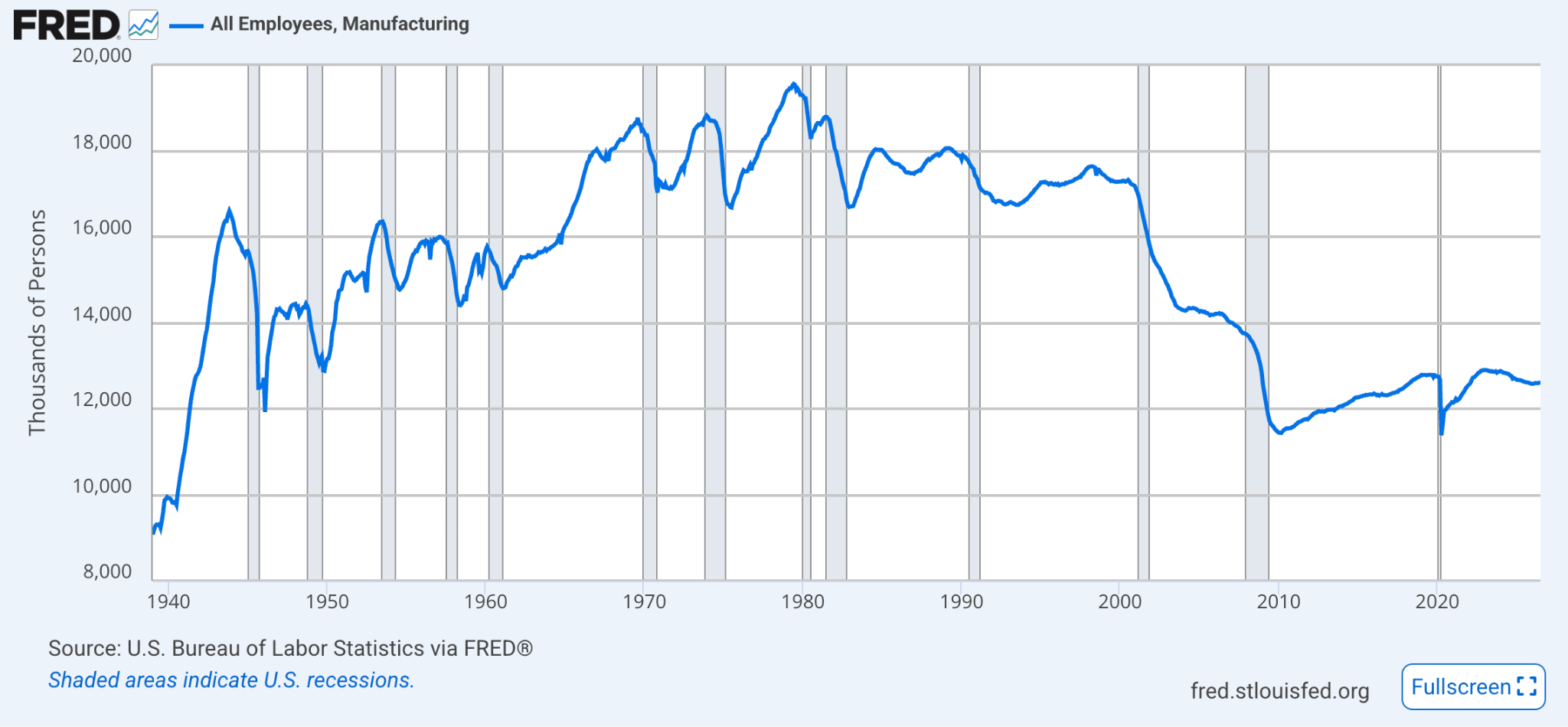
Between August 1945 and August 1971 (when Nixon announced the suspension of the gold-peg), manufacturing employment grew from 14,201,000 to 17,115,000. Over the subsequent 8 years, to August 1979 – the peak of absolute employment in manufacturing in the U.S. – sector employment grew 2,291,000 to 19,406,000. Indeed, during the 34 year period from the end of the second world war to the peak of manufacturing employment, sector employment grew in absolute terms by 5,205,000 or 36.7%.
Despite absolute employment growth, we also know that manufacturing’s relative share of employment in the US began to decline in the early 1950s. Manufacturing’s share of total nonfarm jobs hit an all-time high of 32% in May 1953. The percentage of workers in manufacturing began a slow, steady decline, falling to 25.1% in 1970 and roughly 21% in 1980. The declining share in total employment accelerated from the early 1980s onwards to about 7.7% today. By the late 1970s and early 1980s, we began to see a growing chorus of voices raising concerns about the decline of American manufacturing (see for example, Magaziner and Reich, 1982, Minding America’s Business).
Figure 1: All Employees, Manufacturing
Production
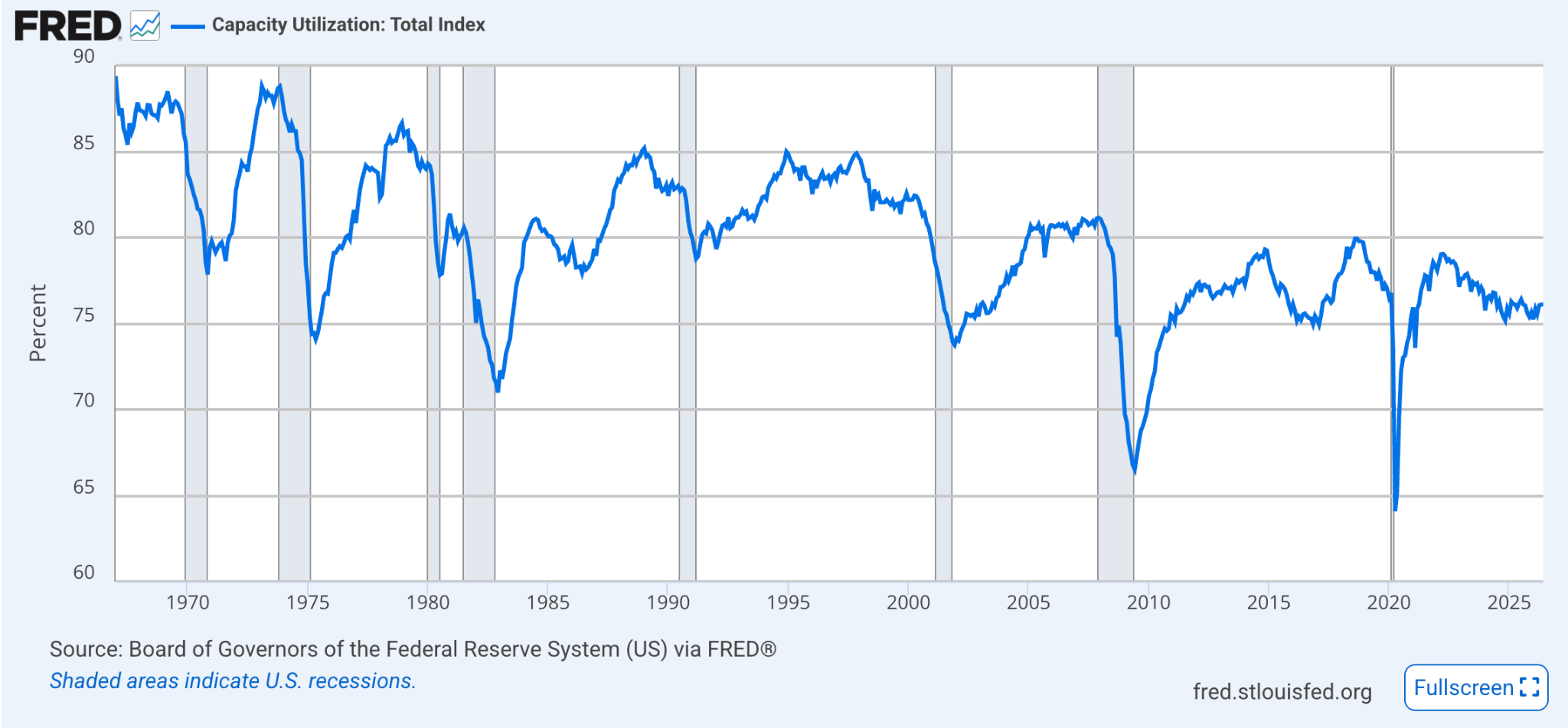
In output terms, American manufacturing experienced sustained expansion during the post-war years through to the late 2000s, after which, output has tended to plateau (Figures 2 and 3). Rates of output growth per worker and overall (Figures 4 and 5) have fluctuated year to year, often fluctuating wildly from +10% to -10% in the years after the second world war. Capacity utilisation also fluctuated significantly (Figure 7), as one would therefore expect, though it is clear that capacity utilisation has experienced a secular decline from the early 1970s through to now. Despite output growth, manufacturing’s value added as a share of GDP has steadily declined from ~13% in 2005 to a little less than 9.5% by 2026 – as other sectors’ contributions increased (Figure 6).
Figure 2: Industrial Production, Total Index
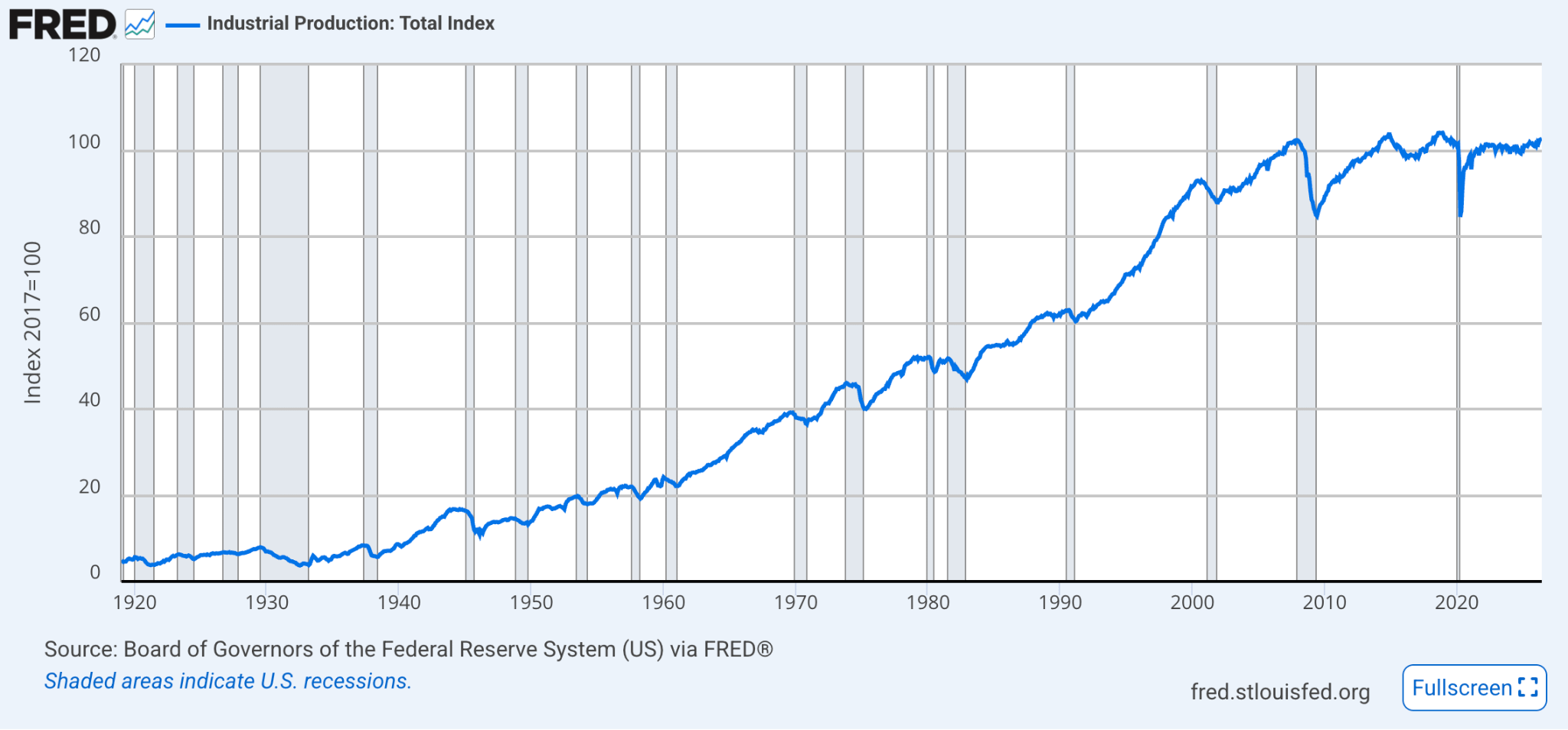
Figure 3: Industrial Production, Manufacturing (NAICS)
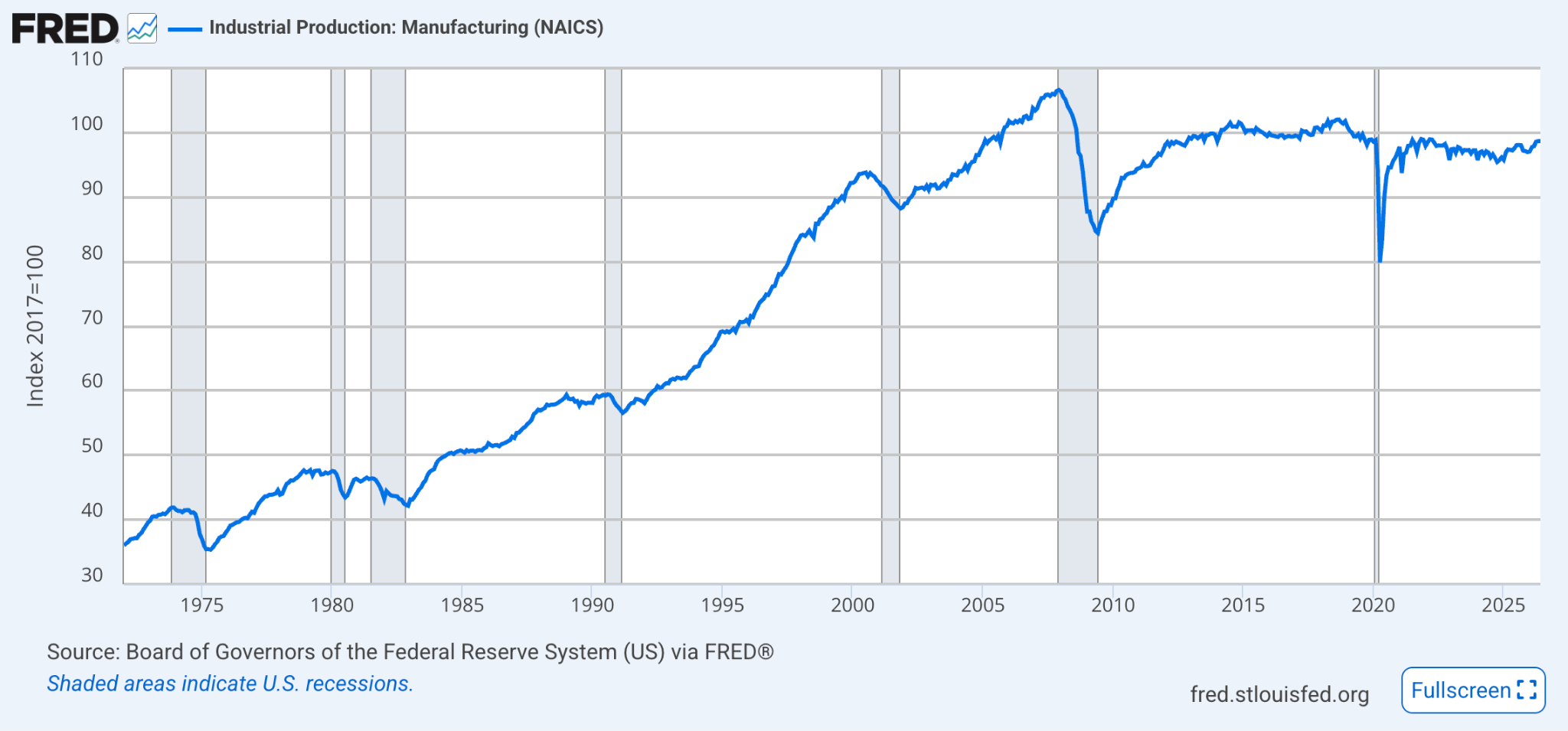
Figure 4: Manufacturing Sector: Real Sectoral Output for All Workers
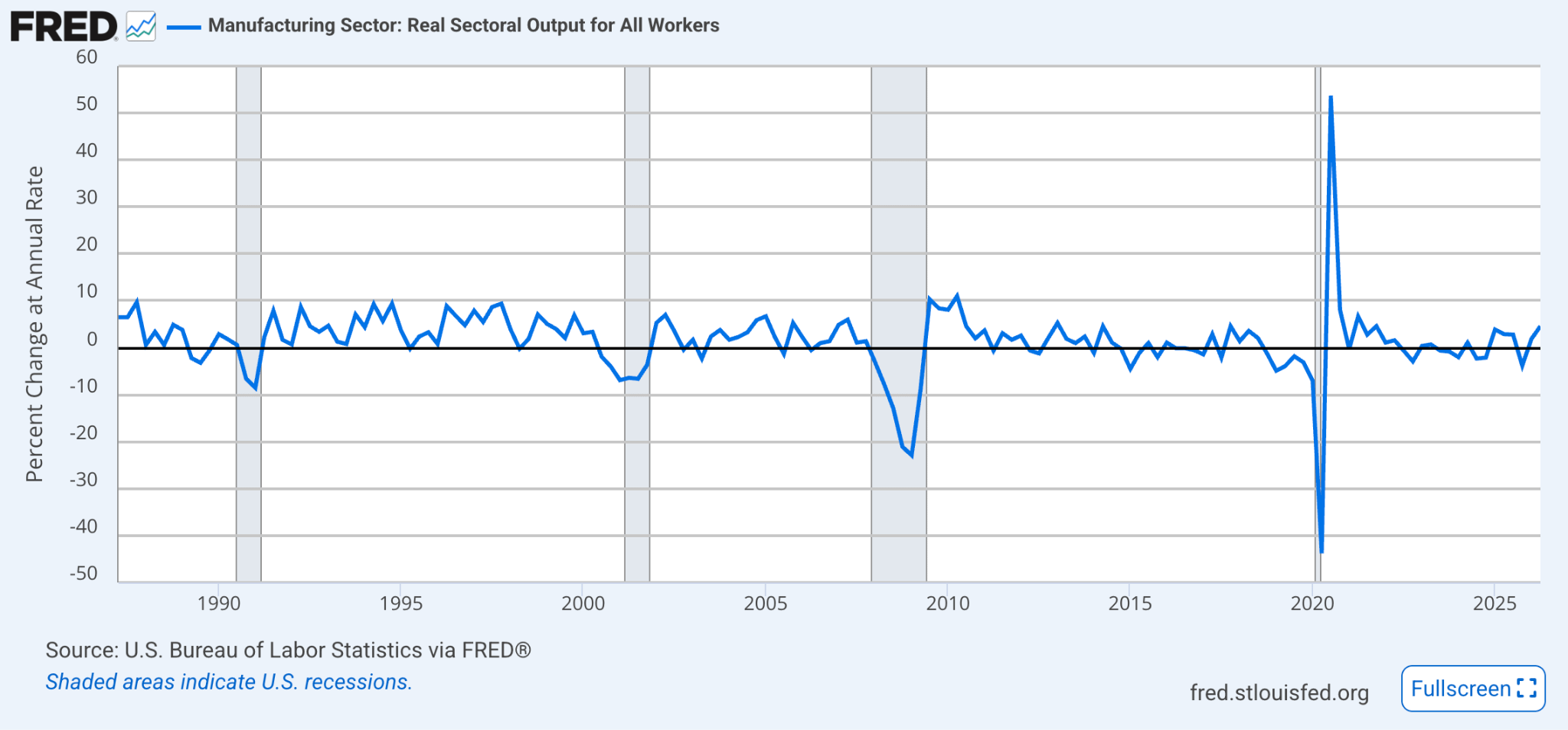
Figure 5: Production: Manufacturing: Total Manufacturing for United States
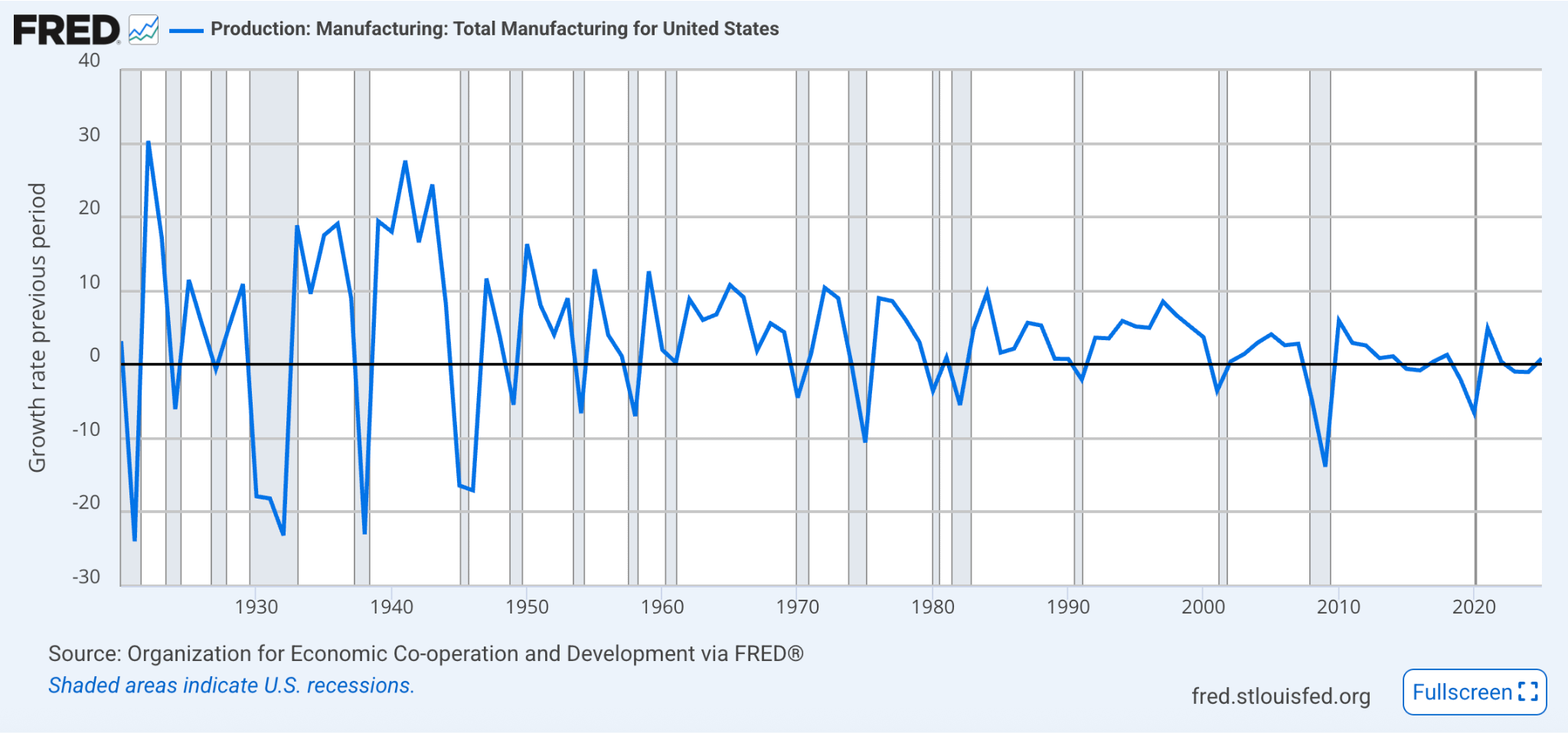
Figure 6: Value Added by Industry: Manufacturing as a Percentage of GDP
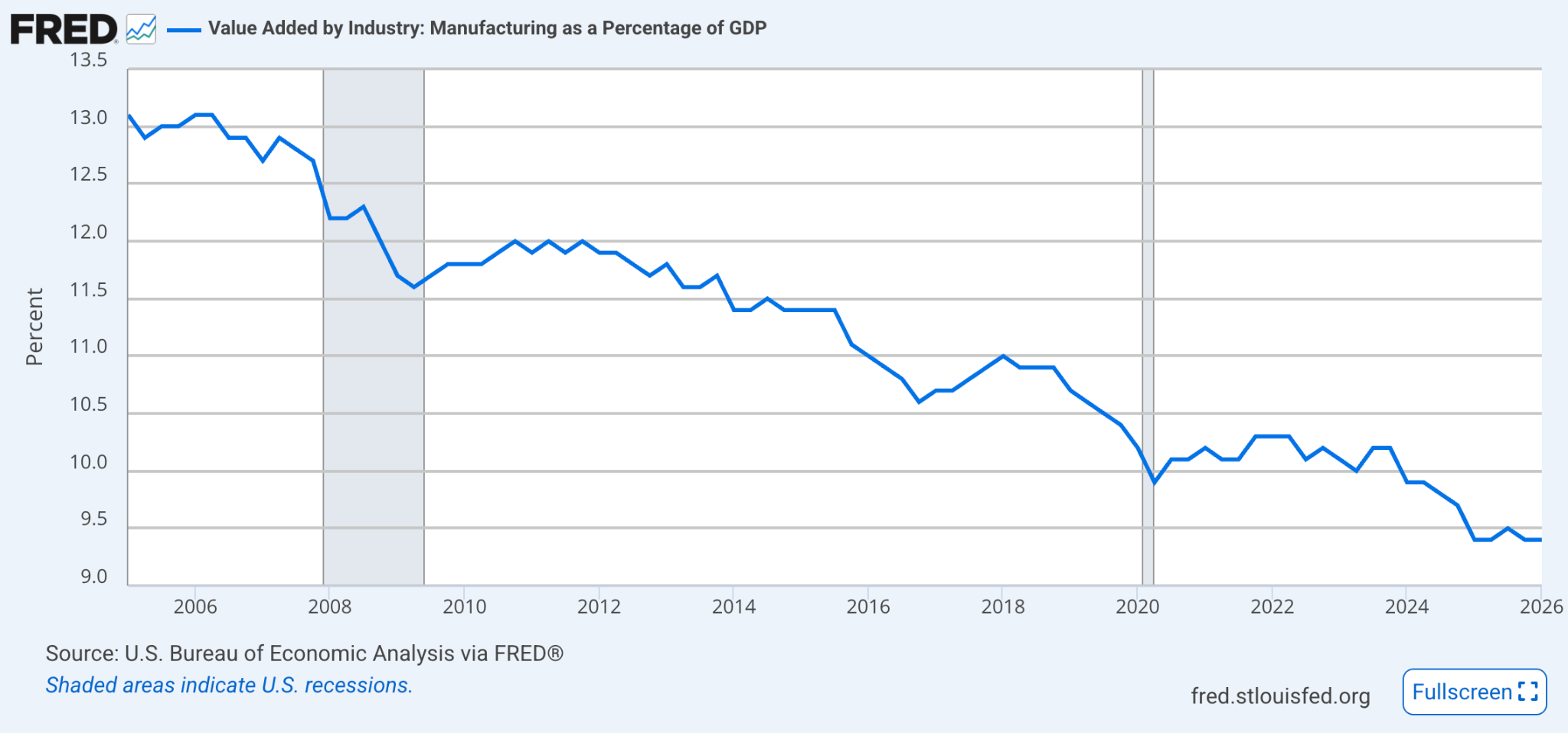
Figure 7: Capacity Utilisation: Total Index
Balance of Payments
A key part of the exchange rate-deindustrialisation argument is premised on the claim that a strong dollar hastened industrial decline evidenced by a growing trade deficit. The available evidence shows that for roughly two decades after the end of world war two, the U.S. ran persistent current account and merchandise trade surpluses while at the same time supplying the world’s primary reserve currency (Figure 8). Indeed, until the early 1980s, the U.S. ran a current account surplus as a percentage of GDP before experiencing a secular drift into persistent deficits (Figure 9). It wasn’t until the early 1980s that we began to witness a turn to persistent current account deficits, which after a truncated turn to the positive side of the ledger during the recession of 1991, has seen a persistent and largely widening deficit. Ironically, manufacturing output actually rose from the 1980s onwards, as discussed earlier.
Figure 8: Balance on Current Account, NIPA’s
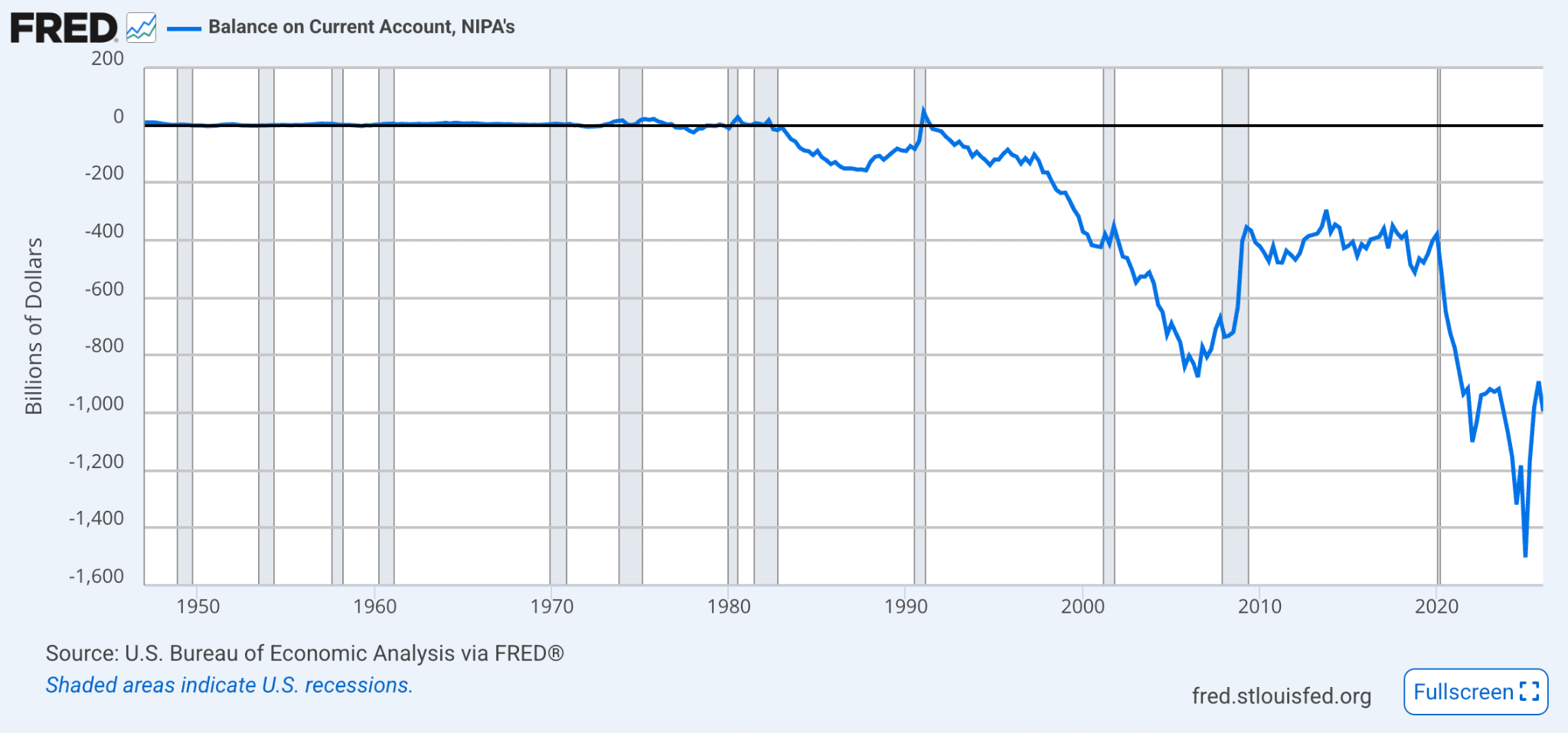
Figure 9: Balance of Payments: Current Account: Balance (Revenue Minus Expenditure) for United States
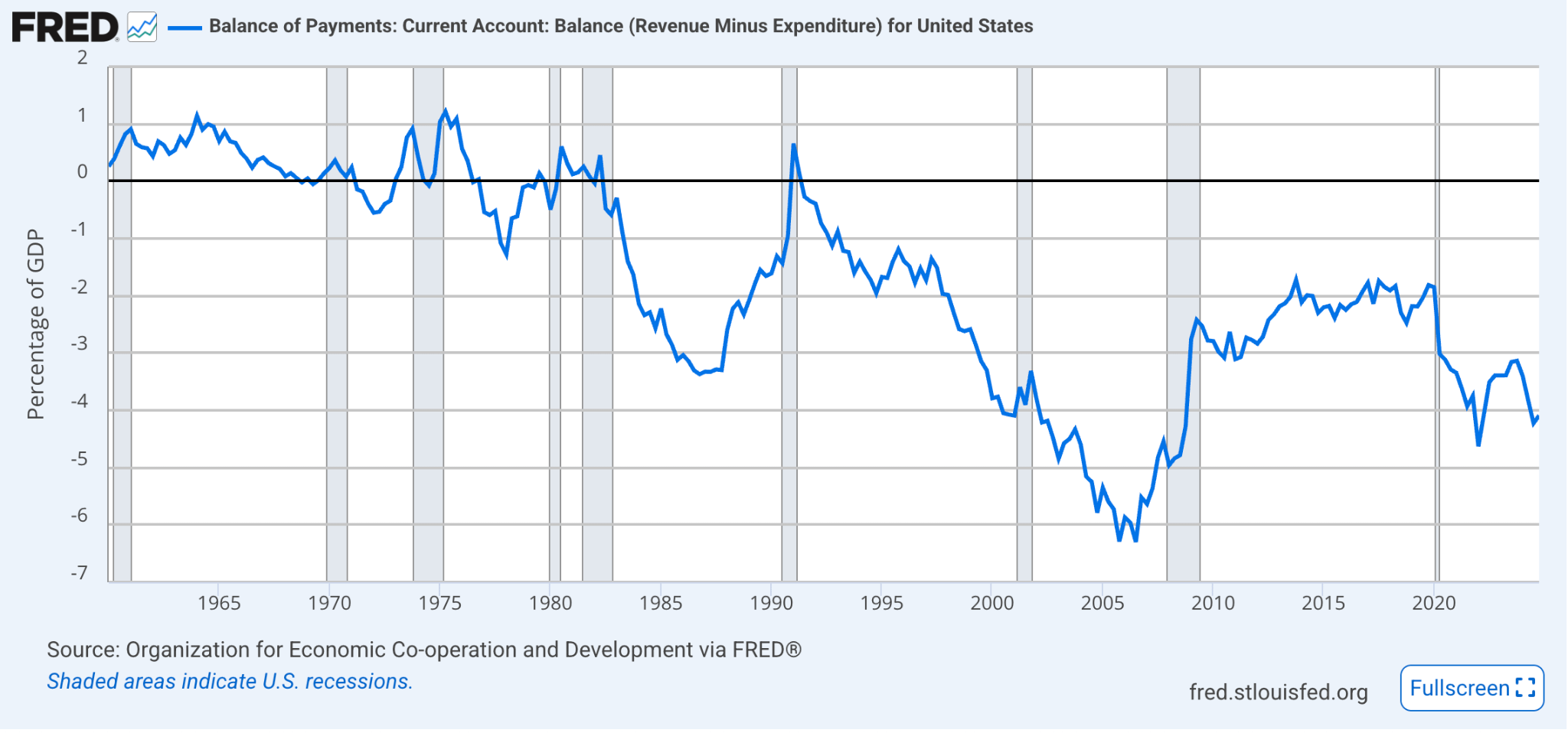
The empirics on employment, output and balance of payments suggest that prima facie the dollar’s function as a principal global reserve currency played a limited role in the dynamics up until the mid-to-late 1970s or even into the early 1980s. On this basis, one can be immediately doubtful of the strong claims made about the role of the dollar’s status, ostensibly due to the arrangement agreed at Bretton Woods in 1946, and de-industrialisation. Something else is going on, to which we return at the backend of this essay.
Historicising Keynes
Before we do, however, there is one other thread of argument to address. That goes to a certain interpretation of Keynes’ proposals, which he developed in the early 1940s and advocated in negotiations with the Americans at Bretton Woods, for a post-war global financial order. The negotiations at Bretton Woods ultimately saw the American proposal for a US-dollar anchored system (as opposed to Keynes’ proposal) prevail. Keynes’ proposals are often invoked in support of the reserve currency-overvalued dollar-deindustrialisation thesis, and so deserves a little more scrutiny. The frequent claim is that Keynes’ bancor and Clearing Union proposal was advanced because he foresaw the problems that would ultimately arise from a national currency servicing as global reserve; namely, overvaluation, balance of payments imbalances and the hollowing out of the industrial base of the reserve-issuing nation.
I suggest that this reading imposes a retrospectivity that isn’t warranted. In doing so, this teleological reading projects later concerns, formalised most clearly by Robert Triffin in the late 1950s and early 1960s, back onto the conditions and debates of the 1942-44 period in which Keynes developed and advocated for his proposals.
When Keynes joined the discussions leading up to the Bretton Woods conference, he was under no illusions as to the distribution of production capacity and claims that could be expected after the war. He knew that Britain was a large debtor to the U.S., and that its industrial capacity had been severely depleted due to the war effort and war damage. On the other hand, and by way of contrast, the U.S. was the dominant industrial power and principal creditor. At the end of the war, the U.S. contributed some 50%+ to global GDP and well over 25% of global industrial capacity. Keynes was determined to avoid a repetition of the Versailles settlement, which placed the entire burden of adjustment on the (vanquished) debtor while the (victorious) surplus nations faced no corresponding pressure. For Keynes, this was a disastrous situation, which he argued against at the time of Versailles (see my discussion elsewhere). He had, himself, experienced first hand the effects of deflationary asymmetry of the interwar gold standard, coupled with the competitive devaluations and “hot money” flows that contributed to intensified instabilities in the 1930s. The conditions, described in 1937 by Keynes’ associate Joan Robinson as “beggar thy neighbour” policies, set the backdrop to Keynes’ approach and design of the International Clearing Union.
The Clearing Union proposal aimed to establish a multilateral clearing institution and mechanisms whereby surpluses earned by one country could, under specific circumstances, finance deficits with another. The bancor would function as the neutral (i.e., non-national) unit of account and means of settlement between the central banks of trading nations. He proposed quotas to the volume of trade, so that persistent surplus nations would be pressured / incentivised to expand imports, revalue currencies or otherwise adjust; and that deficit nations would also face certain disciplines but not be forced into contractionary policies that would further hamper, or even destroy, industrial capacity. Keynes’ proposal was for debtors and creditors (deficit and surplus) nations to share adjustment costs.
Within Keynes’ framework, liquidity would be supplied elastically via the clearing mechanism instead of being constrained by the available stock of gold or by the willingness of a single national authority to run deficits. Countries could buy bancor with gold, but not the other way around. Thus, bancor retained a link to gold, though Keynes had hoped that over time gold’s role within the monetary system would diminish. He preferred a neutral international unit of account in part because he understood the privileges and pressures that came with any national currency being used internationally. With these concerns in mind, he was minded to protect Britain’s position. Still, the decisive driver behind Keynes’ thinking was practical. The design he advanced was an international arrangement that could manage an already unbalanced starting position and prevent exacerbating the risk of deflationary asymmetry that had characterised the 1920s and 1930s. He was not, in that sense, arguing a general theory that the use of a national currency as global reserve would, by inherent logic, lead to chronic current-account deficits through persistent overvaluation; nor was he forecasting the specific industrial trajectories that would later be attributed to dollar hegemony.
Indeed, I suggest that Keynes was principally concerned with the USD becoming reserve not because it would inevitably lead to American industrial hollowing out, but quite the opposite; namely that it would entrench American industrial advantage over Britain and render Britain a lame-duck debtor. Keynes’s overriding concern in 1944 was Britain’s position: a large external debtor with depleted industrial capacity facing a United States that combined creditor status with overwhelming productive superiority. He feared that a dollar-centred system would lock in that asymmetry. The reserve role would allow the United States to finance its own adjustments (or avoid them) while Britain and other deficit countries remained under continuous pressure to deflate, restrict imports and / or accept subordinate status. The Clearing Union and bancor were designed to prevent precisely this outcome — by creating a neutral unit, imposing symmetric discipline on surplus and deficit countries alike, and ensuring that liquidity was not dependent on the willingness of a single national authority to run deficits.
I have quickly gone through The Collected Writings of John Maynard Keynes, Volume XXV: Activities 1940–1944: Shaping the Post-War World: The Clearing Union, edited by Donald Moggridge (Macmillan / Cambridge University Press for the Royal Economic Society), which contains successive drafts of the Clearing Union proposal as well as Keynes’ own notes and correspondence. The persistent and consistent theme was the need for symmetric adjustment so that the U.S. — that is, the expected major surplus nation — could not simply accumulate balances while deficit nations, above all the UK, would be compelled into continuous deflation or subordination. From my reading, there was no discussion of risks that the reserve currency status would hollow out American industry. Rather, the entire design was oriented towards protecting the UK’s position, as debtor, against the creditor’s industrial and financial strength.
Robert Skidelsky’s John Maynard Keynes, Volume 3: Fighting for Britain 1937–1946 (Macmillan, 2000) repeatedly emphasises that Keynes’s central political-economic objective was to prevent Britain from being locked into a permanent debtor relationship under a dollar-dominated system. His later essays, such as “Keynes, Global Imbalances, and International Monetary Reform, Today”, make the same point; namely that Keynes expected the U.S. to be the large surplus country, Britain the large debtor and the concern was to make creditor adjustment compulsory. Donald Moggridge, the editor of the Collected Writings, documents the same direction. On his account, Keynes was trying to solve Britain’s postwar payments weakness vis-a-vis American productive and financial power.
There is, so far as I am aware, no evidence that Keynes anticipated, or was primarily worried about, the long-run industrial hollowing-out of the reserve-currency country itself, even if others have since found his proposals amenable to addressing such concerns. His anxiety ran in the opposite direction: that dollar hegemony would entrench American industrial and financial advantage. In short, Keynes’s fear ran toward the entrenchment of American advantage and British subordination, not toward any prospective industrial hollowing-out of the United States.The later narrative that treats bancor as a prophetic warning against the reserve-currency “curse” for the issuer therefore reverses the actual direction of Keynes’s concern.
Subsequent discussions have often read the so-called Triffin dilemma back into Keynes’ proposals. The Triffin dilemma described the tension between providing international liquidity and maintaining confidence in the reserve currency. On this view, Keynes’ plans for the bancor were interpreted as a foresightful antidote to problems that only became fully apparent in the 1950s and 1960s. That, I suggest, is a retrospective reconstruction that a genealogy would reveal to be misplaced. The historically situated Keynes was responding to the circumstances of the mid-1940s in which there was evident unevenness in the distribution of industrial capacity and external claims, the lessons of the failed Versailles treaty and the need to address the risks of symmetric adjustment under conditions in which gold still functioned as anchor. Under these circumstances, elevating the Clearing Union into a prophetic diagnosis of the reserve-currency “curse” overstates both Keynes’s foresight and the causal weight of the monetary channel he is said to have identified.
Theoretical Difficulties: Capital Specificity and Systemic Reproduction
If the historic record of both the trajectory and dynamics of American manufacturing and a historicised understanding of Keynes suggests the exchange rate-reserve currency-deindustrialisation argument is problematic, I wish now to shift register from the historic to the theoretical to consolidate these emerging doubts. The exchange rate-reserve currency-deindustrialisation mechanism presupposes a particular conception of capital and of production. For relative prices to reallocate productive capacity spatially in the way claimed, capital must be treated as essentially homogeneous and mobile. This way, changes in the real exchange rate alters the relative profitability of production in one place over another, and in response, capital leaves the less profitable and flows towards the higher-return location. Labour and other inputs adjust accordingly. Factors of production are assumed to be fungible, as is the case with the mainstream Cobb-Douglas production function. Here, factor proportions vary continuously in response to relative prices. One capital-labour combination can be readily substituted for another without significant loss. In extremis, capital is presumed to be akin to plasticine, capable of being reshaped and reloaded as relative returns dictate.
These presuppositions are rarely stated explicitly. Yet, they are required for the relative price channel to carry the causal burden assigned to it. However, if capital is not fungible and is in fact heterogeneous and specific – that is, if machines, tooling and process knowledge designed for one particular use or set of uses cannot be costlessly redirected to other uses – then a change in relative prices cannot freely reallocate capacity. Even the more limited claim that an overvalued currency renders existing plants unprofitable and accelerates their closure is conditional. It presupposes the presence of competing alternatives, such as imports or foreign production capable of substituting for domestic output. When such alternatives are not available or do not exist, or where existing domestic incumbents retain localised and decisive advantages (be they technological, product quality and market-match, logistics and distribution networks or favourable regulatory environments), currency overvaluation does not ipso facto translate into unprofitability or exit. The relative-price effect requires a viable competing supply to operate with force; that is, without the presence of the “coercive laws of competition,” as Marx would have put it, the effect of relative prices on production location decisions is considerably muted.
The issue about the nature of capital and its implications for how we think about trade is evident when we consider Ricardo’s own discussions and elaborations. In formal terms, Ricardo’s comparative advantage theorem assumes that resources can be, more or less costlessly, reallocated between industries. Yet, fixed capital cannot be redirected costlessly, a point that Ricardo himself understood. His own reflections on fixed versus circulating capital actually contradicts the assumption needed by the simple “gains from trade” story. The same observation also limits the effectiveness of exchange rate adjustments. Again, Ricardo’s discussion about the mobility of capital from province to province, but not across national borders, is telling in this respect. On Ricardo’s arguments, it’s also worth provincialising and demoralising them, like we did with Keynes’ proposals. When Ricardo argued against the Corn Laws and in favour of “free trade,” the reasoning was that with tariffs imposed on imported corn British landlords would be able to garner economic rents, to the disadvantage of Britain’s emerging industrial capitalists. By allowing the free entry of lower cost corn into the British market, national resources could be distributed from landlords to industrial capitalists. For Ricardo, “free trade” at the time when he made the arguments were all about boosting industrial development!
The Cambridge capital controversies of the 1960s reinforce the underlying issue. See here for a summary. Once it is accepted that “capital” is not a homogeneous, malleable quantity whose value is independent of distribution, the smooth responsiveness of the capital stock to changes in relative prices or rates of return disappears. Indeed, the fungibility that lies at the heart of the Cobb-Douglas production function, necessary for the relative price story to work the way it is usually argued, collapses once it confronts the actual nature of production systems themselves.
Here, Piero Sraffa’s 1961 Production of Commodities by Means of Commodities, published in the context of the “capital controversy,” makes one implication precise. Within Sraffa’s frame, prices are the simultaneous solution that enables the reproduction of a given technical structure, at a given capital-labour distribution setup and a uniform rate of profit. He showed that relative prices are not formed independently by interactions of autonomous supply-demand curves, but are a function of systemic input-output relations. The price of one is the cost of another, and so on. Thus, prices are the values that make the production system writ large consistent with its own reproduction. If we extend Sraffa’s logic from a close system to an open economy whose technical coefficients are nested in cross-border supply chains, then the set of national price systems must be mutually compatible with the cross-border flow of intermediates required for the reproduction of the interconnected global production structure as a whole. On this view, therefore, the exchange rate that reconciles various national price vectors is the residual necessary to satisfy the overall consistency conditions of reproduction. They are the values necessary to close the multi-country reproduction system given the existing technical coefficients, the spatial distribution of capabilities and the prevailing distributive variables. They do not stand outside that system as exogenous drivers capable of freely reshaping the location of production.
Distinct from Sraffa, we could examine the issues from the kind of post-Keynesian analysis of exchange rates discussed by John Harvey. On Harvey’s account, exchange rates are largely a function of portfolio capital flows, which are themselves autonomous and dominant. It is these flows that determine exchange rates. Trade in commodities then occurs at that rate. For Harvey, there is nothing inherent in the dynamics of money capital portfolio flow that compel the automatic alignment of capital flows and trade; as such, chronic current account imbalances are normal rather than being perfunctory disequilibrium awaiting correction. On this view, relative currency prices – the exchange rate – are determined by expected relative returns, interest differentials and the psychological and institutional factors that shape forecasts under uncertainty. Trade and production structures must live with the rate those flows produce.
Now, it’s clear that these two perspectives aren’t necessarily consistent with each other. One treats exchange rates as residuals of systemic reproduction while the other treats them as a function of autonomous financial money capital flows. My point in raising them isn’t to present or attempt a synthesis or reconciliation. Rather, the point of these distinct vantage points is to show that there are reasonable arguments that undermine – in their own ways – the dominant claim that exchange rates function as the primary determinant of production location and relocation. Whether exchange rates are residuals of the requirements of multi-country reproduction or are set by autonomous financial flows, they do not operate in the manner presupposed by the reserve-currency thesis.
My last, brief, theoretical comment introduces Pasinetti’s structural economic dynamics, something which I have discussed on previous occasions. (Pasinetti incidentally made a telling contribution in the Cambridge capital controversies when he proved, in a paper published in 1966, that the neoclassical position was logically flawed.) In any case, for Pasinetti, technical change and demand evolution (Engel’s law) continually drives changes in the composition of vertically integrated labour requirements, capital coefficients and inter-industry proportions. The economic system does not simply reallocate a given set of activities or abstracted fungible factors; rather, it continually configures and reconfigures the entire input-output architecture. When that reconfiguration also involves the spatial redistribution of capability — the migration or emergence of entire clusters of complementary activities — the problem exceeds the reach of models that rely primarily on relative-price signals. Nested industrial ecosystems are dense, cumulative structures in which path-dependency dynamics are operative. They exhibit strong increasing returns to density as well as power positive hysteresis effects through learning-by-doing. Once a set of activities and setups (fixed capital) in a certain location or series of locations has crossed a critical threshold of interconnected capability, further investment becomes easier thus creating powerful momentum within a locality, which also acts as a bulwark to relocation. Until that threshold is reached, even large relative-price advantages may be insufficient to trigger self-sustaining industrialisation. Exchange-rate movements operate against this inertia rather than dissolving it.
In sum, once the presuppositions of capital fungibility and costless mobility are disbanded, the centrality of the exchange rate mechanism to industrial location dynamics is dramatically weakened. The extent to which this is the case is now considered as I wrap up this essay with a discussion about the asymmetric risks of devaluation under hollowed-out conditions.
Capital Flows and the Form of Accumulation
Harvey’s emphasis on autonomous capital flows intersects with a deeper transformation in the form of capital accumulation itself. A high dollar is not a one-sided force for capacity destruction. It cheapens imported raw materials, intermediate inputs and capital goods, which can support higher rates of mechanisation and automation for firms that remain. The net effect on the capital stock is therefore ambiguous. What proved decisive was the progressive redirection of American money capital from the production of commodities toward monetary and financial circuits of profit-making — asset inflation, leverage, share buybacks and the extraction of rents from existing claims — in processes that are broadly described as financialisation. Once that orientation became dominant, relative-price signals for comparable activities in different locations mattered less. Capital was no longer primarily seeking the highest real rates of return in expanded productive capacity. Indeed, as Stockhammer and others have shown, in the case of the U.S. in particular, financialisation and industrial hollowing out were two sides of the same coin.
The rate of profit in US manufacturing provides important evidence for understanding the shift away from industrial accumulation. Multiple measures, whether conventional accounting rates, Marxian surplus-value ratios, or profit shares of value added, show a clear and consistent pattern. From the mid-to-late 1950s through to the 1970s, and then into the early 1980s, the elevated profitability in the early postwar decades was followed by a sustained decline, with only a partial recovery thereafter. High-quality historical reconstructions (including those by Duménil and Lévy (also an earlier work here), and related work using BEA and FTC/SEC data) document that the manufacturing profit rate stood at relatively high levels in the late 1940s and early 1950s. It then entered a prolonged downward trend. Depending on the precise definition (pre-tax or post-tax, with or without inventory valuation and capital consumption adjustments, tangible assets only or broader capital measures), the rate often fell by half or more between the mid-1950s / early 1960s peak and the trough around 1982. One representative set of calculations shows the profit rate in manufacturing declining from averages near 25–30% in the 1950s to roughly 15% or lower in the 1970s, with further compression into the early 1980s in several series.
Profit margins (profits per dollar of sales) from the Quarterly Financial Report for Manufacturing Corporations similarly show compression from the early 1950s onward. After-tax profits per dollar of sales were higher in the immediate postwar years and trended lower through the 1960s and 1970s. The profit share of value added in manufacturing also declined over this period, while labour’s share rose. This distributional shift was a proximate driver of the falling rate of profit. Rising real wages, stronger union density in the postwar decades, and intensifying domestic competition among producers contributed to the squeeze. The capital–output ratio (or the inverse productivity of capital) also moved adversely in many reconstructions, amplifying the decline in the rate of profit.
Facing a domestic profit squeeze occasioned by rising labour shares, intensifying competition, manufacturing firms moved first toward greater concentration and centralisation. Larger scale offered potential cost advantages, market power and the capacity to manage subsequent strategies of financialisation and outsourcing. Concentration in other sectors followed later, once the broader shift in the form of accumulation was under way. Long-run evidence on corporate concentration shows that the rise was stronger in manufacturing (and mining) in the decades before the 1970s, while concentration in services, retail and wholesale accelerated more markedly afterward. One recent comprehensive study (Kwon et al., 2024) covering a century of U.S. data finds that the asset and sales shares of the largest firms increased persistently, but the sectoral pattern is clear: manufacturing consolidated earlier. By the late 1960s and into the 1970s the process was already well advanced in industry (Allen, 2016), precisely during and after the period of declining manufacturing profit rates. This pattern is further evidence that relative sectoral “decline” was occasioned not by exchange-rate (dollar reserve status) determined relative prices, but by responses to declining rates of profit.
A profits recovery began after the early 1980s, and it is highly concentrated. According to a recent study, “[a]cross all US firms, nearly 99% of after-tax profits are captured by the top 10%, with the top 1% alone accounting for more than 93%.” The author, Aidan Regan, concludes that “[a]t the extreme apex, the top 0.1% of firms – just one in a thousand – have a gravitational pull over profit flows that dwarfs the rest of corporate America.” Profit rates and shares rose through the 1980s and 1990s, and in some measures continued to improve into the 2000s and beyond. However, the recovery was typically incomplete relative to the early postwar peaks. By the early 2000s the rate often remained well below the levels of the 1950s and mid-1960s. Meanwhile, labour’s share of value added declined and income inequality widened again.
Crucially, the decline was already under way in the 1950s and accelerated through the 1960s, well before the large, persistent current-account deficits of the post-1970s period and before the most intense phase of dollar appreciation in the early 1980s. This timing weakens explanations that assign primary causal weight to exchange-rate overvaluation arising from reserve-currency status. The profitability squeeze was visible while the United States was still running current-account surpluses. The sources of the squeeze were largely domestic: rising labor costs relative to productivity in many sectors, intensifying competition among U.S. producers themselves, and the gradual erosion of the exceptional technological and organisational advantages that American manufacturing had enjoyed immediately after the war. International competition from recovering European and Japanese producers played a growing role from the late 1960s onward, but it layered onto an already declining domestic profitability trajectory.
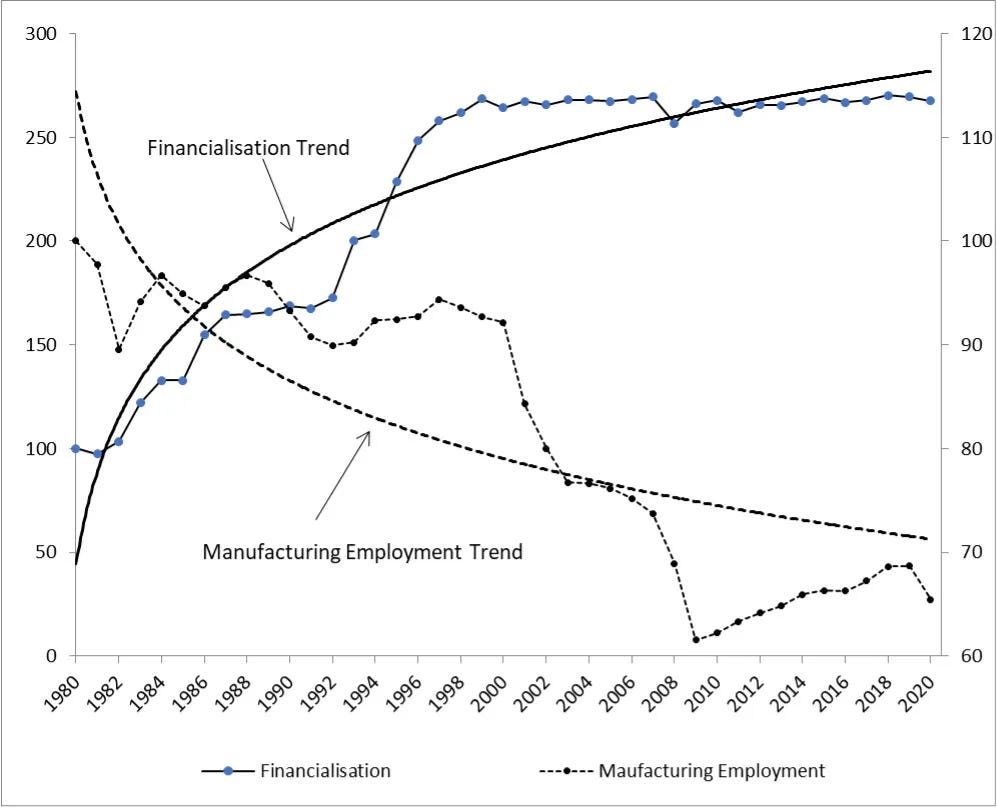
The falling manufacturing profit rate functioned as a powerful “push” factor. When the expected return on expanded industrial capacity declined relative to alternative uses of capital, money capital increasingly sought valorisation outside the productive circuit. This helps explain the subsequent turn toward sector concentration, financial and fictitious capital circuits, the pursuit of regulated rents, and large-scale outsourcing. These shifts were not primarily responses to an overvalued currency; they were responses to the exhaustion of profitable accumulation within the existing industrial structure. The growth of financialisation has been argued by Imad Moosa (2023) to be inversely related to the trajectory of manufacturing employment, as illustrated in Figure 10. See also Hudson (2010) for parallel arguments.
Figure 10: Financialisation and Manufacturing Employment in the US (indices, 1980=100)
In short, the postwar trajectory of the U.S. manufacturing profit rate and patterns of concentration supports an accumulation-centred account of industrial hollowing-out. The relative-price effects of the dollar’s reserve status may have facilitated certain later developments, but they were secondary to a domestic profitability crisis that had already been unfolding for two decades.
In this light the reserve-currency role appears at most as a facilitating condition. It may have made certain forms of offshoring more attractive at the margin, but the decisive shift was the change in the dominant circuit of accumulation. Capacity was run down or not renewed or not expanded because money capital found more profitable outlets outside production, not because exchange-rate arithmetic alone rendered domestic industry unviable. In any case, what we witnessed during the 1980s and 1990s was a progressive expansion in manufacturing output — during a period in which the full effects of the dollar’s reserve status supposedly came into force.
The Asymmetric Risks of Devaluation under Hollowed-Out Conditions
Nothing happens in a vacuum, or on a blank piece of paper. Like Keynes’ experiences in the early 1930s, the specific conditions of industrial capacity distribution are real world constraints or starting points that cannot be presumed away. The practical risks of relying on exchange-rate adjustment become clearer still when the existing structure of production is taken into account. Modern day American manufacturing is heavily import-intensive in intermediates, specialised components, tooling, machinery and critical equipment. Between 1945 and 2025, U.S. imports of machinery, plant and equipment grew from a modest post-WWII baseline into an annual multi-hundred-billion-dollar driver of domestic manufacturing. Machinery imports reached approximately $653 billion by 2025.
A devalued dollar would raise the domestic currency cost of these inputs. Firms would, thus, face higher costs that could be either absorbed via margin compression (with flow-on implications for investment and employment) or passed on via increased prices, eroding real incomes. In either case the initial relative-price impulse from dollar devaluation is diluted or reversed. This does not, therefore, lead to improved trade competitiveness of domestic final goods. Indeed, under already hollowed-out conditions the effect is amplified. Temporary cost shocks could accelerate plant closures, leading to supplier exits and further skill attrition. American manufacturing is facing a skilled worker shortage, exacerbated by many industrial workers reaching retirement age. Reports estimate that up to 2.1 million manufacturing jobs could go unfilled by 2030 due to a shortage of skilled labour. Once those networks thin, the economy’s ability to respond to any subsequent relative-price improvement is permanently impaired; fixed costs of re-entry rise, learning-by-doing is lost and remaining producers operate at higher average cost. Input–output linkages propagate the damage as higher costs in one industry raise costs downstream, so the initial intermediate-price shock is amplified rather than damped. The system settles at a higher cost structure.
Resources may also be drawn toward sectors that can more readily expand exports under a weaker currency, such as agriculture or certain extractive activities. Now, that’s paradoxical, but in countries with natural resources abundance these dynamics are not unforeseeable. These sectors typically have lower density of complementary industrial linkages and weaker contributions to the cumulative process of capability formation. The result can be a further skewing of the productive structure away from the complex, high-linkage manufacturing ecosystems that policy is ostensibly trying to restore. In short, a weaker dollar under present conditions risks reinforcing rather than reversing industrial hollowing-out. Dutch Disease effects occasioned by the rapid build-out of AI-related data centres amplify these dynamics, as costs are pushed up across the board (electricity network infrastructure augmentation, electricity itself and skilled workers), often hampering the viability of enterprises and industry clusters elsewhere. Check out my previous discussions on this set of issues, including this essay.

Conclusion
As we bring this essay to a close, there are two factors to note or to emphasise. First is the fact that the U.S. is actually not heavily trade exposed as a percentage of GDP. The second is that, as noted, competitiveness domestically could lead to factory closures; this is evident in the declining rates of manufacturing profit in the 1950s and particularly into the 1960s and 1970s. Labour’s share of value added grew and the rate of profit declined. This was the “push” factor that saw capital seeking alternative capital accumulation circuits outside of expanded production.These two observations strengthen the accumulation-centred account and further weaken the relative-price story.
First, the limited trade exposure of the U.S. economy. For much of the postwar period, trade (exports plus imports) as a share of GDP has remained modest by international standards. Even at its higher recent levels it is still far below the ratios typical of smaller, more open European or East Asian economies. When the traded-goods sector constitutes a relatively small fraction of total output and employment, the capacity of exchange-rate movements to drive economy-wide structural change is correspondingly limited. Relative-price effects operating on a narrow margin of the economy cannot plausibly explain the broad hollowing-out of industrial capacity, especially in recent decades. The modest trade share also implies that the bulk of manufacturing activity has always been oriented toward the domestic market; domestic competitive pressures and profitability conditions internal to that market therefore matter more than is often acknowledged.
Second, we cannot underestimate the impact of the domestic profitability squeeze that preceded the major wave of financialisation and offshore outsourcing. Manufacturing profit rates came under sustained pressure from the 1950s onward, intensifying in the 1960s and 1970s. Labour’s share of value added rose, unit labour costs increased relative to productivity in many sectors, and the rate of profit declined. This was not primarily an exchange-rate phenomenon. It reflected domestic distributional dynamics, rising real wages, stronger labour organisation in the postwar decades, and intensifying competition among domestic producers themselves. Factory closures and capacity attrition, resulting in growing concentration of capital, began to appear as responses to these internal pressures long before the large current-account deficits of the later period.
The declining rate of profit in the productive circuit supplied a powerful “push” factor. Capital sought alternative avenues of valorisation precisely because expanded industrial production offered diminishing returns. The subsequent shift toward concentration, financial and fictitious capital circuits, regulated rents and outsourcing appears as a rational response to the exhaustion of profitable accumulation within the existing industrial structure. Financialisation and the redirection of capital away from production were not simply the consequence of an overvalued currency; they were responses to a domestic profitability crisis that had already been unfolding for two decades.
Taken together, the limited trade exposure and the earlier domestic profit-rate decline relocate the primary causal sequence. Exchange-rate effects may have amplified or facilitated certain later moves, but the decisive impulse originated in the internal dynamics of capital accumulation under conditions of rising labour shares, intensifying domestic competition and falling industrial profitability. Capital did not abandon production in the U.S. mainly because the dollar was strong; it abandoned production because the productive circuit itself had become less attractive relative to alternative forms of valorisation.
The Vance claim and the family of arguments that support it assign the reserve-currency status of the dollar and the associated exchange-rate effects an explanatory burden they cannot carry. Historically, the United States ran current-account surpluses for two decades while serving as the primary reserve provider. The relative decline of manufacturing employment began earlier and reflected multiple forces, of which productivity growth and later financialisation were prominent. The retrospective elevation of Keynes’ Clearing Union into a prophetic critique of national-currency reserves misreads the practical, historically specific character of his proposal. In fact, it gets it around the wrong way.
Theoretically, the exchange-rate mechanism presupposes homogeneous, mobile capital and fungible factor combinations of the sort embedded in standard production functions such as Cobb-Douglas. Even the claim that overvaluation accelerates plant closures is conditional on the existence of competing alternatives; without them the relative-price effect lacks force. Once capital is recognised as specific, relative prices lose the power to reallocate capacity in the manner claimed. Distinct alternative perspectives — Sraffian residual determination of exchange rates within multi-country reproduction conditions, and Harvey’s account of autonomously determined rates set by financial capital flows — each undermine the dominant thesis, without any requirement that the two perspectives be reconciled with each other. Path-dependent industrial ecosystems and the shift toward monetary circuits of accumulation further limit the causal reach of relative prices. A weaker dollar under already hollowed-out conditions carries its own risks: higher intermediate costs, reinforced hysteresis, and possible diversion of resources toward lower-linkage export sectors.
Exchange rates and the monetary system matter at the margin. They do not generate the sequential, cumulative processes by which nested networks of productive capability are formed, densified or spatially redistributed. Those processes are governed by slower structural and institutional dynamics — the direction of capital allocation, the establishment and stabilising of supply chain networks, the embedding of skills and knowledge, the construction of complementary infrastructure and the prevailing form of accumulation. Treating the high dollar as the master variable confuses a secondary relative-price channel with the primary determinants of industrial capacity. A weaker dollar or a diminished reserve role would not, by itself, restore what was lost; under present conditions it could actually deepen the problem it is meant to solve. And ordinary Americans would carry the brunt of the consequences.
Thank you, Prof. Powell for this excellent treatise on monetary and finance issues. It’s great to have all these references in one place. However, I don’t think much of this helps any country trying to decide whether to or how to operate a world-reserve currency.
The first step must be filling the pool so others can swim, accomplished in many ways such as the Marshall Plan, pouring funds into Europe which were often spent in America. This worked because money was in motion, instead of being static stored value such as gold in vaults. Filling the pool requires either foreign aid (such as Marshall Plan) or running trade deficit.
Money has both particle and wave function, as per Richard Murphy: https://www.taxresearch.org.uk/Blog/2025/08/18/money-as-a-quantum-phenomenon/
but in this article he doesn’t get into what the wave property is, the induced currents running alongside the particles.
Another aspect was setting up the petrodollar, starting the day after WW-III and enlarged in the ‘70s, recycling back US$ into U.S. banking structure. Since then, the intent has been to harvest the world’s savings to fund extravagant wealth and military power. But yes, manufacturing declined in America due to labour pricing itself out of the world market, as if America was an island, and low profit margins caused money to seek, as it always does, a growing economy, being China, Indonesia, etc., seeking higher returns. Dollar hegemony could not entrench American industrial and financial advantage since both move to a growing, not declining, economy - growing in exergy, capacity and complexity. Economic “growth” in America was reduce to financial trickery in market and derivatives manipulation to try to pry out a bit of liquidity through leverage.
Underlying all this was the growing burden of debt, since the U.S. had handed monetary sovereignty to international banking via The Creature from Jekyll Island (U.S. Fed) and legally required a unit of debt to be issued for each unit of currency. Thus, in the fullness of time, the devil has come home to roost with the exponentially-increasing debt burden, which is real debt which must be repaid or defaulted on. And this, on top of humanity’s mortgaging of every aspect of the future.
A good exercise in understand a reserve currency is take a few days (or weeks) and figure out how to operate an international world currency, not controlled by any manipulating hegemon. Is it possible, or would it be a horse designed by a committee? How could both monetary and fiscal union be obtained? How could debt-financing be avoided?
Michael Hudson posits that US current accounts post-war to about the 1990s were in balance absent costs of foreign military adventures —wars, bases, regime change operations. Accumulated foreign dollars went into financial instruments, not into productive investments. This must be a factor in deindustrialization?