
Fusion’s Quantum Leap
China’s Breakthrough and the Remaking of Global Energy Economics

Preface: It’s all about EROEI. China’s rapid and aggressive electrification efforts over the past two decades continues unabated; and in light of the current disruptions to global energy supply chains, the effort is undoubtedly a meaningful and relevant one. Some western observers argued, back in 2011, that China’s investments in electric vehicles was a sign of “wasted investment.” Reality has passed them by. But, it is also clear that China’s policy makers and industry aren’t sitting on their hands. They are working on the future of energy, not for tomorrow, but for 2040 and beyond. Fusion is one part of this story.
In the waning days of 2025, as the world grapples with escalating energy demands and the inexorable march toward net-zero emissions, China’s Experimental Advanced Superconducting Tokamak (EAST) has delivered a seismic shift in the fusion landscape. By shattering the Greenwald limit - a longstanding barrier to stable, high-density plasma - Chinese scientists have not merely advanced physics; they’ve ignited a pathway to redefine systemic Energy Return on Energy Invested (EROEI), the critical metric that underpins sustainable economic growth.
This essay argues that fusion, positioned as China’s “third phase” in its nuclear strategy, isn’t a distant dream but a imminent disruptor. It promises ultra-high EROEI, accelerated timelines for commercial viability and profound substitutions in energy technologies. It has the potential to, in time, render swathes of renewable infrastructure obsolete while upending global supply chains. Drawing from Piero Sraffa’s lens on interdependent production systems, we’ll explore how this transition could cascade through economies, slashing demand for rare earths and lithium while birthing new material imperatives. The stakes? Nothing less than energy sovereignty and a massive reconfiguration of global trade and asset allocation.
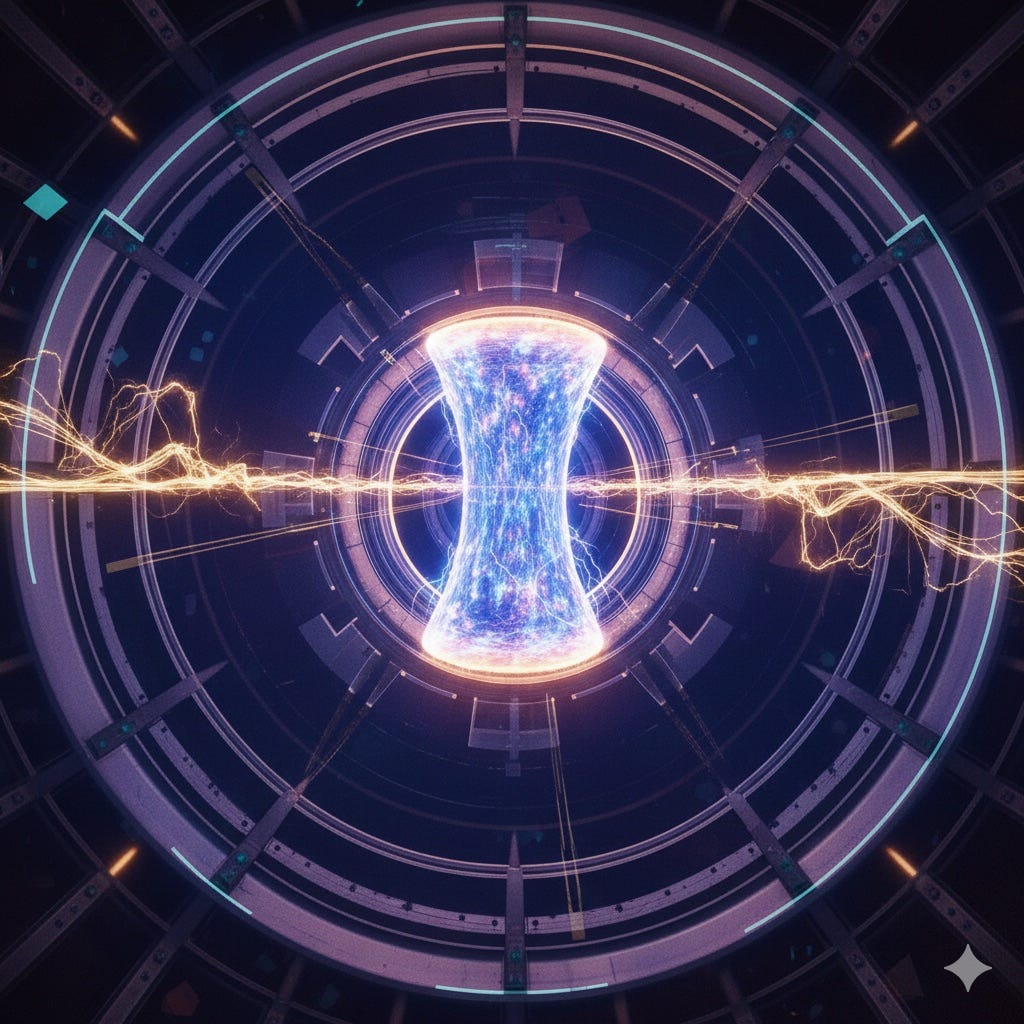
Understanding the Breakthrough: The Science Behind EAST’s Triumph
Nuclear fusion mimics the sun’s core, fusing atomic nuclei - typically deuterium and tritium - to release colossal energy. Unlike fission, which splits atoms in today’s nuclear plants, fusion yields no long-lived radioactive waste and poses negligible meltdown risks. The challenge? Nuclei repel each other, demanding extreme conditions: temperatures soaring to 150 million Kelvin and densities where particles collide frequently enough for sustained reactions.
Enter the tokamak, a doughnut-shaped reactor using superconducting magnets to confine plasma - a superheated ionised gas - in a magnetic bottle. China’s EAST, operational since 2006, has been a linchpin in this quest. The Greenwald limit, established in 1988, posited a ceiling on plasma density beyond which instabilities would erupt, collapsing the reaction and risking reactor damage. For decades, this cap throttled fusion’s viability, as higher densities are essential for more collisions and thus greater power output.
EAST’s January 2026 revelation, published in *Science Advances*, upends this. By priming the reactor with high initial gas pressure and injecting microwave energy for uniform heating, researchers minimised destructive plasma-wall interactions, achieving densities 65% above the Greenwald threshold while maintaining stability. This “density-free regime” boosts fusion rates exponentially - density squared multiplies reaction probability - paving the way for net-positive energy and practical power plants. EAST sustained this for over 16 minutes, a record that edges fusion closer to ignition, where output exceeds input.
This is an achievement with transformative potential. As co-author Ping Zhu notes, it offers a “scalable pathway” for next-gen devices like ITER, the international tokamak in France slated for 2035 operations. For China, it’s a validation of its US$1-3 billion annual fusion investment, dwarfing U.S. efforts and fuelling ambitions for leadership in clean energy.
China’s Energy Chessboard: From Renewables to Fusion
Contextualise this within China’s systemic EROEI crusade. EROEI measures energy yielded versus invested in extraction, processing and delivery. High EROEI fuels prosperity; below 7-10, societies falter, as surplus dwindles for non-energy pursuits. Fossil fuels’ declining EROEI - oil now hovers at 20-30:1, down from 100:1 historically - exacerbates emissions and resource strains.
Beijing’s response? A “thermal-fast-fusion” roadmap since the 1980s, layering fission, advanced breeders, and fusion for escalating EROEI. Today, renewables dominate: 2025 saw 444 GW added, with solar (274 GW) and wind (82 GW) pushing low-emission capacity to 60%. Coal’s generation share plummeted from 81% to 51%, buoyed by solar’s 10-30:1 EROEI and rapid payback. Fission, at 75:1, anchors baseload, with 55 reactors operational and more building.
Yet renewables’ intermittency - solar at 25% capacity factor, wind 35% - demands storage and grids, eroding systemic EROEI. Fusion, as the capstone, promises 100+:1 once scaled, dwarfing renewables (solar 10-30:1, wind 20:1) and fission. China’s US$570 million CRAFT park and startups like Energy Singularity industrialise tokamaks, echoing solar dominance via supply chain mastery.
EROEI Unleashed: Fusion’s Systemic Ripple Effects
Fusion’s EROEI implications are profound. At maturity, it could yield net energy gains of 30-50, far surpassing ITER’s target of 10. Systemic EROEI - factoring grids, storage and backups - would soar, as fusion provides firm, dispatchable power without intermittency penalties. MIT modelling shows fusion could slash global decarbonisation costs by trillions, comprising 10-50% of 2100 electricity under varying cost scenarios.
In China, fusion integrates with renewables, enabling deeper penetration by stabilising grids. Globally, it resolves energy inequality: deuterium from seawater ensures inexhaustible fuel, unlike uneven fossil or uranium deposits. Yet, initial EROEI for prototypes may dip below 1, as NIF’s ignition ignored full-system inputs. Scaling resolves this, but underscores fusion’s “next-gen” role - bridging as renewables’ 10-30 year lifespans expire mid-century.
Accelerating Timelines
Timelines are pivotal. EAST feeds into CFETR, eyed for late-2020s construction, targeting 1-3 GW by 2030s - bridging ITER to DEMO prototypes. ITER delays push full operations to 2039, but China aims for CFETR’s Phase I (200 MW steady-state) by the 2030s, Phase II (1 GW+) validating DEMO by 2040s. Commercial plants? Post-2040, aligning with EU’s 2055 roadmap and China’s own strategic assessment of energy systems transformation. Private ventures like Commonwealth Fusion promise grids by 2030s, but realism points to 2040-2050 for wide-scale.
Substitution dynamics hinge here. Renewables’ assets - solar panels (25-30 years), wind turbines (20-25), fission reactors (40-60) - will retire en masse by mid-century. Fusion slots in as baseload successor, minimising stranded assets. In China, this phases out coal while renewables handle peaks, boosting overall EROEI. Globally, fusion could displace 5 GtCO2 annually by 2050 if capacity triples.
Material Metamorphosis: Fusion’s Demand Shifts
As substitutions unfold, raw materials demand transforms. Renewables consume large quantities of steel, concrete, copper, rare earths (neodymium for wind magnets), lithium (batteries) and polysilicon (solar). Offshore wind demands 15.5 t/MW critical minerals; solar 7 t/MW. Fusion? Minimal: deuterium from seawater, tritium bred onsite via lithium-neutron reactions. Per MW, fusion requires far less material than renewables - nuclear overall uses 1/1000th the mining of solar per unit energy.
Yet fusion-specific needs emerge: beryllium for blankets, tungsten for diverters, rare earths for magnets and helium for cryogenics, for instance. Beryllium poses near-term bottlenecks, but there are no showstoppers with sufficient reserves for scaling. As fusion supplants renewables, demand for lithium (batteries) and neodymium plummets, easing supply risks; China dominates 80% of rare earths. This alleviates environmental tolls: renewables’ land use (solar 124x nuclear per TWh) and mining dwarf fusion’s compact footprint.
Sraffa’s Prism: Fusion’s Supply Chain Cascade
View this through Piero Sraffa’s Production of Commodities by Means of Commodities (1960), a framework reviving classical economics by modelling economies as interdependent input-output systems. Sraffa posits prices and profits emerge from production relations, not marginal utility - emphasising averages across interconnected sectors. Applied to energy transitions, it reveals how fusion disrupts chains: energy as universal input reshapes all commodities.
In Sraffian terms, fusion, with minimal inputs, lowers energy’s “surplus” extraction burden, boosting average profitability. Substitution dynamics? As aging renewables retire, fusion integrates via “vertically integrated” chains, minimising intermediaries and maximising EROEI. Material shifts cascade or propagate through networks: reduced lithium demand frees resources for other sectors, altering global trade balances.
Sraffa-inspired models, akin to Leontief’s input-output, forecast fusion enabling shorter, efficient chains, shortening transitions and stabilising wages/profits amid decarbonisation. Yet there remain risks: if fusion’s initial costs spike, it could distort chains, favouring incumbents. This will require careful public policy design and intervention to minimise the risk of incumbent drag on system transitions.
A Fusion-Fuelled Renaissance
China’s EAST triumph heralds fusion not as panacea but as an important pivot, elevating systemic EROEI, accelerating timelines and reconfiguring supply chains in Sraffian interdependence terms. By 2050, a trillion-dollar market beckons, underwriting energy independence and climate goals. Geopolitically, it shifts power: nations mastering fusion lead; laggards import.