
Four Tropes and Four Refutations
Rejecting mainstream analytical claims about China's economy

This short essay provides direct refutations of four standard, mainstream tropes that one finds in relation to China’s economy and developmental experience and trajectory. It draws on my recent essay that expands on an alternative frame for understanding China’s economy.
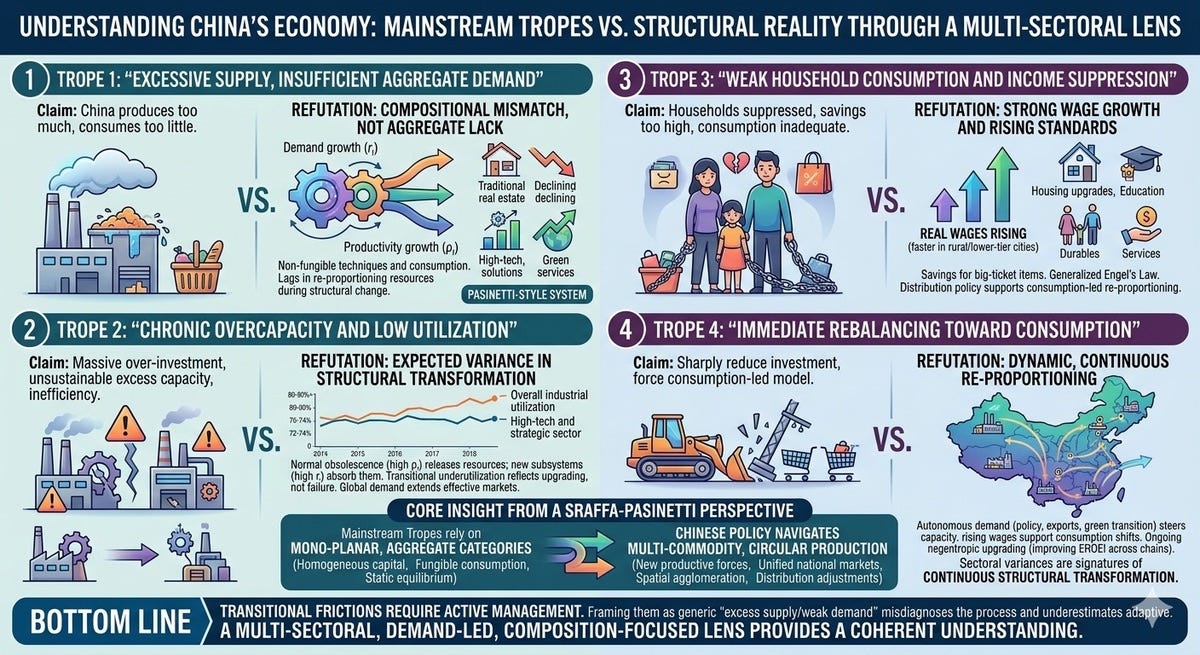
Trope 1: “Excessive Supply, Insufficient Aggregate Demand”
Claim: China produces too much and consumes too little, creating a chronic imbalance where supply outpaces demand.
Refutation: This assumes a one-good economy where “supply” and “demand” are homogeneous aggregates. In reality, both production techniques and consumption are non-fungible. What appears as “excess supply” is often a compositional mismatch during structural change.
In a Pasinetti-style system of vertically hyper-integrated subsystems, demand growth (ri) and productivity growth (ρi) differ across sectors. Saturation in legacy goods (e.g., traditional real estate and low-tech durables) coexists with strong demand in high-tech, green solutions and services. Apparent weakness in aggregate demand reflects lags in re-proportioning resources from declining to expanding subsystems — not a general shortage of purchasing power.
Trope 2: “Chronic Overcapacity and Low Capacity Utilisation”
Claim: Massive over-investment has created unsustainable excess capacity, with low utilisation rates signalling inefficiency and impending crisis.
Refutation: Industrial capacity utilisation has remained stable in its long-run historical range of 72–74% even as total capacity expands. High-tech and strategic sectors frequently operate at 80–90%+.
These variances are expected features of structural transformation, not failures. Rapid productivity growth in progressive subsystems (high ρi) naturally releases resources through obsolescence, while new subsystems (high ri) absorb them. Transitional underutilisation in legacy areas reflects ongoing replacement investment and technique upgrading — the normal process of circulation and decomposition of social capital in a dynamic multi-sectoral economy. Global demand further extends effective markets for high-EROEI outputs.
Trope 3: “Weak Household Consumption and Income Suppression”
Claim: Households are suppressed, savings are too high, and consumption is structurally inadequate, requiring a major shift away from investment.
Refutation: Real wages have risen significantly, with faster growth in rural areas and lower-tier cities narrowing gaps. Labour share has edged upward. Savings are largely a residual of strong investment opportunities and rising incomes: households comfortably cover daily living costs while saving for big-ticket purchases (housing upgrades, education and durables).
Consumption growth, particularly in services, continues amid goods saturation — exactly as predicted by generalised Engel’s Law. Distribution policy (wages, transfers and social welfare) actively supports consumption-led re-proportioning by shifting demand composition toward higher-elasticity sectors. This is not suppression but coordinated structural evolution.
Trope 4: “The Economy Needs Immediate Rebalancing Toward Consumption”
Claim: China must sharply reduce investment and force a consumption-led model to correct deep imbalances.
Refutation: Re-proportioning is already occurring continuously through demand-led structural dynamics. Autonomous demand (policy investment, exports and green transition) steers capacity toward expanding subsystems while rising wages and spatial convergence support consumption shifts.
Forcing an abrupt aggregate consumption rebalancing ignores differentiated production coefficients and the need for ongoing negentropic upgrading (improving EROEI across hyper-integrated chains). Successful policy manages the dynamic effective demand condition — aligning weighted sectoral growth with labour supply and technical change — rather than chasing some idealised, static consumption/investment ratio.
Core Insight from a Sraffa-Pasinetti Perspective
Mainstream tropes rely on mono-planar, aggregate categories (homogeneous capital, fungible consumption and static equilibrium) that dissolve in a multi-commodity, circular production system.
China’s policy approach — emphasising new productive forces, unified national markets, spatial agglomeration and distribution adjustments — implicitly navigates the real challenges of differentiated coefficients, obsolescence, replacement investment and and re-proportioning. Variances in utilisation, prices and growth across sectors are not evidence of fundamental failure but signatures of a system undergoing continuous structural transformation.
The Bottom Line: Transitional frictions exist and require active management. However, framing them as generic “excess supply / weak demand” misdiagnoses the nature of the process and underestimates the adaptive logic at work. A multi-sectoral, demand-led, composition-focused lens provides a far more coherent understanding of both achievements and ongoing challenges.
Let's re-work these four points a bit:
*Claim: China produces too much and consumes too little, creating a chronic imbalance where supply outpaces demand.
] China is not the entire world, thus the ratio of supply to demand is irrelevant. China is the world’s factory, its production shop.
* Claim: Massive over-investment has created unsustainable excess capacity, with low utilisation rates signalling inefficiency and impending crisis.
] 10 to 25% “excess capacity” is a national security asset, available in times of critical need, which of course can’t be foreseen.
* Claim: Households are suppressed, savings are too high, and consumption is structurally inadequate, requiring a major shift away from investment.
] Do we really want to recreate the American consumption conveyor belt that moves cheap products from manufacture to brief consumption to landfill? Are not savings good insurance against the next economic shock, such as another pandemic? Savings and investment are not on opposite ends of a balance bar.
* Claim: China must sharply reduce investment and force a consumption-led model to correct deep imbalances.
] See previous.
A goals-oriented approach as to how the future nation operates is the better measure of success.