
China’s Post-GDP Prosperity
Rising Use Value in an Age of Slowing Growth

Preface: to what extent is Gross Domestic Product a sufficient indicator of social and economic wellbeing? We know, from the moment the notion was ‘invented’ that even its ‘founder’ Simon Kuznets warned of its limitations. He warned Congress that, “The welfare of a nation can scarcely be inferred from a measure of national income”.
This short discussion is in the spirit of Kuznets, reflecting on how China’s material capacity and material-cum-energetic surpluses continue to expand, while rates of GDP growth taper and settle. The message is rather straightforward: the welfare of China cannot be inferred from the measure of GDP.
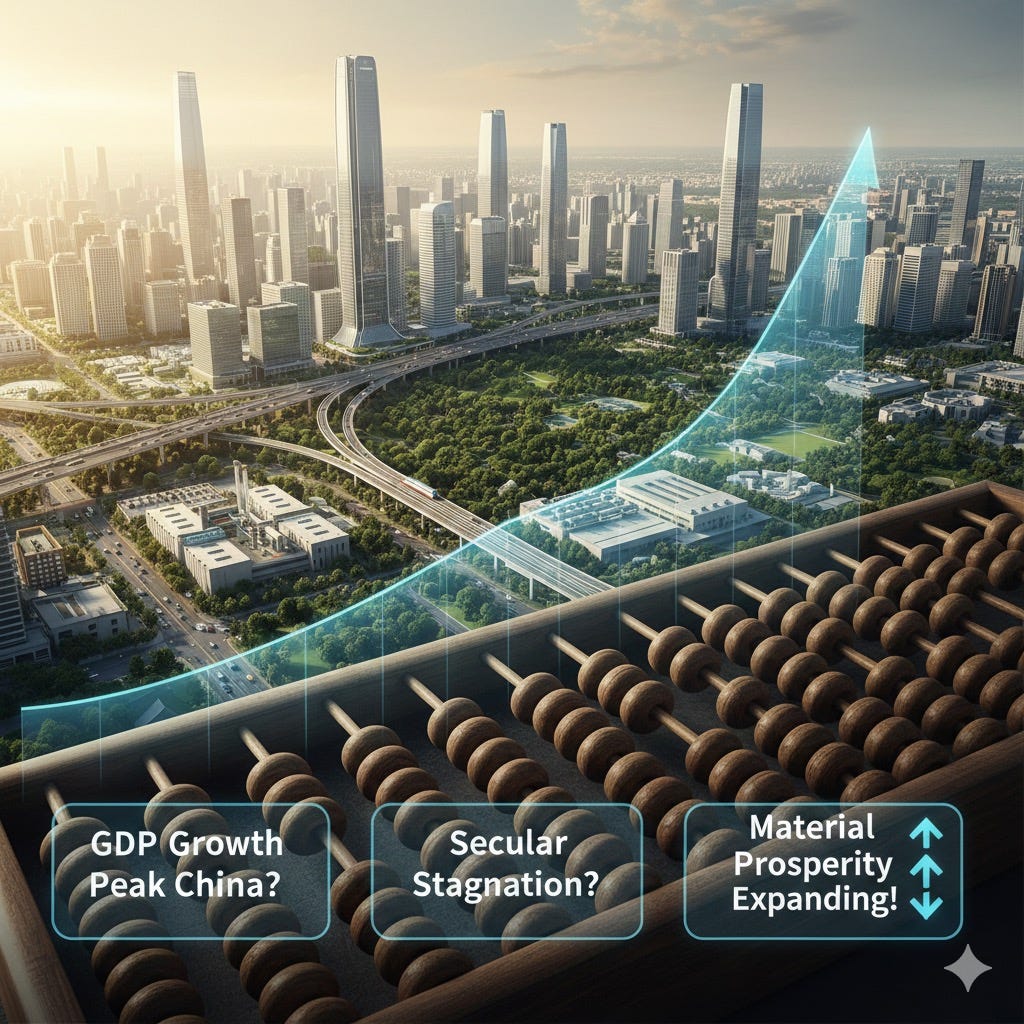
For much of the past four decades, China’s rise has been narrated through the lens of GDP growth. Double-digit expansions became shorthand for dynamism, power and transformation. Now, with growth rates slowing into the mid-single digits, commentary in the West and even among some domestic analysts has turned toward crisis talk: “peak China,” “secular stagnation,” and “the end of the miracle.”
This narrative misses the real story. GDP is a measure of exchange value - that is, the monetary value of goods and services produced. It is not, and never has been, a direct measure of real prosperity. By focusing on exchange value alone, mainstream analysis risks obscuring what is actually happening in China today: the country is producing more goods, services and infrastructure than at any point in its history, generating and using more electricity than ever before, while the prices of many of these outputs are falling in real terms. The paradox is clear: China’s material prosperity, its use value, is expanding even as its GDP growth rate plateaus.
Far from crisis, this suggests something else is going on. One wonders whether China may be pioneering a mode of economic development in which prosperity is no longer tightly bound to perpetual acceleration in GDP expansion, but is underpinned by energetic surpluses and relative abundance. Or less grandiose, China’s experience points to the limitations of exchange value measures as a metric on human, social and economic system health and wellbeing.
The GDP Trap
Gross Domestic Product is often a useful shorthand for comparing economies and tracking business cycles, but it is fundamentally a monetary measure. GDP = Prices × Quantities. If quantities (real output) rise while prices fall faster (deflation), nominal GDP can stagnate or shrink even as real output (use values) increases.
“Real GDP” attempts to adjust for inflation or deflation, but it remains a statistical construct. It is reliant on price indices, assumptions about quality change, and often smoothing that underplays large shifts in unit costs. When many sectors of the economy follow technology or scale curves (where unit costs fall even as output rises), real GDP tends to understate welfare improvements.
A Framework: Use Value and Exchange Value
Two classical categories, often conflated in public discourse, are essential here:
Use value: The physical goods and services available to people - what improves daily life: food, energy, mobility, housing, communications and healthcare etc.
Exchange value: The market-monetary valuation of those goods and services; GDP is built on this. (See my foundational essay on Systemic Exchange Value for a more detailed elaboration on these concepts.)
Modern economies (and modern economic policy narratives) tend to equate prosperity with the expansion of exchange value, and collapse use value and exchange value into a single category: price. But the opposite condition is possible: use value can rise rapidly under deflationary or strongly productivity-driven conditions, even while exchange value (nominal GDP, corporate revenues, etc.) flattens or grows slowly.
The Paradox of the Great Deflation (c. 1870–1890)
There is an historical example, which is the Great Deflation in the late 19th century (especially in Western Europe and the U.S.). There, industrial output surged, real wages rose and living standards improved; and yet, the decline in money prices meant that some contemporaries saw the era as economically troubled.
The period from roughly 1870 to 1890 in the industrialising world is often called the Great Deflation because consumer and producer prices fell steadily for nearly two decades. Yet this was simultaneously a period of rapid industrial expansion: steelmaking, railways, shipbuilding, chemicals, and textiles all experienced extraordinary increases in output, fixed capital formation, and labour productivity. Real wages also rose, even as nominal prices and, in some cases, nominal wages remained flat or declined. Conventional monetary interpretations - where deflation is associated with falling demand, recession and financial stress - don’t explain this apparent contradiction.
The key is that this deflation was supply-led. Massive technological change (Bessemer steel, open-hearth furnaces, mechanised weaving and rail distribution networks), dramatic extensions of energy inputs (coal and steam), and economies of scale fundamentally changed production cost structures. Unit costs fell faster than aggregate demand could absorb the increased output. Prices therefore declined not because the economy was weak, but because the production system became structurally more efficient. This is what we could call “good deflation.” An excellent paper by Borio et al., (2015) explores this in more detail.
In Sraffian or classical terms, the technical coefficients of production were shifting rapidly. Industries reorganised around more capital-intensive techniques with lower per-unit labour requirements. The distributional order - profit rates and wage shares - adjusted through the price system rather than through contraction. With productivity gains outpacing price declines, real wages rose, allowing aggregate purchasing power to expand even in an environment of falling nominal values.
This is why the era is best understood not as a monetary deflationary slump, but as a reorganisation of the production system. Falling prices were the expression of technological deepening and structural transformation. The real economy - measured in outputs, tonne-miles, energy throughput or physical consumption - grew vigorously, even as nominal measures stagnated or declined. The paradox dissolves once we separate real technological progress from the monetary lens through which later economists typically view deflation.
Today, China exhibits many of the same features.

China’s Deflationary Abundance
China’s current experience as a contemporary analogue to the Great Deflation: a supply-driven, technology-intensive cost compression cycle that produces deflation in nominal price indicators while the real economy expands through massive output and capability accumulation.
Supply-Driven Cost Compression Amid Structural Upgrading
China’s current economic conditions - marked by soft consumer prices, prolonged factory-gate deflation and extraordinary expansion in clean-energy and advanced-manufacturing output - mirror the paradox of the Great Deflation of 1870–1890. Then, as now, falling prices were not signs of contraction, but the surface expression of deep productivity shifts and sectoral transformation. China today is experiencing a similar structural reconfiguration.
Clean-Energy Scale as the Driver of Price Compression
In 2024, China exported ~235.9 GW of PV modules, a 13% increase from 2023. It grew again in 2025. The geography of demand has broadened: while Europe’s module imports from China fell by around 7%, markets across Asia-Pacific, Africa, Latin America and the Middle East, and emerging economies accelerated purchases. China has become the marginal cost setter for global solar deployment, not because demand is weak, but because Chinese productive capacity continues to expand faster than global consumption.
Domestically, China added ~180–190 GW of new solar generating capacity in 2024 - an unprecedented yearly addition by any country. Output of wafers, cells, and modules in 2024 was close to or exceeded the full-year production levels of 2023, despite significant price declines. The technological cycle (larger wafer sizes, higher cell efficiency, thinner materials, gigawatt-scale factories) has driven a historic collapse in unit production costs. Early data shows that in 2025, China accelerated its solar expansion to unprecedented levels, adding an estimated 210 GW to over 250 GW of new solar capacity in 2025 alone (to August), significantly exceeding the 2024 additions.
What appears externally as “oversupply” is, internally, hyper-productivity and externally, is manifest abundance: learning curves, process intensification, logistics optimisation and capex scale all reduce unit costs faster than demand can rise. Price deflation is the natural outcome as output volume expands.
PPI and CPI Deflation as Indicators of Productivity, Not Stagnation
China’s CPI was flat (0%) year-on-year in 2025, while PPI contracted by roughly 2.6%. These headline figures point to a broad-based softening of nominal prices, but at the sectoral level they reflect the same mechanism as the late-19th century: production efficiency outpacing demand. Detailed CPI data is available here.
Intermediate-goods prices are weak because supply chains in photovoltaics, batteries, EVs, electronics, refinery-to-chemicals and machinery have experienced rapid technological improvements. This cascades and propagates across supply chains, as I have discussed elsewhere. Factory-gate deflation reflects competitive pressures and economies of scale, not a collapse in activity. Export volumes - and sales overall - remain extremely strong in clean-energy, machinery and automotive sectors, suggesting output remains high even as prices stagnate or fall.
China’s technical coefficients in key manufacturing complexes are shifting downward rapidly. This lowers the long-run normal prices across an interconnected production system, exerting disinflationary pressures even where demand is robust.
Wages and Real Incomes: The Quiet Countertrend
Despite modest nominal wage growth - 3.9% to 4.3% across the broader economy - real wages have risen due to falling consumer prices. Average per capita disposable incomes rose 5.4% in 2025, more so in rural areas and less so in urban areas. Detailed data on wages by sector can be found here.
CEIC data show the real wage index in urban non-private units at or near historical peaks. Workers in tradable and productive sectors benefit from rising productivity and stable employment conditions. Lower prices for goods with high consumption shares (electronics, household goods, energy services) enhance real purchasing power.
This mirrors the paradox of the 1870–1890 era: slow nominal wage growth coexisting with improving real living standards due to cost compression in essential goods.
Output Growth in the “New Three”: Structural Recomposition of the Economy
China’s “new three” industries - solar cells, lithium batteries and EVs - continue to anchor export expansion.
Exports of these goods grew roughly 30% in 2023. In 2024, EV and NEV exports continued to rise strongly, though with some moderation from an exceptionally high base. Lithium-battery capacity expansion and module giga-factories continue to deepen China’s global dominance. The pattern continued into 2025, as I explored at length here.
The macro significance is twofold:
Firstly, it points to rising energy-to-output conversion efficiency. These industries dramatically expand China’s capability frontier, linking material throughput, energy conversion and industrial sophistication.
Secondly, increasing share of technologically intensive goods in total exports. The export basket is shifting toward sectors characterised by declining unit costs, strong learning curves and global demand growth.
This means China’s nominal trade growth understates its real productive expansion; global consumers capture part of the surplus via lower prices for green technology.
Conceptual Synthesis: China’s “Second Great Deflation”
When viewed through a classical production lens, the apparent paradox dissolves.
Prices fall because technological deepening lowers normal prices across interconnected supply chains. Real wages rise because essential goods become cheaper even if nominal wage growth slows, relatively speaking. Output booms in key advanced sectors where China is the global cost-setter. Domestic and global markets absorb massive supply due to the cost advantage of Chinese producers, not because demand is overstated. Put plainly, demand continues to expand.
This is a supply-led deflation, not a demand shortfall.
Just as in 1870–1890, nominal measures give the illusion of stagnation, while real economic capacity - energy systems, productive forces and innovation cycle - expands rapidly. The system is adjusting its technical coefficients and distributional structure in real time. What we are witnessing is the expression of a profound structural transformation rather than a macroeconomic slowdown.
In other words: China’s deflation is the monetary shadow cast by a real-economy productivity boom.
Putting these numbers together, we see households are getting more real goods - solar electricity capacity, clean energy and EVs for instance - at lower or stabilised prices. Many price trends are deflationary; consumers and firms face falling costs for many goods. Wages are growing slower in nominal terms but real incomes are still rising for many, because deflation (especially in tradable / goods prices) offsets slower wage increases. All the while, physical output (quantities) in key sectors is rising, often by double digits, even when exchange value is compressed by falling unit prices.
Thus, China is producing more than ever (use value) even if exchange-value metrics like nominal GDP or profit margins appear under pressure. The issue of profits as a function of system liquidity dynamics has been discussed previously here.
The Property Question and Distribution
It’s helpful to restate that while property and local government debt are often cited as China’s major vulnerabilities, their macro weight is diminishing relative to the clean-energy, export and industrial base gains. Property developers have been reined in; their debts being restructured and speculative bubbles unwinding. See my recent examination of the deleveraging of China’s real estate sector, for more details. Local government fiscal imbalance remains a challenge but is a design issue (vertical mismatch of revenue vs cost) rather than a consumption-driven drag on use-value expansion. The notion of ‘hard budget’ constraints, in this context, is a myth (see my exploration of this issue here). Residential property investors (households) do have losses in certain city-markets, but, in aggregate, these losses are small relative to the gains in real wages, cheaper goods, rising access to mobility, energy and digital services. So, while not irrelevant, the property risk is secondary to the transformation underway in China’s productive, renewable, tech-heavy core economy.
Misreading the Transition
Why does GDP slowdown get all the attention?
For starters, it is because exchange value metrics are embedded in policy, finance and political legitimacy. A slowdown in nominal GDP is a simple metric to grasp, even when living standards keep rising. Profit margins and business revenues (exchange value) get squeezed in deflationary environments - a concern for firms and investors - but this doesn’t necessarily translate into lost welfare for workers-consumers. Indeed, as I have shown elsewhere, China’s political economy and social settlement socialises gains via competition and consumer surpluses, while keeping in check tendencies for capital to seek and consolidate rents.
Additionally, policy commentators and the mainstream western media often conflate “less growth in exchange value” with “less growth in material welfare,” which the empirical data contradict. This misalignment leads observers to misinterpret China’s trajectory: seeing weakness where there is structural transformation amongst rising material standards of living.

Historical Parallels and Comparative Lessons
Looking back, as noted, the Great Deflation in western industrialising countries saw steady declines in many consumer and producer goods prices, massive output growth (railways, steel, and textiles are obvious cases in point), and rising real wages. Contemporary commentators often regarded deflation as depression even as millions saw living standard improvements. We can note that there are in fact two distinct types of deflation: one, in which prices fall as a reaction to a collapse in aggregate demand, as firms seek to shift or clear inventory; and the second, more typically historically, when prices fall as demand and output rises, due to the effects of downstream competition and rapid transformations in production coefficients. In SEV terms, the EROEIp and EROEIu vector delivers rising efficiencies and surpluses.
More recently, deflationary pressure in tech and ICT have produced similar dynamics but on smaller scale: unit costs falling, bursts of productivity enabling more use value for each unit of money. China is scaling this up across many sectors simultaneously.
Few large economies have attempted or sustained deflationary output growth at China’s scale. Many advanced economies fear deflation because of debt burdens and low demand; China’s case differs because it combines state-led accumulation in clean energy and high-tech manufacturing, a growing domestic market coupled with global export strength focused on the expanding markets of the global south, and economies of scale that push down costs.
Policy and Global Implications
Given this structural divergence between use value growth and exchange value plateauing, what follows for policy and global economics?
For domestic policy, there is good reason to accept that headline GDP growth targets (~5%) may be increasingly symbolic rather than exhaustive measures of welfare. Policies should emphasise use-value measures: real wages, access to mobility / energy, infrastructure quality, housing affordability and digital access. I have previously described these in terms of the foundational economy.
That said, attention needs to be trained to preventing deflationary spirals where falling prices lead to lower investments or debt distress - especially for small firms, households with fixed-rate debts, but avoid over-stimulating nominal value without regard for efficiency. This is how the anti-involution campaigns should be interpreted. At the same time, it is imperative to continually stoke or stimulate innovation, renewable / green technologies, build out infrastructure and encourage sectors where output scale can continue rising while unit prices fall. Framed in more technical terms, innovation must focus on increasing system-wide EROEI through the augmentation of technological coefficients in production and circulation.
Globally, this analysis points to the fact that China’s abundance in solar modules, EVs and batteries exports acts as a deflationary force in certain sectors, making clean energy cheaper abroad. Consequently, trade partners may benefit from cheaper inputs but may see some of their own, comparable, industries under price competition. As I have discussed elsewhere, trade should be analysed through the lens of impacts on energetic transformation capacities rather than through those of monetary balances. As far as capital flows are concerned, global investment flows may need to adapt if profits are squeezed in real terms, even as volumes rise. We see this taking place, incidentally, as Chinese capital continues to expand productive capacities elsewhere.
Toward a Post-GDP Mode of Prosperity
China appears to be developing a model of economic development that to some extent decouples welfare and use-value expansion from continuous nominal GDP acceleration. Use value (what people can consume, the material, energy, mobility and technology they use) is rising. At the same time, exchange value (nominal metrics: GDP growth, profit margins and revenues) is growing more slowly or sometimes flatlining under deflationary pressures. If this can be sustained - if social legitimacy and political stability derive more from real material improvements than from ever-higher headline money-denominated growth - then we are witnessing a transition to what might be called post-GDP prosperity.
China’s slowing GDP growth over the past decade or so is real. But it is not the end of its story. Interpreted narrowly, exchange-value slowdown looks like decline or stumbles. This interpretation led some to question whether China’s economy would overtake that of the U.S., suggesting that “peak China” has already arrived. Interpreted broadly, the data suggests that what is happening is a quiet but profound expansion of use value: more clean energy capacity, more export of renewable tech, more mobility and infrastructure and rising real incomes for many as prices fall. Growing abundance is socialised via intense competition resulting in “buyers’ surpluses.” (Incidentally, as for comparative economic size, on PPP terms, China’s economy is already substantially bigger than that of the United States.)
The empirical data - low to negligible CPI and compressed PPI, export surges in solar modules, continuing real wage gains and booming NEV output - all point in one direction: China is producing more than it ever has before in physical and utility terms, even where finance, nominal earnings or profit margins might seem under stress. It’s also importing more in physical terms too, so as to support and sustain it midstream value-adding. What many mainstream commentators call China’s “slowdown” is actually one of its most powerful economic transformations yet - a shift toward prosperity without reliance on perpetual expansion of the rate of growth of aggregate exchange value.
China may be the first of the large economies to show that prosperity need not always move hand in hand with headline GDP growth. When use value rises strongly, even under deflationary conditions, it is possible to prosper even if exchange value‐measures plateau.