
China’s Future Industries
The 15th Five Year Plan and Catalysts for Global Cooperation and Sustainable Growth

Preface: as the American-Israeli attacks on Iran provoke a wider regional war, China’s decision-makers were meeting in Beijing at the so-called Two Sessions to review the work report for 2025 and finalise the details on the 15th Five Year Plan. If we are looking for contrasts between two approaches to national and global affairs, we couldn’t find anything clearer. This essay discusses one of the key elements of the 15th Five Year Plan, namely its focus on so-called “future technologies” and how it is that we can interpret this.
As China’s “Two Sessions” opens in March 2026, the newly adopted outline of the 15th Five-Year Plan (2026-2030) solidifies “future industries” - including artificial intelligence, quantum computing, biomanufacturing, brain-computer interfaces, embodied intelligence, and 6G - as core drivers of national development. This builds on President Xi Jinping’s vision of “new quality productive forces,” first articulated in 2023, which emphasises innovation-led, high-efficiency growth to enhance domestic resilience while tackling shared global challenges like energy security and sustainable prosperity.
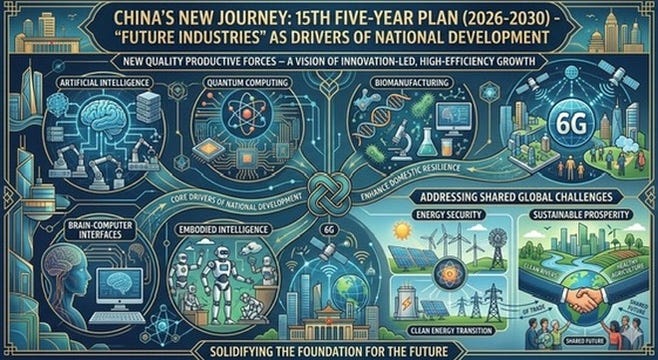
Far from fuelling zero-sum rivalry, China’s strategic investments in these sectors present opportunities for international collaboration. Through what I call a “thermoeconomic” perspective - treating economies as energetic regimes shaped by energy return on energy invested (EROEI) - this approach modernises Marxist political economy and anchors development theory in the laws of thermodynamics. Historical modes of production advance via superior energetic systems, each regime accumulating higher EROEI to support greater complexity and living standards. “New quality productive forces” extend this logic, harnessing high-tech to boost negentropic potential: organising energy and information flows to resist entropy and elevate systemic efficiency.
China’s Approach to Cultivating Future Industries
China’s strategy leverages unparalleled scale, state coordination, and massive R&D investment to accelerate progress in future industries. The 15th Five-Year Plan prioritises modernising traditional sectors alongside emerging ones (new energy, aerospace) and frontier domains (quantum technology, hydrogen energy, biomanufacturing). This aligns with President Xi’s emphasis on innovation-driven productivity featuring high technology, efficiency, and quality, aiming for self-reliance in semiconductors, AI and biotech, potentially delivering exponential EROEI gains.
Thermoeconomically, the push addresses core challenges: bolstering energy resilience and efficiency to generate expanding energetic surpluses. Upstream efforts optimise production, storage, and distribution (e.g., grid-scale batteries, fusion research) to cut losses and amplify output per input. Midstream and downstream, AI-enabled manufacturing and embodied intelligence minimise waste in supply chains and end-use. Quantum tools treat data as a negentropic resource, speeding information processing and systemic circulation, enhancing decision-making, logistics and resource velocity.
China’s scaling success - from solar dominance and EV leadership to 6G prototypes - illustrates building higher-EROEI accumulation regimes that sustain rising living standards.
China’s nano-materials innovations vividly exemplify this EROEI imperative, fostering energy-efficient regimes for sustainable advancement. Breakthroughs in 2D semiconductors, such as Southeast University’s 6-inch single-crystalline MoS₂ wafers (achieved via kinetic-accelerated oxy-MOCVD, addressing contamination and domain-size hurdles) and Fudan University’s WUJI chip (a 32-bit RISC-V processor with 5,900 MoS₂ transistors), deliver ultra-thin, low-power electronics that drastically reduce energy inputs while maximising computational throughput. Triboelectric nanogenerators (TENGs) achieve remarkable efficiencies - up to 117% in frequency-complementary marine-wave harvesting setups - powering self-sustaining IoT and wearables through mechanical-to-electrical conversion. Graphene progress, including ultra-durable fast-charging batteries exceeding 3,000 cycles, supports low-cost distributed computing, treating data as a negentropic asset by enabling rapid, low-waste processing.
These advancements reinforce resilient supply chains via digital infrastructure. The NDRC’s logistics data openness initiatives, alongside Beijing and other regions’ cross-border data flow expansions (e.g., FTZ negative lists and streamlined mechanisms), standardise exchanges and boost midstream efficiencies. Concurrently, digital RMB (e-CNY) advancements - interest payments on verified wallets starting January 2026 and over US$55 billion in cross-border transactions via platforms like mBridge - anchor finance to robust, energy-efficient real-economy data systems, accelerating systemic circulation speed.
Opportunities for International Companies, Researchers and Talent
China’s momentum creates fertile ground for mutual benefit. International firms can pursue joint ventures and R&D alliances in quantum and biomanufacturing, pairing China’s infrastructural scale with Western creativity. Researchers gain access to vast datasets and funding, hastening negentropic breakthroughs in brain-computer interfaces and beyond.
Talent circulation is especially compelling: “new quality productive forces” welcome global expertise in energetic advancements, from hydrogen storage to AI-optimised utilisation. Talent visas and collaborative labs promote brain circulation, applying thermoeconomic analysis of EROEI to craft surplus-generating policies.
Prime synergies target systemic circulation speed. Quantum data processing optimises supply chains, slashing energy waste and elevating cross-border EROEI. Global firms could partner on embodied intelligence for smart grids, distributing surpluses equitably. These engagements temper tensions, embodying the idea of Marxist productive forces as collective progress toward superior energetic regimes and higher living standards, offering market access while advancing efficiency-focused paradigms.
Advancements in China’s Future Industries and Their Role in Global Challenges and SDGs
China’s innovations in future industries offer powerful tools for shared problems, amplifying energy resilience and EROEI in a thermoeconomic frame. Green tech and AI-health applications directly support UN SDGs, notably SDG 7 (Affordable and Clean Energy) and SDG 13 (Climate Action). (China remains committed to the UN SDGs, hence the reference to them in this essay, so as to provide another lens through which the policy trajectory can be understood.)
Upstream hydrogen and fusion efforts promise higher EROEI by reducing fossil reliance and enabling exportable surpluses. Midstream advanced manufacturing, via AI grids, cuts transmission losses. Downstream embodied intelligence curbs consumption waste. Quantum/data tools serve as negentropic accelerators - speeding R&D, predictive maintenance and adaptive economies amid constraints.
From China’s point of view, this extends Marxist theory in interesting ways: productive forces as energetic systems, each mode an EROEI regime. China’s tech-led shift generates surpluses addressing poverty (SDG 1), inequality (SDG 10), health (SDG 3 via AI-biomanufacturing), and hunger (SDG 2 through efficient agriculture). Global sharing - quantum for climate modelling (SDG 13), 6G for education (SDG 4) - fosters cooperation.
Critically, these developments sustain energy sovereignty and opportunities for the Global South, especially amid disruptions in global energy markets from ongoing conflicts in West Asia, which exacerbate volatility in oil supplies and prices. China’s focus on low-cost electrification - through scalable solar, wind, and battery technologies - enables affordable, resilient power access, boosting EROEI in resource-constrained regions. Digitalisation of systems further amplifies this, with localised Digital Westphalian AI - emphasising data sovereignty and cross-border interoperability - empowering nations to build independent, yet connected, AI ecosystems. This sovereign AI approach, as seen in Huawei’s HarmonyOS and similar initiatives, allows Global South countries to harness AI for local needs without ceding control to foreign entities, countering digital dependencies.
In supply chain terms, China’s strategy augments production systems - viewed as EROEI vectors - by optimising input-output efficiencies across value chains, while enhancing whole-network circulation through digital platforms and standardised data exchanges. This not only mitigates energy shocks but accelerates SDG progress: enabling industrial innovation (SDG 9) via efficient manufacturing, and sustainable cities (SDG 11) through smart, energy-thrifty infrastructure. By exporting these capabilities via Belt and Road collaborations, China catalyses a thermoeconomic shift for the Global South, fostering self-reliant growth in an era of geopolitical turbulence.
By embracing thermoeconomics, China’s strategy catalyses a worldwide shift to elevated EROEI regimes, securing sustainable prosperity. This is even more prescient as the war in the middle east continues.
China’s future industries - framed by thermoeconomics and “new quality productive forces” - transcend rivalry, beckoning collaboration to forge resilient and efficient systems. Engaging this vision can unlock energetic surpluses for humanity, harmonising progress with planetary boundaries. Meanwhile, the west prosecutes a war in west Asia. Contrasting possibilities could not be any clearer.