
America Against Itself, redux
Disintegration, Demagogic Decadence and the Return of the State of Exception

The early warning signs of American precarity were evident 3-plus decades ago. The hubris of the “end of history” masked a political economy that was itself fragile to the core.
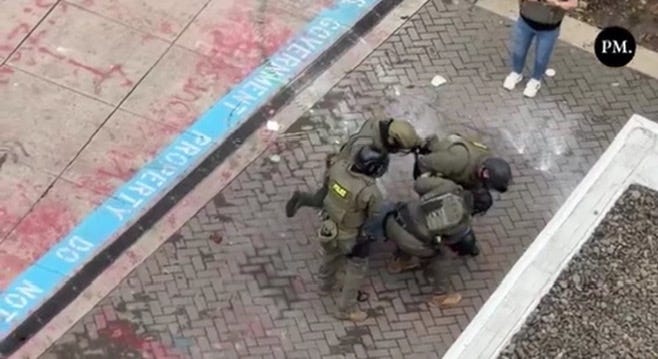
Two lenses from the early and mid 1990s - one cinematic, the other philosophical-sociological - offer unusually prescient windows into understanding the present moment. Wang Huning’s 1991 book America Against America and David Koepp’s 1996 film The Trigger Effect both dissect the same civilisational fault lines plastered over by Fukuyama’s fallacious fantasies of western-cum-American triumph. Wang and Koepp, in their own ways, speak of atomisation, fragility and the collapse of social cohesion. Though neither anticipated the world of smartphones, social media or opioid addiction, both foresaw the psychic architecture of a society on the edge - a world where the thin tissue of order depends on trust that no longer exists.
Today, across the United States, signs of deep social fracture are surfacing in data once read as marginal indicators. Sales of bulletproof glass, home security systems, and CCTV installations are surging. The bulletproof glass market alone is growing at nearly 10% per annum, projected to exceed US$4.28 billion by 2030. In parallel, U.S. spending on residential and commercial alarm systems has climbed past US$70 billion annually. These are sociological metrics of fear; they are barometers of a population fortifying itself against a sense of internal collapse.
It’s a sense of collapse that’s been decades in the making.
Gun violence remains at historically high levels. According to the Gun Violence Archive, 2023 saw over 650 mass shootings in the United States - roughly two per day - with little sign of abatement. Mass shootings have a minimum of four victims shot, either injured or killed, not including any shooter who may also have been killed or injured in the incident. (The Archive maintains an up to date catalogue of mass shootings, and can be viewed here.)
The opioid epidemic continues to claim more than 80,000 lives a year, and its geography overlaps with the country’s most violent and economically depressed regions. Crime, addiction, mental illness and the commodification of security form an interconnected ecosystem. We see emerging before our eyes a society arming itself against itself.
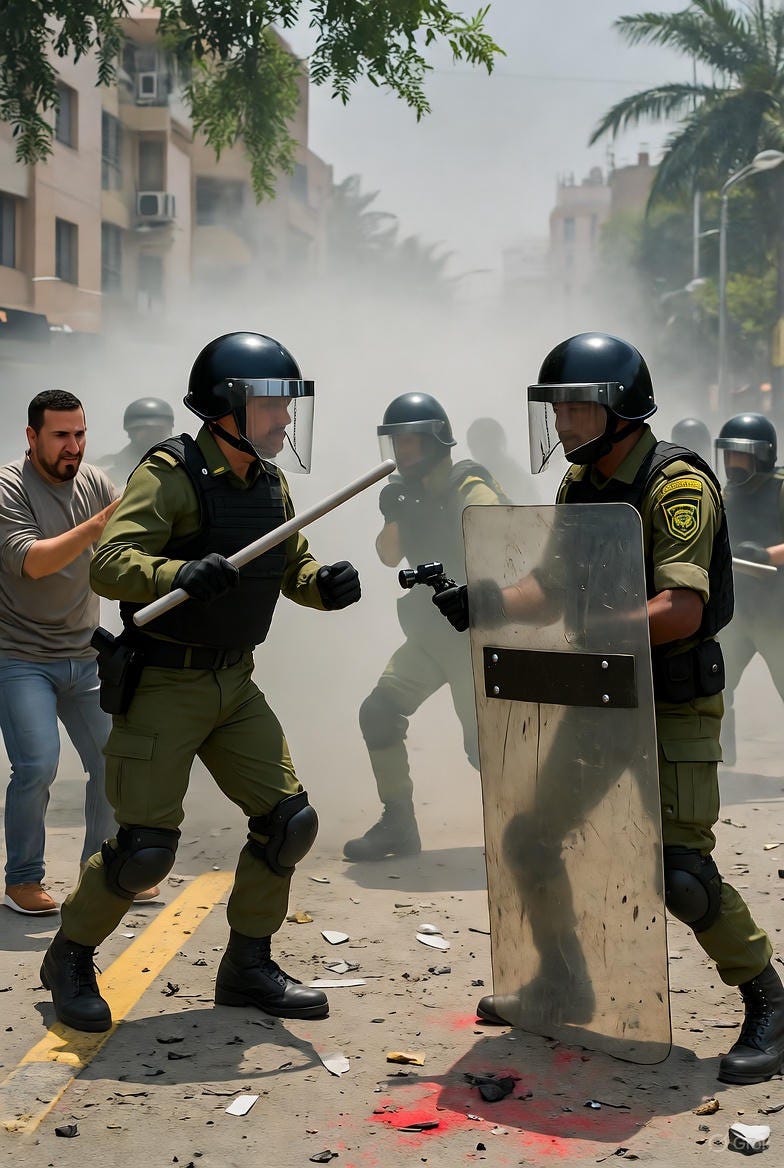
Wang Huning’s America: Atomisation as Destiny
When Wang Huning - now a member of the Central Committee of the Communist Party of China - travelled through the United States in the late 1980s, he was struck less by its wealth than by its loneliness. America Against America is an ethnography of material decline and social disconnection. He saw a society where individuals were liberated from all traditional bonds - family, community and class - but also stripped of the solidarity and moral purpose that make freedom meaningful.
What remained was what Wang called atomised liberty: a condition of permanent self-containment in which human relationships are transactional, trust is instrumental and meaning collapses into consumption. The result was paradoxical: apparent material abundance coexisting with emotional deprivation; freedom breeding insecurity rather than confidence.
For Wang, far from being an aberration the emergent social anomie was a structural feature of late capitalism - a system whose efficiency in generating financial wealth also eroded the very institutions that made collective life possible. The result was a nation in which “society” itself was disintegrating, leaving only individuals, markets and, lurking never far away, the coercive apparatus of the state.
The Trigger Effect: Precarity as Metaphor
Released just five years after Wang’s book, David Koepp’s The Trigger Effect offered a dramatisation of these same themes in cinematic form. The film begins with a simple premise: a power outage strikes a suburban American town. At first, the characters assume it is temporary. But as hours stretch into days, social norms dissolve. Fear, rumour and suspicion take over. Neighbours turn on one another. Weapons appear. The invisible systems that sustain modern life - electricity, communication, logistics - prove to be the only glue holding the social order together. The ephemera of social trust lost their material moorings; in an instant, cohesion gave way to collapse.
Koepp’s point was subtle but devastating. American civility is an artefact of stable supply chains and foundational energetic infrastructure. Once those break, the underlying insecurity surfaces instantly. The “trigger effect” of the title is psychological - it speaks of the fragile threshold between the ordinary and the violent, between neighbourliness and paranoia, and ultimately how easy and quick the unravelling can be triggered.
The film and Wang’s book thus describe the same society from different angles. Both see America’s stability as a fragile and, perhaps, an ephemeral state maintained by consumption and technology rather than shared meaning. Once that energy flow or trust network fails, what remains is fear.
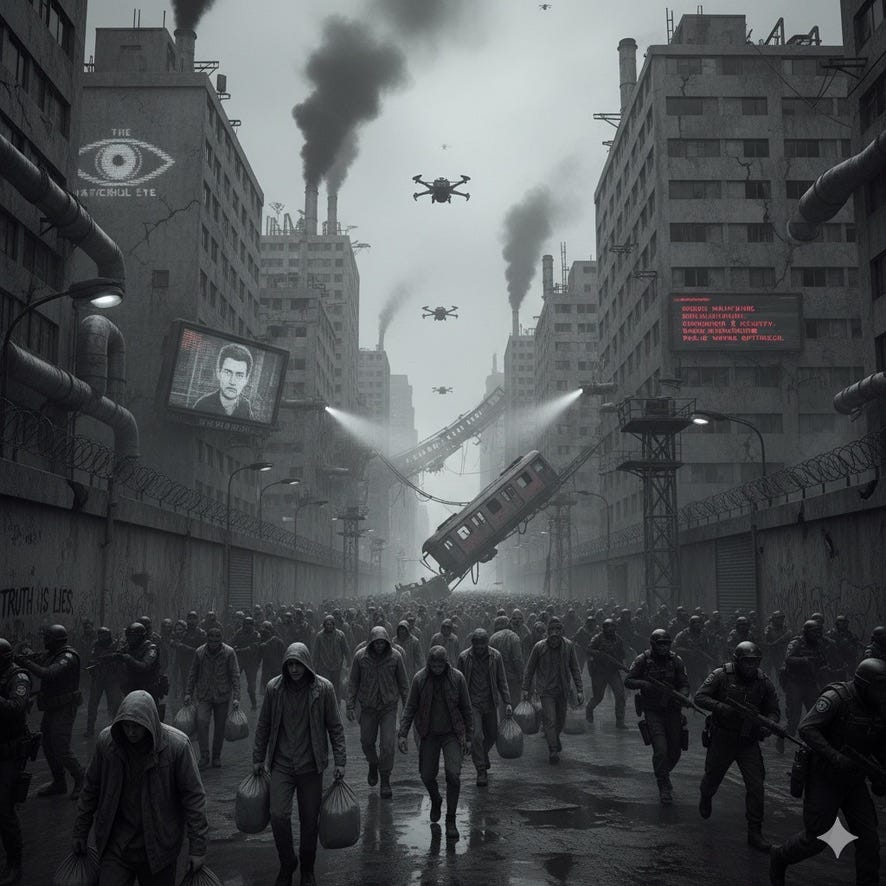
The Data of Fear
Three decades later, their insights find empirical confirmation.
Private security and fortification is a growing feature of American cities. The U.S. physical security market is projected to exceed US$170 billion by 2030, with residential spending outpacing commercial growth. Bulletproof glass demand, growing near 10% annually, mirrors the rise in private fortification by retailers, schools, and even suburban homeowners.
Violence is an American sine qua non. In 2024, the U.S. homicide rate remained 70% above pre-pandemic levels, despite declines elsewhere in the developed world. Gun-related deaths continue to exceed 47,000 annually. It’s not just mass shootings.
Addiction and despair are on every street corner, so it seems. Opioid deaths have quadrupled since 2000, with synthetic opioids like fentanyl now killing more Americans each year than all car accidents and gun homicides combined. A five decade “war on drugs” has been a palpable failure; drugs are killing more Americans today than ever before.
These are not isolated problems. They describe a system that has normalised violence and is internalising insecurity. Such a system increasingly treats its own citizens and of course, undocumented residents (illegals, so to speak), as potential threats to be contained rather than as participants in a shared civic project.
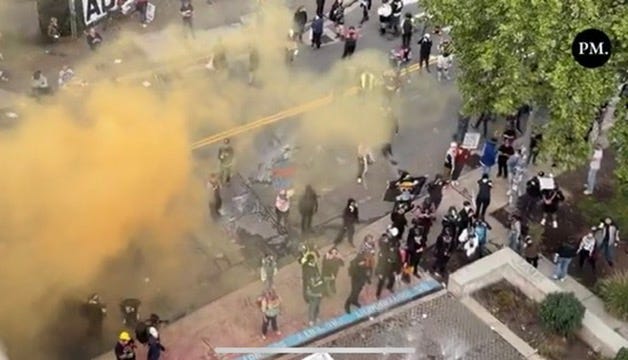
Political Violence as Narrative Fuel
Even as violence spreads and becomes normalised, its political meaning is manipulated. The Cato Institute’s long-term study of politically motivated killings shows that such acts remain exceedingly rare - accounting for less than 0.1% of all U.S. homicides since 2020.
But, paradoxically, rarity enhances symbolic power; it punctures the normalised insouciance towards societal violence. When right-wing commentator Charlie Kirk was recently assassinated, Donald Trump and his allies seized the event to paint a picture of a violent, lawless Left - despite evidence that politically motivated violence is not left-skewed ideologically. Quite the reverse, actually. That much is confirmed by the CATO study. Let’s not forget, CATO is hardly a paragon of leftist politics.
Yet, this rhetorical inversion transforms anxiety into political capital.
It is here that the line between democratic populism and authoritarian opportunism blurs. By amplifying fear and exaggerating disorder, political actors justify the expansion of coercive authority - more policing, surveillance and the normalisation of emergency powers. Fascism, historically, did not arise from chaos; it arose from the promise to control chaos.
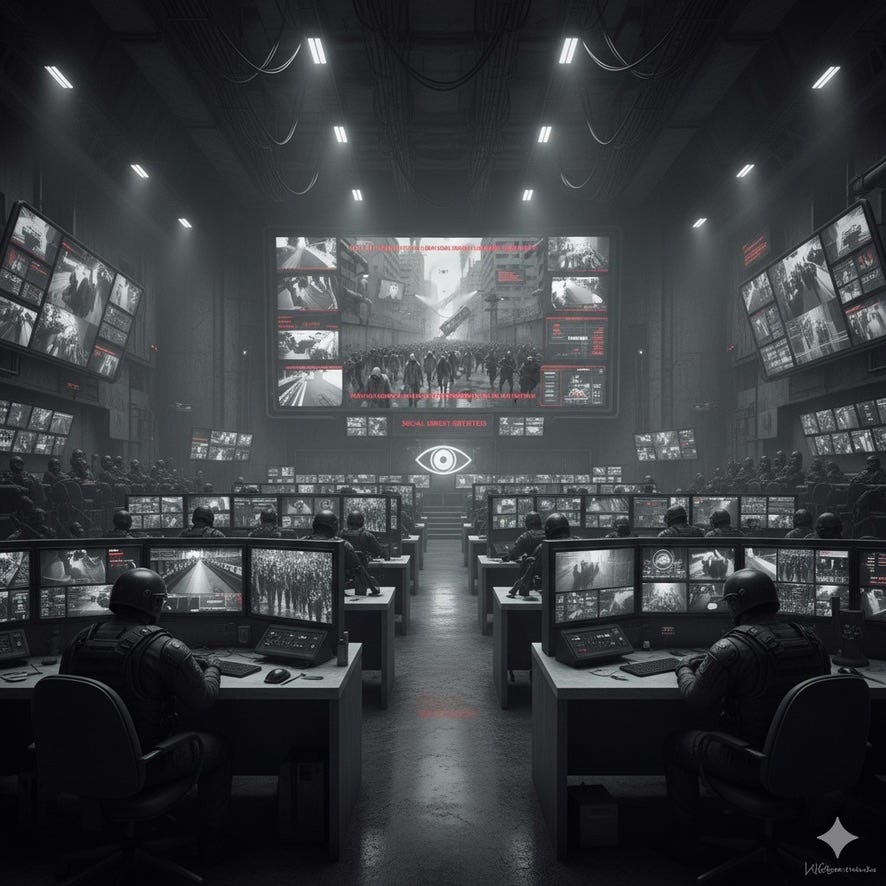
The State of Exception: Proto-Fascism as Everyday Governance
Trump’s politics exemplify this pattern. His proto-fascism was long foreseen by those close to him, including former chief of staff in his first administration, John Kelly. Trump’s proto-fascism and persistent invocation of “radical left,” “Antifa,” and “deep state” enemies enact a rolling state of exception - what the political theorist Carl Schmitt identified as the sovereign’s true power: the authority to decide when the law no longer applies.
In Trump’s America, states of exception are declared one city block at a time. Washington DC; Portland; Chicago. His surrogates - particularly his present deputy chief of staff Stephen Miller - lay the groundwork for continual calibration of the Schmittian dyad: who is our friend and who is our enemy.
Protesters, migrants, journalists, even civil servants become internal enemies. Judges too are identified as enemies, when they don’t tow the line. Each act of naming justifies further coercion. Meanwhile, the constitutional system designed to limit executive power is steadily undermined by partisan paralysis. Congress no longer checks; the judiciary - increasingly stacked politically - hesitates; and the military and security apparatuses become politicised.
The descent into demagogic decadence is gathering pace.
This is fascism not yet in the historical sense of totalitarian uniformity, but in its functional structure it is already well-formed. It is bearing all the hallmarks of a metamorphosis from kleptocracy to full-blown fascism. We see a fragmented society governed by fear. As fear is fanned and ultimately takes hold, a charismatic leader weaponises it into claims of belonging; a politics of nostalgia galvanises those who long for a better, safer time. These are the affective dimensions of energised mobilisation that rationalises the suspension of legal norms in the name of restoring order. The erosion of institutional oversight under permanent emergency is the end result. A shut down of the legislative arm only amplifies the unquestioned centrality of executive power. When will we see Washington’s own version of the Reichstag fire of 1933, one wonders.
This dynamic is precisely what Wang foresaw: atomisation breeding authoritarian dependency. The fragile infrastructures portrayed in The Trigger Effect provide the material substrate for Schmitt’s “exception.” When the lights flicker, people crave control, and control arrives dressed as protection. The demands that the emergent world of AI-oligarchy will place on America’s ailing electricity infrastructure is likely to add fuel to the fires of fear.
The energetic substrate is never far from view.
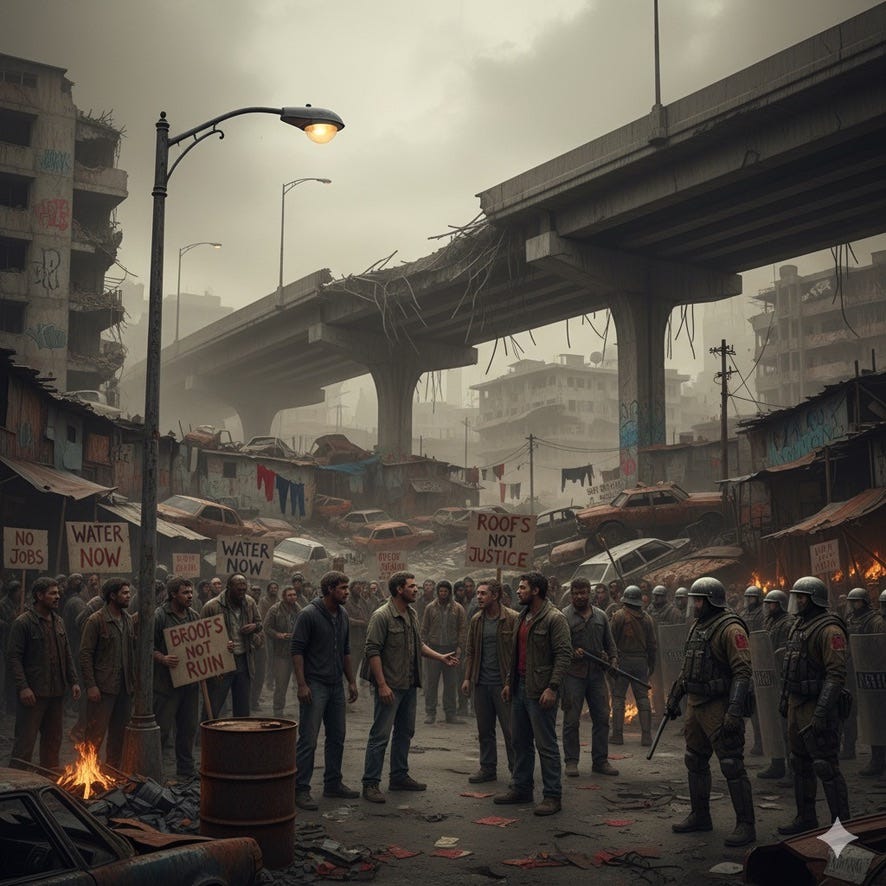
America Against the World
Why does any of this matter beyond the United States? The world once caught a cold when America sneezed, so it was said. This spoke to America’s economic centrality. Today, the global economy is less dependent on U.S. demand: China, India and the Global South have diversified growth, and dollar hegemony faces incremental erosion. Yet America’s domestic implosion still matters profoundly, if not as much economically, then geopolitically and ideologically.
As its internal cohesion unravels, the U.S. displaces domestic tension outward. Each episode of internal discord has historically produced a foreign enemy to unify the home front: the “war on terror,” the “war on drugs,” and now the “new cold war” with China. This is the classic imperial reflex. It is a psychological projection of internal disorder onto external adversaries.
Unable to sustain long, direct wars, a fractured America sustains proxy conflicts. Ukraine and the Middle East have become theatres through which the U.S. reasserts its global identity while avoiding domestic sacrifice. America’s brazen killing of innocent people, ostensibly running drugs from Venezuela, symbolises its belligerence, bellicosity and braggadocio in the name of national defence. The politics of tariffs sought to mobilise a sense of collective grievance, in which a shared sense of victimhood could be enacted to give coherence to a fractured polity.
Proxy warfare allows a divided nation to act unified by exporting violence rather than confronting internal decay. Tariffs seek to punish others, while avoiding culpability for decades of financialisation and hollowing out.
Even in decline, American culture dominates the world’s information sphere. Its political moods, broadcast through social media, spill across borders. When American political institutions devolve into paranoia, the world’s digital discourse tilts toward conspiracy and rage. A proto-fascist America thus spreads not by conquest but by cultural osmosis - its anxieties replicated globally through platforms it created. We see American paranoia and proto-fascist responses spread as ideological contagion as others in the collective west fear a similar fate.
A nuclear superpower with fractured governance remains a systemic risk. The weaponisation of finance, the casual use of sanctions, and the politicisation of deterrence all become more likely as institutional restraint weakens. A Schmittian presidency, unmoored from oversight, increasingly errs towards wielding the dollar, drones or data as tools of retribution rather than diplomacy.
The Feedback Loop of Fear
The arc traced from Wang Huning to The Trigger Effect, from the fortification economy to Trump’s states of exception, reveals a powerful affective logic: fear as the raison d’être of system function. Hatred of that which one fears are powerful motivators. A political culture that has, over the last 40 years, intensified “negative campaigning” as the principal method to “get out the vote”, has cultivated a population that is at once immune to soft fears (the skin has been thickened) but is, at the same time, predictably responsive when the right “triggers” are activated.
Precarity; declining social and economic welfare; a widening gap between promise and reality; a sense of displacement from a “place that was familiar” to a world that feels alienating; and rising violence combine with a deeply millenarian politiCal culture to “trigger” the proto-fascist descent.
Social disintegration creates insecurity; insecurity demands control; and control deepens disintegration. America’s descent into self-protection is both a symptom and cause of its political crisis. It is in the midst of a self-destructive auto-immune spiral.
If the United States once defined itself as the world’s horizon of possibility, the “light on the hill”, it now epitomises the horizon of precarity. A nation that once exported confidence and unbridled swagger now exports anxiety and displacement from the moorings of the sacramental order of reality. Simulacra now smother any residual sense of the “real”, fabricating narrative and self-referential signs to deliver comfort in times of denial and anger. American millenarian hubris has been absorbed by the simulacra, refusing to come to grips with realities but instead, girding the loins for one last crusade.
The danger, then, is not that America will collapse quietly, but that it will implode loudly - first as it retreats to the comforts of simulacra, and then by externalising its own dysfunction through militarisation, proxy conflict and ideological contagion. America’s millenarian reflex is never far away. If Wang saw a nation “against itself,” the world must now contend with the next phase; an America against the world, a superpower at war with its own reflection.