
Advancing the Frontier with TENGs
Triboelectric Nanogenerators in a China-Led Era of Sustainable Energy

Preface: This short essay is part of a series of upcoming essays that focuses on developments in new materials, and how these materials may reshape economic value flow systems as well as geopolitical contours. This essay draws on earlier academic work in triboelectric nanogenerators (TENGs), to explore what these technologies may mean for the world of marine based IoT and ocean-based economic collaboration. This focus dovetails with ongoing work on China as a ‘thermodynamic’ civilisation in which energy and information are central features of social and economic development.
In our June 2025 review published in Materials Science and Engineering: R: Reports, my coauthors and I explored the promising landscape of carbon allotropes and fabrics-based triboelectric nanogenerators (TENGs), highlighting their potential for flexible, self-powered electronics and sustainable energy harvesting. At that time, TENGs were emerging as a versatile technology, with power densities approaching 5-10 W/m² in wearable designs and early applications in IoT sensing. Fast-forward to early 2026, and the field has evolved dramatically, driven by material innovations, hybrid integrations, and a surge in commercialisation.
Chinese researchers have, for instance, developed a self-powered eye-tracking system that harnesses energy from blinking to help paralysed individuals control devices like wheelchairs.
Yet, this progress is not evenly distributed globally.
China’s unparalleled leadership in research and development, patent filings, raw materials control and manufacturing scale has positioned it as the dominant force, reshaping supply chains and accelerating TENGs toward real-world impact. This update examines these dynamics, emphasising how interconnected global supply networks are amplifying China’s influence, and spotlights marine IoT as a prime example of TENGs’ role in fostering collaborative blue economy initiatives along the Maritime Silk Road, particularly in the South China Sea region.
Rapid Evolutions in TENG Technology: From Lab to Market
Since mid-2025, TENG advancements have focused on enhancing efficiency, durability and multifunctionality, addressing key barriers like output variability and environmental resilience. Researchers have achieved breakthroughs in hybrid designs, such as TENGs integrated with piezoelectric or solar elements, yielding efficiencies exceeding 117% in ocean wave harvesting systems, a feat pioneered by teams at the Beijing Institute of Nanoenergy and Nanosystems. Material innovations, including MXene composites and hydrogel-based structures, have boosted power densities to over 1,000mW/m² in some prototypes, while self-healing variants extend device lifespans for biomedical and wearable uses. These developments align with global sustainability goals, enabling TENGs to power AI-integrated sensors and self-evolving systems for applications in human-machine interfaces and environmental monitoring.
Market projections underscore this momentum. The TENG sector, valued at US$207 million in 2025, is forecast to reach US$2.7 billion by 2035, with a compound annual growth rate (CAGR) of 29.5%. China’s segment grows even faster at 39.8%, reflecting its ecosystem of state-supported innovation and rapid prototyping. Patent activity tells a similar story; over 11,000 triboelectric-related filings from 2020-2024, predominantly from Chinese institutions, cementing the nation’s R&D edge. As TENGs transition from first-generation harvesters to second-generation smart systems, their uses span wearables (e.g., self-charging textiles), biomedical implants, and large-scale energy grids, marking a new frontier in localised, battery-free power.
Supply Chain Interconnectivity: China’s Grip on the Upstream Ecosystem
The true accelerator of TENG progress lies in supply chain dynamics, where interconnectivity between raw materials, processing and manufacturing creates a virtuous cycle; or a bottleneck, depending on geography. Carbon allotropes like graphene (which I have discussed elsewhere) and carbon nanotubes (CNTs) are foundational to high-performance TENGs, enhancing charge density and flexibility. Here, China’s dominance is stark. It controls 85-90% of global spherical graphite production and over 95% of synthetic graphite anode materials, with reserves of 81 million tonnes representing 28% of the world’s total. In 2024, China accounted for 82% of global graphite output and refined over 90% into battery-grade forms, leveraging low-cost precursors and integrated hubs in Guangdong and Zhejiang.
This upstream control intersects with downstream manufacturing, where China’s “Made in China 2025” extensions enable vertical integration, reducing lead times and costs. For TENGs, this means seamless scaling of carbon-fabric hybrids, with efficiencies like 3.6 W/m² from CNT-infused textiles now produced at volumes unattainable elsewhere. Global dependencies amplify risks. Western players rely on Chinese imports for 60-75% of graphene, facing pricing floors set by Beijing that present pricing challenges to local production. Geopolitical tensions, including export controls eased temporarily until November 2026, highlight vulnerabilities, prompting U.S. and EU efforts to localise chains … but at higher costs.
In essence, China’s command over raw materials like graphene not only fuels its 70%+ share of TENG patents but also dictates global standards, fostering interconnectivity that benefits collaborative partners while challenging competitors. This dominance, while raising concerns about monopolies, drives innovation through economies of scale, positioning TENGs as a cornerstone of the green transition.
Marine IoT: A Beacon for Blue Economy Collaboration in the South China Sea
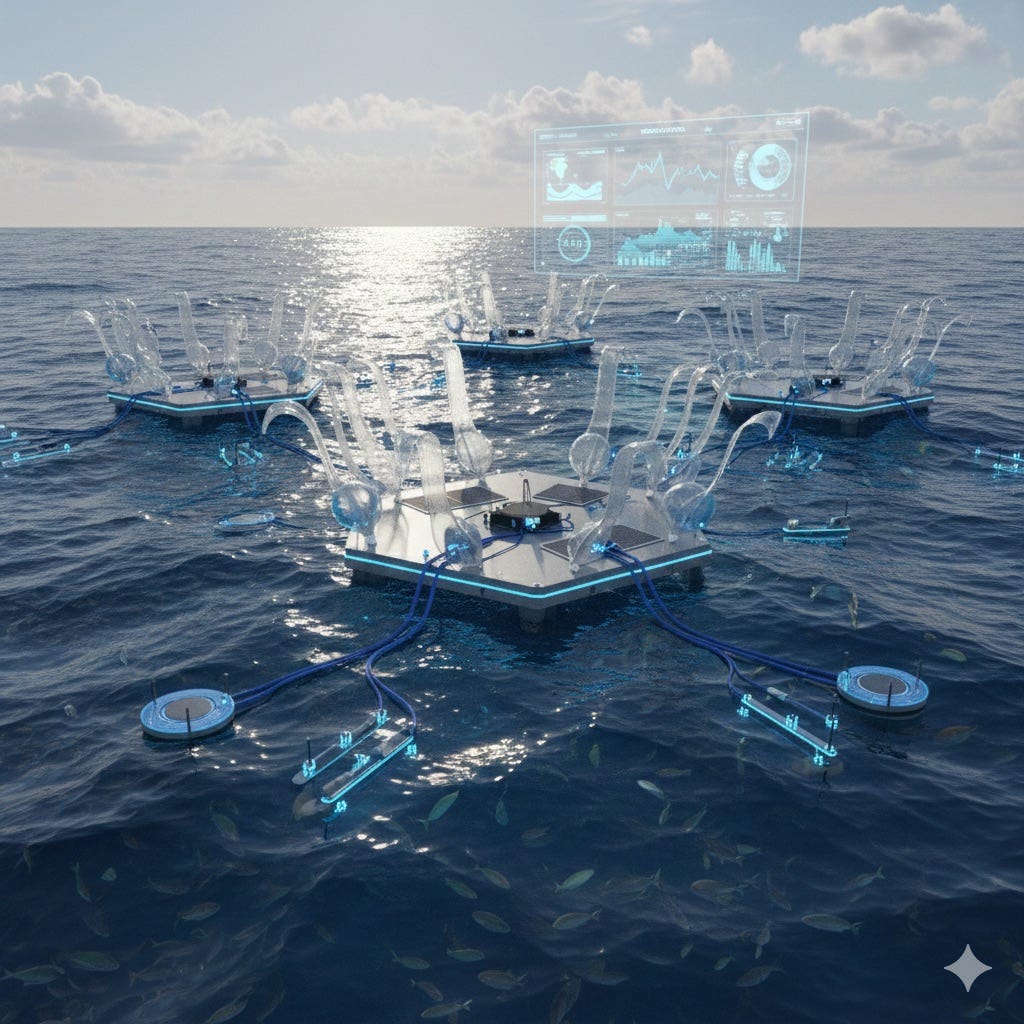
No application better illustrates TENGs’ transformative potential - and China’s strategic outreach - than marine Internet of Things (MIoT) systems in the blue economy. In the South China Sea (SCS), TENG-powered devices enable self-sustaining, civilian-focused networks for environmental stewardship and economic growth, aligning with the Maritime Silk Road’s emphasis on shared prosperity. These systems harvest wave energy to power sensors monitoring water quality, salinity, and biodiversity, supporting sustainable fisheries that account for 25% of global catch.
China’s leadership shines through initiatives like the Belt and Road Blue Cooperation, which has forged partnerships with ASEAN neighbours - Vietnam, the Philippines, Malaysia and Indonesia - for joint marine ranching and disaster mitigation. Prototypes, such as rolling-sphere TENG buoys yielding 230 µW for real-time data transmission, facilitate collaborative projects like coastal ecosystem management and renewable energy pilots. By advancing the Code of Conduct (COC) toward a 2026 agreement, China promotes “setting aside disputes” for practical gains, such as integrated ocean accounting and blue finance incentives that enhance resilience against climate change.
These efforts, underpinned by China’s 16 Blue Partnership Principles, emphasise ecological conservation and inclusive growth, turning the SCS into a model for regional harmony. TENG-enabled MIoT not only boosts economic outputs - projected to contribute 8% to China’s GDP - but also fosters trust through tech transfers, like joint oil/gas exploration and fisheries monitoring, mitigating illegal, unreported, and unregulated (IUU) fishing. In this context, TENGs exemplify how technology can bridge divides, advancing a sustainable blue economy that benefits all stakeholders.
Charting the Course Ahead
As TENGs mature, their trajectory is inextricably linked to China’s supply chain prowess and collaborative vision. While global players must navigate dependencies, the interconnectivity fostered by initiatives like the Maritime Silk Road offers a pathway to equitable innovation. By 2030, TENGs could power decentralised grids and smart oceans, but only through inclusive partnerships. Our original paper envisioned TENGs as a sustainable bridge; today, they stand as a testament to strategic leadership driving global progress. The challenge - and opportunity - lies in ensuring this momentum serves the common good.