
A plan for a new energy system
A summary review of China's recently released 15th Five Year Plan for Building a New Energy System

Preface: China is, within the body of my work, conceptualised (in large part) as a thermoeconomic state. Consequently, energy-related initiatives are central to understanding intent and trajectory. Recently, the 2026-2030 Five Year Plan for Building a New Energy System was released. This short essay summarises the key elements of the Plan, and discussed in a little more detail the Plan’s approach to green hydrogen, green ammonia and green ethanol as part of a wider push to realise a clean, low-carbon and higher EROEI energy system. Given current challenges in global oil and gas markets, this Plan and the following review seems timely.
China’s National Development and Reform Commission (NDRC) and National Energy Administration (NEA) released the Five Year Plan for Building a New Energy System on June 25, 2026. The Plan outlines the construction of a clean, low-carbon, safe, and efficient new energy system by 2030. The focus aligns with broader 15th Five Year Plan (FYP) goals like carbon peaking (as scheduled before 2030), a 17% reduction in carbon intensity (GDP per unit CO₂), non-fossil energy reaching ~25% of total energy consumption and energy self-sufficiency.
Key Elements
Key targets by 2030 outlined in the Plan include the following:
Total energy production capacity of ~5.8 billion tons of coal equivalent;
Coal and petroleum consumption peaking during the period;
Non-fossil energy contributing to ~25% of consumption and ~50% of power generation;
Wind and solar capacity exceeding 50% of installed power capacity (becoming the main body) with new energy power generation share of ~30%;
Enhanced flexibility within the power system, with pumped hydro (~160 GW), new storage (~300 GW), smart grids, virtual power plants and demand response increasingly featuring;
Major bases (e.g., “Three Norths” wind/solar, Southwest hydro-wind-solar, offshore wind, coastal nuclear); strengthened grids, pipelines and reserves anchoring ongoing infrastructure development; and
Enhancing energy security via oil/gas production stabilisation (for example, crude oil production of ~200 million tons/year), diversified imports, ongoing use of coal as a safety net with clean use, and as we’ve discussed in previous essays, ongoing efforts towards enhancing technology self-reliance.
The plan emphasises non-fossil scaling. This sees wind, solar, hydro and nuclear with a “10-year doubling action plan”, coupled with fossil fuel clean / efficient use and peaking anchored by enhance power system flexibility achieved via expanded storage, grids and demand-side management. The plan sees green fuels / hydrogen integration, more energy-saving/electrification in end-uses (industry, transport and buildings), and ongoing innovation (e.g., long-duration storage and green hydrogen / ammonia / alcohol). It aims to strike a balance between security (via domestic production and expanded reserves) with transition, by promoting integration like “wind / solar + hydrogen / ammonia / alcohol” bases, green power direct connections and retrofits (e.g., coal co-firing with green ammonia).
The plan is doubtless large in scale, and ambitious. The plan to peak coal and petroleum consumption is particularly so, even as fossil fuels are expected to retain a transitional “safety net” role, with oil/gas exploration, coal capacity reserves, and refinery optimisations fine-tuning actual operational integrations. But, with electrification expected to continue expanding rapidly, the plan anticipates oil and coal consumption peaks between now and 2030. Investment in grids, storage, and new infrastructure is prioritised (e.g., >2 trillion RMB in some new projects) as part of this process.
Role of Green Hydrogen, Green Ammonia, and Green Ethanol (Green Fuels/”Hydrogen-Ammonia-Alcohol”)
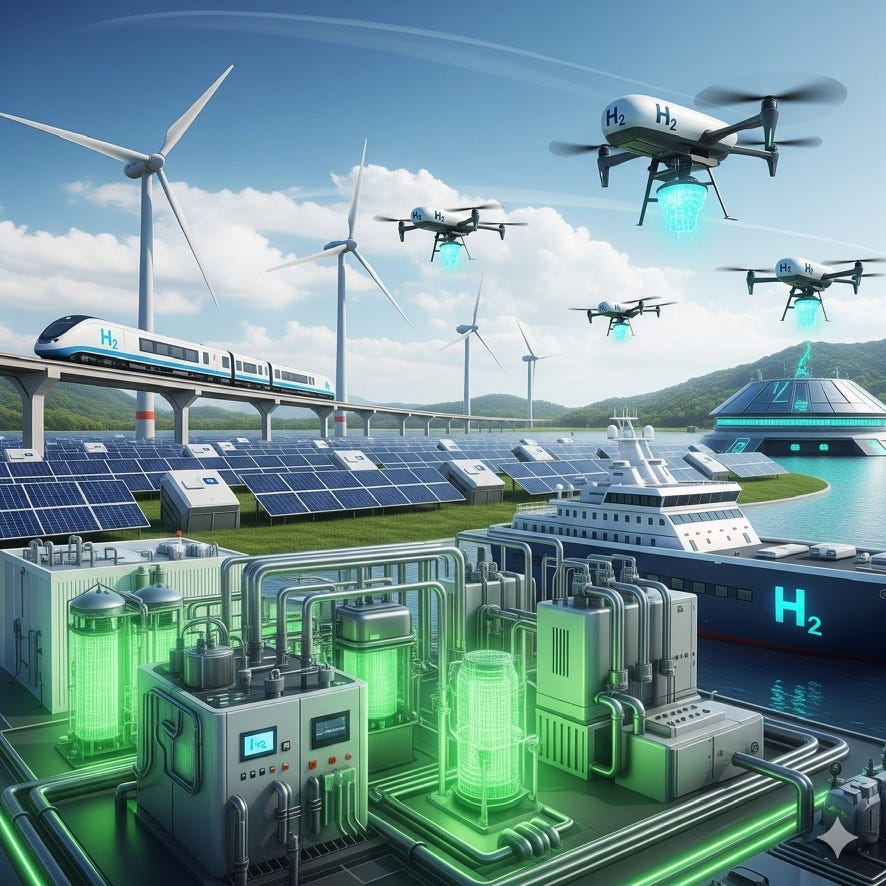
The role of green hydrogen, green ammonia and green ethanol — or broadly speaking, “green fuels” — are of particular note as they can function as key enablers for deeper decarbonisation, especially in hard-to-electrify sectors, and for leveraging abundant renewables (addressing curtailment via non-power uses). The Plan calls for full-chain development (production, storage, transport and use) of hydrogen and green fuels, with specific targets and infrastructure. This “full-chain” approach mirrors the “industrial chain” design principles that underpin much of China’s overall industrial development strategies, which integrates spatial clustering, technical alignment, pooled talent and learning-through-system osmosis effects. Key elements of the Plan, insofar as green hydrogen, green ammonia and green methanol / ethanol are concerned include the following:
Targeting of 2 million tons annual production of Green Hydrogen (绿氢/可再生能源制氢) from renewables by 2030. This is a major 7-8X expansion from current levels of ~25k tons installed / operating. A comprehensive “whole of chain” approach is again evident so as to tackle engineering and economic challenges. Modes include green power direct-connection electrolysis and off-grid renewables. Industrial by-product hydrogen purification is also promoted. the Plan supports large-scale, long-duration storage, grid balancing and integration with renewables (“wind / solar + hydrogen”).
Layout of production bases for Green Ammonia and Green Methanol / Ethanol (绿氨醇 green fuels) and infrastructure integrated with hydrogen. The use of existing underutilised oil / gas pipelines for green methanol transport is explored. A recent successful trial of such transportation over 200km of refined oil pipelines warrants optimism. Green methanol is already finding its way into commercial vehicle production, in car fleets being manufactured by Geely and riverboats from the same manufacturer. Emphasis in the Plan is placed on “green hydrogen-ammonia-methanol” chains and bases, especially in renewable-rich western / northern regions.
There is also a broader push of Hydrogen / ammonia / alcohol as future industries with more pilots, a push to achieve further tech breakthroughs, development and implementation of sustainability certification and applications in power (co-firing), transport, chemicals / metallurgy and storage all identified. This builds on earlier pilots and integrates with the national hydrogen pilot program.
Implications for “Peak Diesel” / “Peak Oil”, EROEI, Transport, and Industrial Applications
These green vectors accelerate fossil peaking (explicitly targeted for coal and oil during 2026–2030) by providing scalable, storable and transportable alternatives derived from renewables. China is a massive diesel consumer (mainly in heavy trucks, shipping, rail, agriculture, industry and refining); peak diesel has reportedly been achieved during 2024 and now, peak oil objectives are supported via substitution, efficiency and electrification where possible, with green fuels filling gaps. These objectives are set against the recent turmoil occasioned by the US war against Iran, and the implications this has had on global crude oil deliveries. While China has been exceptionally well prepared, as I have explained previously, there remains some way to go for China to be fully comfortable that it is fully protected from global oil shocks.
In so far as peak oil dynamics is concerned, the Plan promotes petroleum substitution with green fuels (e.g., green methanol / ammonia for shipping / vehicles, sustainable aviation fuel, bio-ethanol / diesel pathways and hydrogen fuel cells for heavy-duty applications as I had flagged in an essay last year). Refineries are being pushed to shift toward lower crude throughput, higher green power / hydrogen integration, and high-value products. Coal-to-liquids reserves are maintained for security but not emphasised for growth. This supports oil consumption peaking while maintaining strategic reserves and domestic production. Green fuels open “mobile high-density energy” for sectors resistant to direct electrification.
An important aspect of the Plan overall is its impact on EROEI and System Efficiency. Renewables have high upfront energy investment but near-zero marginal costs and improving EROEI over time with scale/tech. Green hydrogen/ammonia/alcohol act as energy carriers that “store” and “transport” renewable energy (addressing intermittency and geography), enabling higher overall system utilisation of wind/solar (reducing curtailment). I’ve explored the implications when green hydrogen gets cheaper in a previous essay. This effectively improves net societal EROEI by displacing low-EROEI fossil extraction/refining in end-uses and enabling downstream processes (e.g., green steel via hydrogen DRI and chemical feedstocks). Long-term, it shifts China “up the EROEI curve” by building on abundant solar and wind resources rather than depleting hydrocarbons. Challenges remain in electrolysis efficiency and full-chain losses, but policy-driven scale and integration (e.g., co-located bases) aim to mitigate this.
In transport, the Plan promotes the expansion of hydrogen fuel cells and application in heavy trucks, ammonia/methanol for shipping (key for IMO decarbonisation), and green fuels for aviation/rail/tractors. Charging/swapping + refuelling infrastructure are part of the ecosystem that must be developed to make these objectives “land on the ground.” The Plan also supports “new energy” heavy vehicles and multi-modal low-carbon corridors. Hydrogen for metallurgy (steel decarbonisation), chemicals (ammonia/methanol production, replacing fossil H₂), refining, and high-temp heat is supported in the Plan. This enables zero / low-carbon industrial parks and “green” supply chains. Storage for seasonal / grid balancing will be developed.
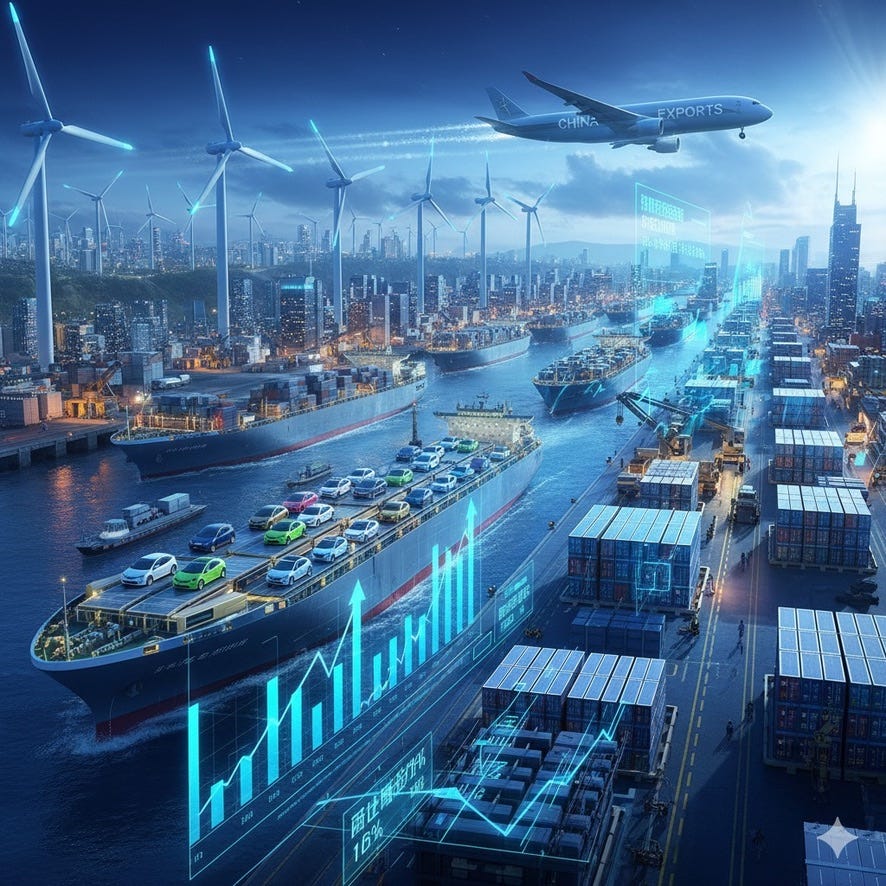
The plan overall positions green hydrogen / ammonia / ethanol (and related fuels) as strategic bridges and growth engines for the energy transition. The overarching aim is to facilitate fossil peaking while preserving energy security, leverage China’s renewable manufacturing / renewables leadership and capacity, promote the ongoing drive to industrial upgrading, and create new export / tech opportunities. China’s ability to supply global markets with these capabilities is already evident, as a growing proportion of exports to the global south comprise solar, wind, battery and EV-related technologies and systems. Implementation of the Plan revolves around pilots with a view that they scale to full commercialisation, supported by infrastructure buildout, driving cost reductions that propagate throughout the entire economic and social system. The extent to which China continues to achieve success in its new energy initiatives will be critical for China’s carbon goals and global green tech influence.
This is truly where China leads the world, in actually being able to construct a plan, and then be fully capable of implementing it, while the rest of the world fumbles along from one election-cycle to the next, incapacitated by that administrative churn to even take a first step. Such social advances come from actual governance, not from profit- or rent-seeking.